A pressure-washing request gets unclear when “the exterior” means several surfaces. Separate the house, driveway, and hardscape before comparing San Diego pressure washing services. That gives each pro the same work list without predicting the result.
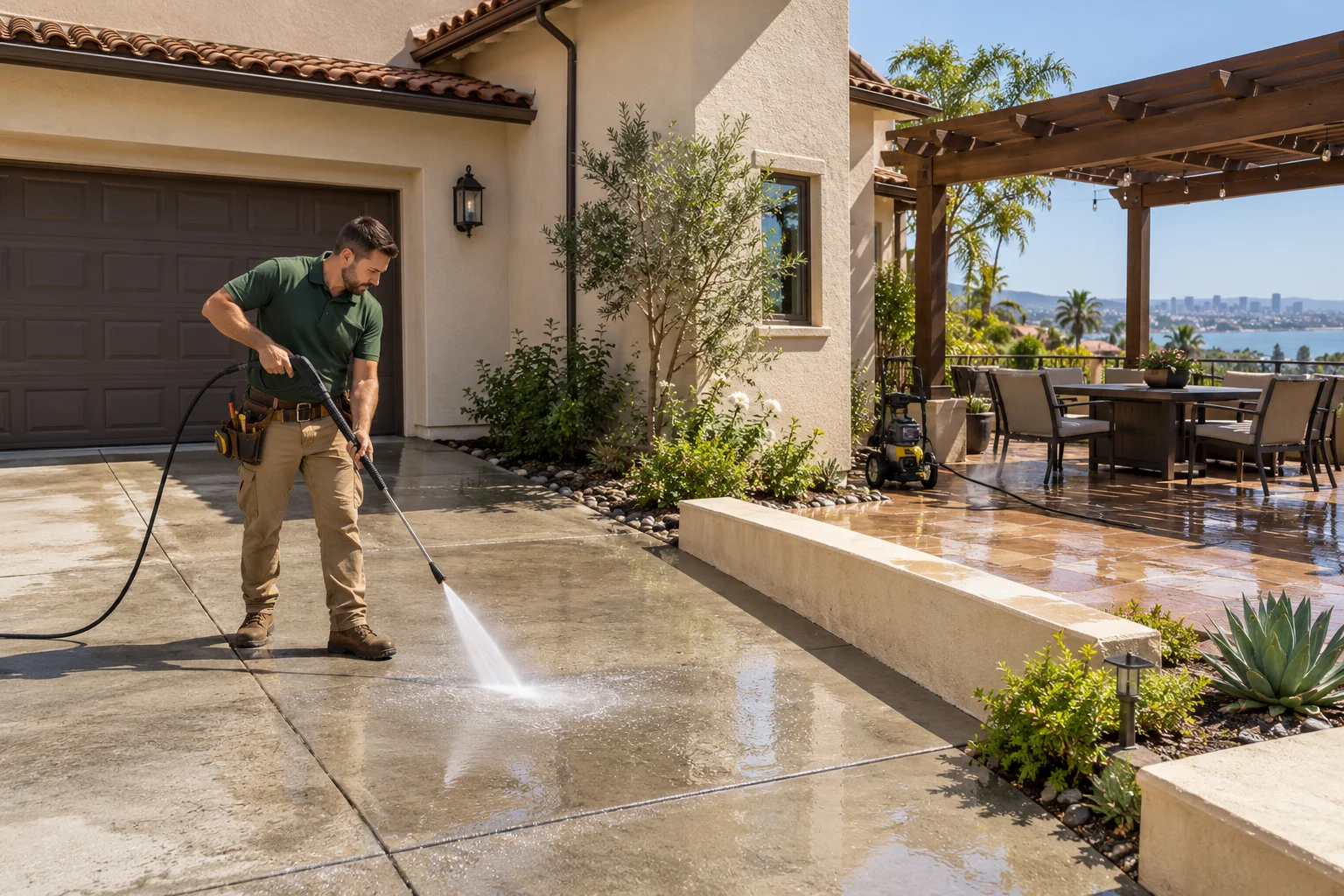
List house walls, driveways, and other hardscape separately
Start with three groups: house walls, driveway, and other hardscape. Don’t combine them under labels such as “outside cleaning” or “whole property.” A proposal can only reflect the areas you’ve identified.
For the house, list each wall by location. Use simple labels such as front wall, garage wall, side-yard wall, and rear wall. Note whether you want the entire wall considered or one marked section. Include attached features only when you want them discussed. Don’t assume they’re included with the wall.
Treat the driveway as its own work area. Record whether your request covers the full driveway or selected sections. Mark the apron, parking area, edges, and any separate walkway individually. This keeps pressure washing driveways distinct from washing the house exterior.
Place patios, paths, steps, and other hardscape in a third group. A patio shouldn’t quietly enter the driveway scope because both surfaces appear in one photo. Our patio pressure-washing guide explains how to separate a full surface request from a stain-focused request.
This structure also lets you request only what you need. You might choose the house alone, the driveway alone, or both as labeled items. Other hardscape can remain optional until the proposals explain how it would be handled.
For a broader overview, read the San Diego pressure-washing guide. Fix Pro San Diego can also connect you with an independent local pro through our pressure-washing referral service. We arrange the match but perform no cleaning work.
Describe stains without predicting what will come off
Describe what you can see. Don’t promise yourself or a prospective pro that a mark will disappear. Its appearance, position, and boundaries are more useful than an unsupported prediction.
Give each visible area a short label. Examples include “dark strip beside garage,” “two spots near parked car,” or “discoloration below front window.” State whether a mark looks isolated, repeated, or spread across a larger section. You can also note when it first caught your attention without guessing its age or source.
Avoid declaring that a mark is oil, mold, rust, paint, or another substance unless you know that independently. A description such as “orange mark near the side gate” records what’s visible. It doesn’t turn an uncertain observation into a diagnosis.
Photograph both the whole surface and the marked area. The wide image gives location and scale. The closer image shows the visible pattern. Include a familiar fixed feature, such as a garage edge or paving joint, when that helps establish position.
Ask each pro to identify any exclusions or uncertain results in writing. Their proposal should distinguish the requested area from a promised outcome. If a pro discusses a separate process, ask that it appear as its own line item or scope note.
No verified San Diego market price for this exact house-versus-driveway split appears in the approved claims ledger. Confirm the current price directly with each pro before hiring. Our San Diego pressure-washing cost guide can help organize the questions, but the proposal for your property controls.
Likewise, the ledger doesn’t approve one pressure setting for every house surface. Don’t select a proposal only because it names a particular PSI. Ask the pro to explain the planned approach for each labeled surface.
Mark joints, paint, plants, and nearby finishes
A useful scope shows more than the broad washing area. Mark the boundaries and nearby items that a pro should review before quoting. This matters most where the house, driveway, and landscaping meet.
On house walls, identify painted sections and changes between finishes. Mark trim, doors, windows, vents, fixtures, and wall-mounted items visible within the requested area. If one wall has a patch or a different finish, label it separately. Don’t state that it can or can’t be washed. Ask the pro to assess it.
On driveways and hardscape, point out joints, cracks, patched areas, borders, drains, steps, and transitions. A photo should show where the requested surface ends. If the driveway meets decorative paving or another finish, record that boundary rather than calling everything concrete.
Show nearby plants, planters, soil, gravel, furniture, and stored items. State which items can be moved before the appointment and which must stay. Avoid promising that a nearby item will be unaffected. The pro should see its location and address it in the proposed scope.
Use labels that match across your notes and photos. “H1” might mean the front house wall. “D1” could mean the main driveway section. “P1” could identify a patio. The labels don’t need special terminology. They only need to remain consistent.
Ask each proposer to note areas they’ll include, omit, or inspect in person. If paint, a joint, a plant bed, or another finish changes their approach, that distinction should appear before you compare proposals. You’re building a shared property map, not prescribing how the cleaning must be performed.
Record gates, slopes, hoses, and parking access
Access belongs in the first request, not as an afterthought. Record how someone would reach each labeled area from the street or driveway. Include gates, side yards, stairs, narrow passages, and locked sections.
Measure nothing unless a pro asks for a specific measurement. Clear photos often communicate the layout better than an unsupported estimate. Photograph each gate open and closed when possible. Note whether permission, a key, or coordination with another resident is needed.
Show slopes in a wide photo. Include the upper and lower ends rather than photographing only one patch. Record visible drains, curbs, channels, garden beds, and neighboring surfaces near the requested area. Don’t predict where water will travel. Ask the pro how the layout affects the proposed work.
List available outdoor hose connections by location without promising their condition or suitability. If you don’t know whether one works, write “not confirmed.” Ask the pro what access they need and what they expect the homeowner to provide.
Parking affects the usable work area. State where vehicles normally sit and whether they can be relocated before work begins. Mention shared driveways, assigned spaces, street access, and gates when they affect entry. Don’t promise that public or shared space will be available.
Current water-use and runoff rules for this request could not be confirmed from the approved claims ledger. Check with the city or water district that governs the property. Ask the selected pro to identify any current requirements that affect the proposed scope.
San Diego County includes many cities and service areas. Don’t assume one jurisdiction’s current instructions apply countywide. Confirm the property’s location first, then check with the authority serving that address.
Send one labeled photo set when comparing proposals
Build one photo set and send the same set to every pro. Changing the images or scope between requests makes proposal differences harder to interpret.
Begin with one street-facing overview when it can be taken from your property or another permitted location. Follow it with wide photos of each requested area. Then add close views of stains, joints, paint changes, plants, and access points.
Name the files in a clear sequence. For example, H1 can show the full front wall, while H1-A shows one marked section. D1 can show the driveway, followed by D1-A for a visible spot and D1-B for a joint. Keep any patio or walkway images in their own group.
Add a short written scope beside the photos:
- House: H1 and H2 included.
- Driveway: D1 included.
- Patio: P1 requested as an optional item.
- Access: side gate shown in A1.
- Nearby items: planter and painted border shown in N1.
- Outcome: no stain-removal result assumed.
Ask each pro to return a proposal using those same labels. The response should show what’s included, what’s excluded, and which areas need an on-site review. It should also separate optional work from the main request.
Don’t compare proposals by the final amount alone. First check whether they cover the same walls, driveway sections, hardscape, and access conditions. Confirm the price directly with the pro, since Fix Pro San Diego doesn’t set prices or collect payment for the work.
Before hiring, confirm the professional’s details and proposed scope. California consumers can use the CSLB license check when reviewing a contractor. The appropriate classification depends on the work being proposed, so don’t treat one general label as proof that every scope fits.
When to call us
Hand the request to a pro when several surfaces, access points, or nearby finishes make the scope difficult to compare. Fix Pro San Diego matches homeowners across San Diego County with licensed, independent local pros and performs no cleaning work itself.
Call us at (858) 400-4611 to request a match with a local pro.
Would you rather hand this one to a pro than do it yourself? Call (858) 400-4611.
Request a quote