A useful National City repair list groups small jobs by room, documents access, and separates specialty work. If you’re searching for a handyman in National City, one organized list and photo set will give the matched pro a clearer starting point.
Fix Pro San Diego is a referral service. We match homeowners with licensed, independent local pros, while the homeowner contracts with and pays the selected professional directly.
Group repairs by room and exterior wall
Start with a slow walk through your home. Write each room name before listing any repair. That simple structure keeps unrelated items from blending together.
A practical list might use these headings:
- Front entry
- Living room
- Kitchen
- Hallway
- Main bedroom
- Other bedrooms
- Bathrooms
- Garage or storage area
- Porch, patio, or exterior wall
Under each heading, describe what you see. Avoid writing only “fix door” or “repair wall.” Note which door or wall needs attention. Include its location within the room.
For example, write “bedroom closet door rubs near the upper corner.” That’s clearer than “door problem.” Use “small drywall opening beside the hallway outlet,” rather than “wall damage.” These descriptions help distinguish separate tasks.
Walk the exterior as its own area. Record loose trim, damaged hardware, open joints, or other visible concerns. Keep each exterior wall separate. You can label them by the feature they face, such as the driveway, alley, patio, or front entrance.
National City is a South Bay city, so your list should also reflect how the property is reached. A front entrance, side gate, alley entrance, and shared hallway create different access needs. Record the entrance closest to each repair.
If your list includes mixed household tasks, review the general home repairs service before requesting a match. It can help you describe the overall category without forcing every item under one vague label.
Nearby homeowners can also compare this approach with the Chula Vista handyman planning guide. Keep your final list focused on the conditions at your National City property.
Record doors, drywall, trim, and hardware
Doors, drywall, trim, and hardware can look like one group of small repairs. They still need separate descriptions. A pro may need different materials or information for each item.
For a door, record:
- Whether it swings, slides, folds, or rolls
- Which edge rubs or catches
- Whether the latch reaches the strike plate
- Whether a hinge or handle feels loose
- Whether the frame or nearby trim looks damaged
Don’t diagnose the cause unless you already know it. Describe the movement and the visible condition. A note such as “bathroom door closes but won’t latch” gives the pro useful information without guessing.
For drywall, record the room and exact location. Note whether the issue is on a wall or ceiling. Describe it as an opening, dent, loose surface, visible seam, or damaged corner. Don’t hide the edges with furniture when taking photos.
Trim needs similar detail. State whether the affected piece is a baseboard, door casing, window trim, shelf edge, or another finished piece. Note whether it’s loose, split, missing, or separated at a joint.
Hardware includes more than handles. Your list may contain hinges, brackets, hooks, shelf supports, cabinet pulls, curtain hardware, or wall-mounted accessories. Record which item is loose and what it’s attached to.
Use one line for every repair. Assign a short label, such as “Kitchen 1” or “Hallway 2.” Put that same label beside its photos. This makes a longer National City home repair list easier to discuss.
If several items overlap, don’t combine them too early. A rubbing door and cracked casing may be related, but they remain two visible conditions. Let the matched professional decide whether they belong in one scope.
Note parking, alleys, and building access
Access notes matter because the pro needs to reach the actual work area. Record them while walking the property, not after someone asks.
Start outside. Note whether the usual entrance faces a street, driveway, parking area, or alley. If the closest entrance is different from the mailing address entrance, say so. Mention stairs, gates, elevators, shared corridors, and narrow side passages.
Don’t promise that a particular parking space will be open. Describe what you control and what the pro should confirm. For example, write “contact me for gate entry” or “the repair area is reached through the side entrance.”
Interstate 5 and Interstate 805 should appear in your notes only when they affect the approach. A useful instruction might identify which property entrance is easiest from the side used by the arriving pro. Avoid filling the repair request with general driving directions. The street address and a clear entrance note usually do more useful work.
Inside the property, trace the path to each repair. Note furniture, stored items, pets, or household belongings that affect access. Decide what you’ll move before the appointment. Don’t claim an area is clear until you’ve checked it.
For exterior work, identify the wall from a fixed feature. “Alley-facing wall beside the rear gate” is clearer than “back wall.” If the property has several units or entrances, include the unit information already used for that address.
Access details shouldn’t replace repair details. Keep them in a separate note at the end of the list. That lets the pro review the work first, then understand how to reach it.
Keep small repairs separate from specialty work
A repair list can reveal that one request contains several kinds of work. Sorting them before requesting a match helps define which professional fits each scope.
Keep ordinary doors, trim, drywall, hardware, and similar small repairs together. Put electrical, plumbing, structural, fire-protection, or permit-related concerns in a separate section. Don’t assume every item belongs with a general handyman.
California’s current minor-work exemption applies only to casual, minor, or inconsequential work below $1,000, including labor, materials, and all other items. It also has conditions, including that the work doesn’t require a permit. Price alone doesn’t determine whether someone may perform the work.
The Contractors State License Board says licensing is required for projects that require a permit, use employee labor, or cost $1,000 or more. The proper license classification depends on the scope. A single-trade project may require a specialty contractor rather than a general contractor. You can check a contractor’s license through CSLB before hiring.
Don’t divide one larger operation into smaller entries to place each line below the threshold. California’s exemption doesn’t apply when contracts are split to evade licensing requirements. It also doesn’t cover work that forms part of a larger operation.
Mark uncertain items as “scope needs confirmation.” Don’t label them as permitted, exempt, structural, or nonstructural without verified information. Ask the relevant authority and the professional reviewing the job.
You can use the one-pro-or-several repair list guide to organize mixed scopes. Fix Pro San Diego can match you with a licensed independent local pro based on the work described. The selected professional determines what falls within their classification and proposed scope.
Send one photo set when requesting a match
Send one organized photo set with the written list. Random images without labels force the recipient to guess which room or repair each photo shows.
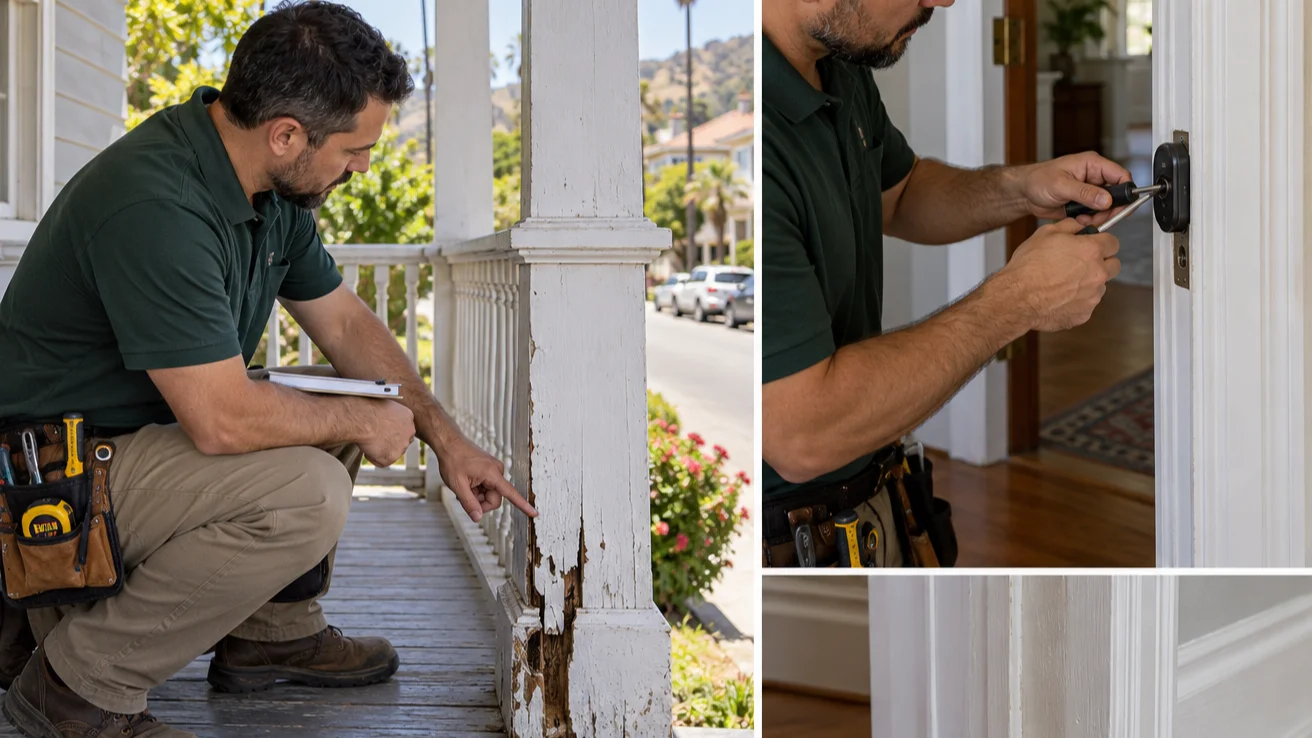
Take at least two useful views of each item. Start with a wide photo showing the room or wall. Follow it with a closer image of the visible damage or hardware. Add another angle only when it explains movement, depth, or access.
Keep the area visible. Good lighting helps, but don’t edit the image to hide marks or change colors. Include a common object for visual context only when it won’t cover the damaged area. If size matters, write the measurement separately.
Name or order each photo to match your list:
- Front entry 1: door and frame
- Front entry 2: latch area
- Hallway 1: wall location
- Hallway 2: closer drywall view
- Patio 1: full exterior wall
- Patio 2: affected trim
Include one exterior access image when the entrance may be unclear. A photo of the gate, alley entrance, stairway, or shared corridor can explain how the repair area is reached. Don’t include unrelated vehicles, neighbors, documents, or personal information.
Our guide to photographing home repairs before requesting quotes offers a simple way to pair wide and close views. Use the same order for your notes and attachments.
Finish with a short summary. State how many listed items are indoors, outdoors, or separated for specialty review. Mention access details once. Then send the complete set together when requesting your match.
When to call us
Handing the list to a pro makes sense when several small repairs have accumulated, the cause isn’t clear, or the work may fall outside a simple repair scope. Call us at (858) 400-4611 and we’ll match you with a licensed, independent local pro.
Would you rather hand this one to a pro than do it yourself? Call (858) 400-4611.
Request a quote