The bathroom pocket door in a 1950s Clairemont ranch stops halfway into the wall. In a North Park bungalow, the original pair meets off-center and scrapes the jamb. Before anyone opens drywall, record what the door does and what you can see of the track, rollers, and frame.
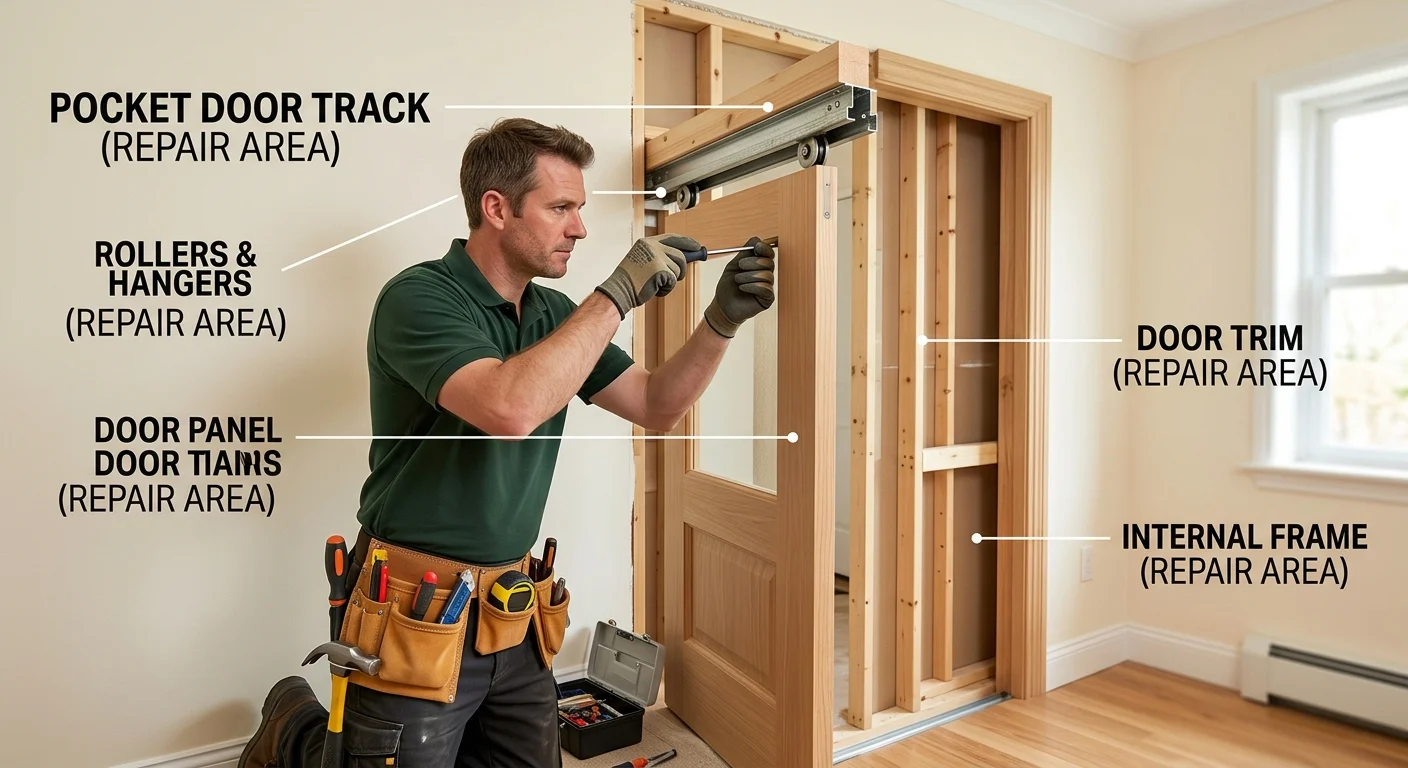
Record how the pocket door moves
Start with motion, not guesses about hidden hardware. Open the door all the way. Close it all the way. Stop it at the middle. Write down what happens at each stop, in that order, on the same day.
Note scrape, grind, skip, drop, or tilt. A panel that drags the floor at the latch edge and rides high at the pocket is a different story from one that binds only at the last inch. A door that rolls freely until it hits the strike, then refuses to latch, is pointing at alignment or the frame, not a seized hanger you cannot see yet.
San Diego County is not one climate for wood. Coastal homes in Pacific Beach, Point Loma, and Imperial Beach sit in marine air that keeps interior doors swollen for weeks. Inland houses in El Cajon, Escondido, and Ramona dry out in summer heat, so the same oak or fir slab can shrink, rattle, and drop off its ride. A Mission Hills plaster bungalow and a Mira Mesa split-level will not fail the same way. Write the city and the room. A hall closet next to an unconditioned garage behaves differently from a primary bath that steams twice a day.
Watch the gap around the slab as it travels. An even shadow that stays even usually means the panel is still square in the opening. A wedge that grows as the door leaves the pocket often means the hanging edge is dropping. If the door walks toward you or away from you while it slides, the panel may be twisting in the cavity. Do not yank it to “help.” Stop, mark the spot with painter’s tape, and photograph the gap from the same height.
This is not the same job as a hinged slab that rubs a jamb. That pattern lives in our guide to how to fix a sticking door in San Diego. Pocket doors hide the hangers in the wall. Patio sliders ride a bottom track you can see from the deck. Mixing those three into one description sends the wrong pro to the wrong opening.
Record left versus right on double pockets. Kensington and South Park still have original pairs that meet in the center. If only one leaf sags, say so. If both bind at the meeting stile, say that too. Time of day matters after a Santa Ana. Note whether the bind is worse in the afternoon.
Separate track and roller symptoms
The track is the rail the door rides on, usually along the head of the opening. Rollers (sometimes called hangers or wheels) are the parts on the door that run in that rail. You can often see a strip of track from below. You usually cannot see the rollers without lifting trim or the slab.
Treat what you hear and feel as clues, not a diagnosis. A sandy grind that stays in one spot along the head often tracks with debris or a dent in the visible rail. A rhythmic bump that travels with the door often tracks with a flat or chipped wheel. A sudden drop, then a scrape on the floor, is the pattern people mean when they say the door fell off the track. That still needs an in-person look. The hanger can be off the rail, the rail can be bent, or the pocket throat can be pinching the slab. Photos of the closed door will not settle that.
Look at the visible head track without taking anything apart. Flashlight along the opening. Note rust, paint drips, missing screws, or a rail that sags in the middle. Beach-city salt air in Coronado and Ocean Beach rusts steel hardware faster than a dry Santee interior. Painted-shut track is common after a remodel in older City Heights and Barrio Logan flats, where trim got a heavy coat and the door was left in the pocket.
Do not assume a “roller job” because an online video showed a clip-in wheel. Older San Diego bungalows use split-jamb pockets and hanger styles that do not match a 2000s kit from a big-box aisle. Newer downtown condos and Little Italy lofts often use aluminum kits with nylon wheels. Write the brand if a sticker is still on the edge. Write “no label” if there is none.
A pocket door can be repaired in many houses. That is not the same as promising the wall stays closed. Some hangers come out through the opening. Some tracks need the head casing off. Some failures live inside the pocket, past plaster or drywall you cannot judge from a phone picture. Fix Pro San Diego is a referral service. We match you with licensed independent local pros. We do not open walls or reset hardware ourselves.
If the only symptom is a patio slider grinding on a sill, that is a different system. Keep this notes file about the interior pocket. The matched pro for door and window repair can sort which opening you actually have once they are on site.
Check the opening, trim, and visible frame
Stand in the doorway with the slab parked in the pocket. Look at the three sides you can see: strike jamb, head, and the pocket mouth. The frame is the structure that holds that opening square. Trim (casing) is the finish layer on top of it. They fail for different reasons, and who can fix door frames depends on which layer is actually damaged.
Sight the strike jamb. A bow toward the door will catch the latch edge even when hangers are fine. Press gently along the casing. Soft spots, hairline splits at mitered corners, or a gap that opens and closes as you lean on the wall are frame and trim clues, not roller clues. Canyon-side lots in La Mesa, Mount Helix, and parts of El Cajon move. Older lath-and-plaster in University Heights can rack a pocket opening a quarter inch over years. That shows up as a door that used to close and now misses the latch by a finger width.
Measure the opening width at the floor, mid-height, and head, if you can do it without forcing the door. Write the three numbers. You are not building a new jamb. You are showing whether the hole is still a rectangle. A tapered opening is a door repair frame problem as much as a hardware problem.
Check casing for cracks at the head, nail pops, and pieces that have been pried before. Split-jamb pockets often hide the track behind a removable stop. If a previous owner glued that stop, say so. If the casing is original fir in a 1920s Craftsman, say that too. Matching that profile is part of the finish, not a side note.
City of San Diego Information Bulletin 203 lists some door and window replacement in single-family, duplex, or townhouse units as not needing a building permit when existing openings stay unchanged and no fire-resistive upgrades are needed. Historic resources and historic districts are carved out. Confirm the current rule with City of San Diego Development Services before anyone widens a pocket, moves a header, or works on a designated house in places like Mission Hills or Kensington. Unincorporated county and other cities set their own permit desks. Do not treat a City of San Diego bulletin as a countywide pass.
If the pocket wall has a bulge, a hollow sound that changes, or a stain from a bath on the other side, write it down. Do not open the wall to investigate. Concealed studs, backing, and plumbing are not something a listing photo can prove.
Document hardware and door-panel details
Photograph the pull, lock, edge, top corners, and bottom clearance. Take one wide shot of the whole opening and one close shot of each detail. Same lighting, door in the same position. A second set with the door fully closed helps the pro see the latch.
Write the panel material if you know it: solid wood, veneer, hollow core, mirrored, or a louvered laundry door. 1960s and 1970s tracts in Clairemont, Serra Mesa, and Chula Vista are full of hollow-core pockets that rack when a hanger lets go. Pre-war bungalows more often have heavier wood that marks the jamb when it drops. Note chips at the latch edge. Those chips happen when someone lifts the slab by the pull.
We could not confirm a verified lead-paint year or renovation rule in our claims ledger. If anyone will sand or disturb painted trim, read the current scope on the EPA renovation program page before work starts. That is a paint-disturbance issue, not a roller catalog.
Do not order replacement wheels from a photo. Hanger spacing, rail shape, and door thickness have to match. Bring the door’s thickness (a tape on the edge is enough) and any stamp on the top rail. If the panel is out of the opening already, do not hang it back on a bent rail to “see if it works.” Park it safely and leave the pocket empty for the visit.
Hardware on the strike side matters. A privacy bolt that no longer lines up is often a dropped door, not a bad lock. A floor guide that is bent or missing lets the slab wander and look like a track failure. Write whether a guide is present. Many original San Diego pockets never had a floor guide. Later kits did.
Keep this file with your other door notes. If you also have a hinged bedroom door that rubs, list it separately. One visit can cover both, but the scopes stay distinct so the quote is honest.
Know what an in-person review should cover
A useful visit walks the same list you started: motion, visible track, opening square, trim, panel, and hardware. The pro should say, in plain words, whether they think the next step is hardware in the opening, trim removal, panel work, or opening the pocket. They should not diagnose the inside of a closed wall from your camera roll alone.
Ask them to separate three buckets out loud. Track and roller work. Frame and casing work. Panel repair or replacement. Those buckets change labor, dust, and whether drywall finishing follows. If the pocket must be opened, the finish work is a wall job on top of a door job.
California’s minor-work exemption in Business and Professions Code section 7048 applies to casual, minor, or inconsequential work below $1,000 including labor, materials, and all other items, and only when the work does not need a permit and is not part of a larger operation. Advertising as a contractor, employing others, or splitting jobs to stay under the number knocks the exemption out. Price alone is not permission. The CSLB license check is how you confirm the person in your hallway is licensed for the scope they described. CSLB also tells consumers that work needing a permit, employee labor, or $1,000 or more requires licensing, and that a single-trade job can need a specialty classification rather than a general contractor.
No verified San Diego average for pocket door repair sits in our claims ledger, so this page will not invent one. Hardware-only work and a full pocket rebuild are not the same bid. For broader door-job context, read door repair cost in San Diego. Ask the matched pro for a written description of the work before anyone cuts casing.
Bring your motion notes, the three width measurements, and the photo set. Point at the tape marks. Say whether the bind started after a floor refinish, a bath remodel, or a year of no change. Floor height changes in North Park craftsman rehabs and Encinitas beach houses often steal clearance at the bottom of a pocket slab.
If the opening is out of square, expect a conversation about shims, jamb repair, or leaving the hardware alone until the frame is true. Fixing wheels on a twisted opening is how the same door fails again after the first humid week.
When to call us
Call when the slab drags, tilts, jumps the rail, or will not latch, and you cannot see the hangers without taking the opening apart. That is the moment for an in-person review, not a parts order from a photo. Call us at (858) 400-4611 and we’ll match you with a local pro who quotes the job before starting.
Would you rather hand this one to a pro than do it yourself? Call (858) 400-4611.
Request a quote