A loose door lever, chipped drywall, and separated trim can become one confusing request. A clear Rancho Santa Fe punch list helps you separate small repairs, explain access, and find the right local pro.
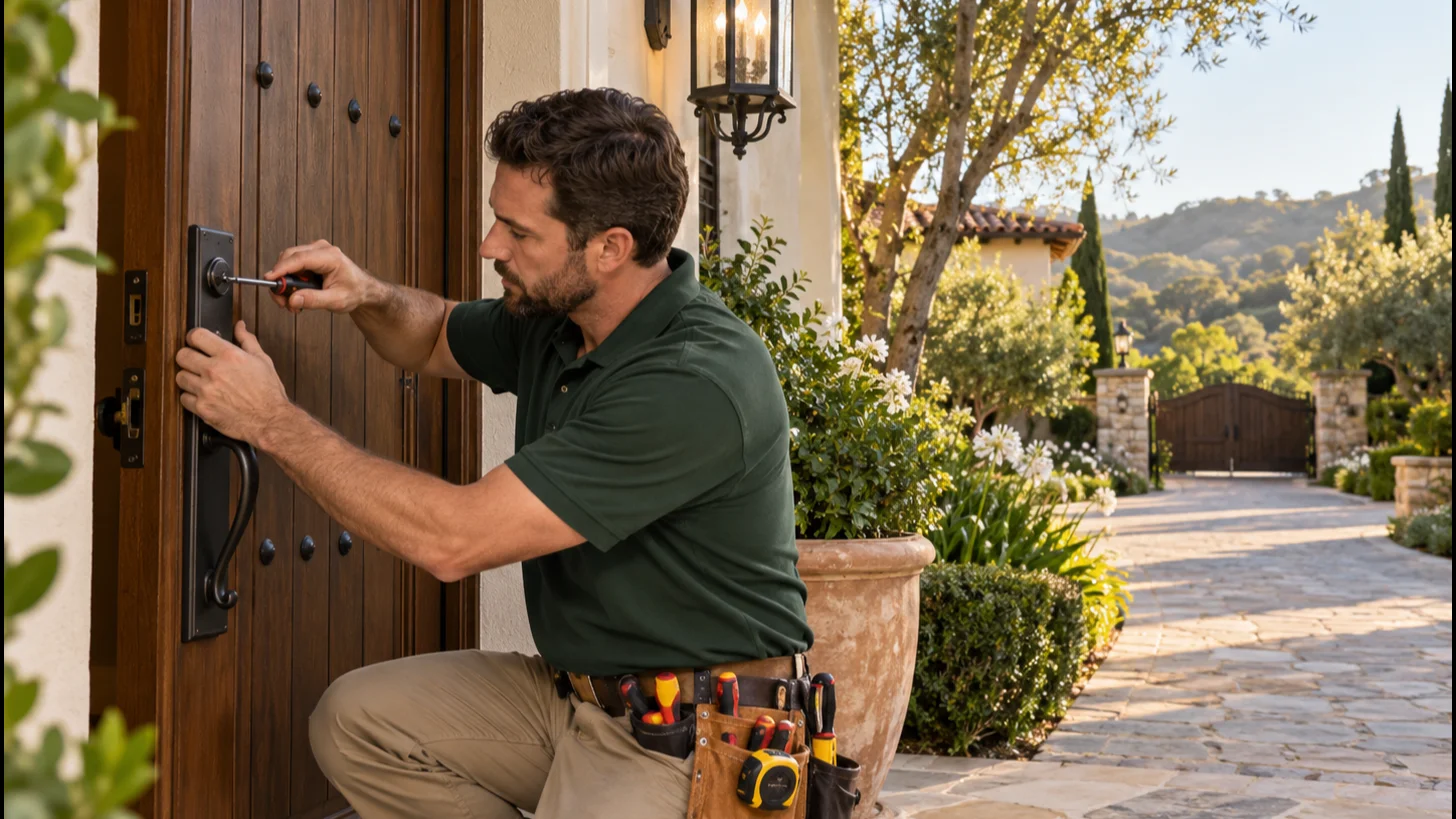
Separate small repairs from custom woodwork
Start by separating repair work from design and fabrication. A loose hinge, damaged casing corner, missing knob, or small wall patch belongs on the small-repair list. A built-in cabinet, made-to-fit panel, decorative wood feature, or new trim design belongs in a custom carpentry discussion.
This distinction matters when you’re searching for a handyman Santa Fe homeowners can contact. “Fix the trim” might describe a small patch, several replacement boards, or newly fabricated millwork. Those are different requests. A pro needs enough detail to identify which kind you have.
Write one line for each item. Name the room, the object, and the visible problem:
- Guest room: closet door jumps out of its track.
- Hallway: casing has a chipped lower corner.
- Office: wall has two small anchor holes.
- Kitchen: one cabinet pull is loose.
- Entry: lever moves, but the latch doesn’t retract correctly.
Don’t diagnose hidden causes. Describe what you can see and what happens during normal use. That keeps the request accurate.
If the work involves new wood components or a design decision, review the guide to carpentry services in Rancho Santa Fe. The nearby Fairbanks Ranch carpentry guide also explains how to frame a woodwork request. Keep those projects separate from a routine general home repair request.
This page can’t confirm a universal boundary between small repair and custom carpentry. The actual scope depends on the damaged area and proposed work. Send photos and let the matched professional identify the appropriate service.
Group doors, trim, drywall, and hardware by room
A room-by-room list gives the pro a usable path through the property. It also prevents similar items from getting mixed together. Begin at the main entry, then follow the same route you’d use during a walkthrough.
Use four labels under each room:
- Doors and windows
- Trim and wall surfaces
- Hardware and mounted items
- Other visible repairs
Under “doors and windows,” record rubbing, sticking, loose hardware, damaged casing, or a latch problem. Note which side of the door shows the issue. Include whether it affects an interior door, exterior door, closet door, or cabinet door.
For trim and drywall, identify the exact location. “Drywall damage upstairs” is too broad. “Small hole beside the guest-room closet” gives the pro a clear starting point. Mention whether the damage is on a wall or ceiling. If paint or texture matching may be part of the request, say so without assuming a match is possible.
Hardware notes should name the object. Record a loose towel bar, missing cabinet pull, shifting shelf bracket, or damaged strike plate separately. Don’t combine everything under “miscellaneous.”
Give each repair a short label that matches its photos. For example, use “Office 1A” for the wide office view and “Office 1B” for the close-up. Place those labels beside the same item in your written list.
Don’t add electrical, plumbing, structural, or permit-related work just because it’s in the same room. Those items need separate review. The room list organizes locations, but it doesn’t decide which trade or license classification fits the work.
A good Santa Fe handyman request stays narrow. It identifies the visible condition, exact location, and desired result. It doesn’t guess at concealed damage or promise that every item belongs in one scope.
Record gates, driveways, and building access
Access notes belong in the original request, not in a separate message after matching. Rancho Santa Fe properties don’t share one confirmed gate, driveway, parking, or association procedure. This page can’t verify the rules for a particular address.
If the property has controlled entry, confirm the current process with the property or association office. Don’t assume a gate code can be shared. Record the approved entry method without placing private codes in a public form or photo.
Describe the route from the property entrance to the repair area. Useful notes include:
- Which entrance the pro should use
- Where approved parking is located
- Whether the work area is in the main building or another structure
- Whether stairs, narrow passages, or closed gates affect the route
- Who can provide property access
- Whether pets need to remain in another area
- Where the pro can meet the homeowner or property contact
Keep these notes factual. “Long driveway” is subjective. A photo showing the entrance and marked destination is clearer. If a route has several turns, label each image in order.
Don’t photograph access credentials, alarm details, keys, or private documents. A useful access photo shows the path and destination without exposing security information.
If the requested work involves an exterior gate, describe that repair separately from entry instructions. State whether the visible issue concerns a hinge, latch, post, panel, or automated component. Don’t assume each part belongs to a general handyman scope. The matched pro can review the details and identify whether another specialist is needed.
Keep specialty trades off the small-repair list
A small-looking item isn’t automatically minor work. California’s current minor-work exemption applies only to casual, minor, or inconsequential work below $1,000 for all labor, materials, and other items. It also carries conditions, including that the work doesn’t require a permit. Price alone doesn’t decide whether someone may perform the job.
The exemption doesn’t apply when someone divides a larger operation to avoid licensing rules. It also doesn’t apply to someone advertising as a contractor or employing others to perform the work.
CSLB tells consumers that licensing is required for projects requiring a permit, using employee labor, or costing $1,000 or more. The proper license classification depends on the scope. A single-trade project may require a specialty contractor instead of automatically belonging with general repair work.
That means an outlet, hardwired fixture, plumbing alteration, structural change, or permit-related item shouldn’t be buried between loose knobs and drywall patches. Put it on a separate “needs classification” list. Describe the visible problem, but don’t ask an unconfirmed handyman to perform regulated work.
For electrical work, the Electrical Safety Foundation International recommends using a qualified licensed electrician. If your request includes an outlet, switch, wiring, or another electrical component, keep that item separate until the proper professional is identified.
Before hiring, check the professional’s current status through the CSLB license lookup. Match the listed classification to the proposed scope. Fix Pro San Diego connects homeowners with licensed independent local pros, but the homeowner contracts with and pays the professional directly.
Fix Pro San Diego doesn’t set prices. No verified Rancho Santa Fe hourly handyman rate appears in the approved source set. Ask the professional how the quote is structured, what it includes, and how changes will be handled before work starts.
Send one consistent photo set with the request
Photos should follow the same order as your written punch list. Start with one wide image showing the room or area. Add a medium view showing the repair in context. Finish with a close-up of the visible damage or hardware.
Use the same label across every file and note. If the list says “Entry 2,” the related photos should say “Entry 2A,” “Entry 2B,” and “Entry 2C.” Don’t send one set by text, another by email, and an unlabeled group later.
Include a reference object only when it helps show scale. A ruler can clarify the length of a drywall opening or missing trim section. Keep the ruler beside the damage, not across it. Don’t estimate dimensions from a distant photo.
For moving parts, still photos may not explain the issue. Add a short video showing the door rubbing, latch failing, or drawer shifting. Record the normal movement without forcing the object. The written note should still explain what the viewer is seeing.
Photograph both the repair and its surroundings. A close-up of a hinge won’t show the full door, adjacent trim, or approach. Likewise, an entire room photo won’t reveal a stripped screw hole. Both views help define the request.
Our guide to photographing home repairs before quotes gives a repeatable image order. Review the set before sending it. Remove duplicates, confirm every repair has a label, and make sure no private access information appears.
Keep one final copy of the list. Send that same version with the same photo names to the matched professional. If the scope changes, revise the list and identify the added or removed items clearly.
When to call us
Call when your Rancho Santa Fe list contains several defined repairs or the correct service isn’t clear. Fix Pro San Diego can match you with a licensed independent local pro, while that professional confirms the scope and performs the work.
Call us at (858) 400-4611 and we’ll match you with a local pro who quotes the job before starting.
Would you rather hand this one to a pro than do it yourself? Call (858) 400-4611.
Request a quote