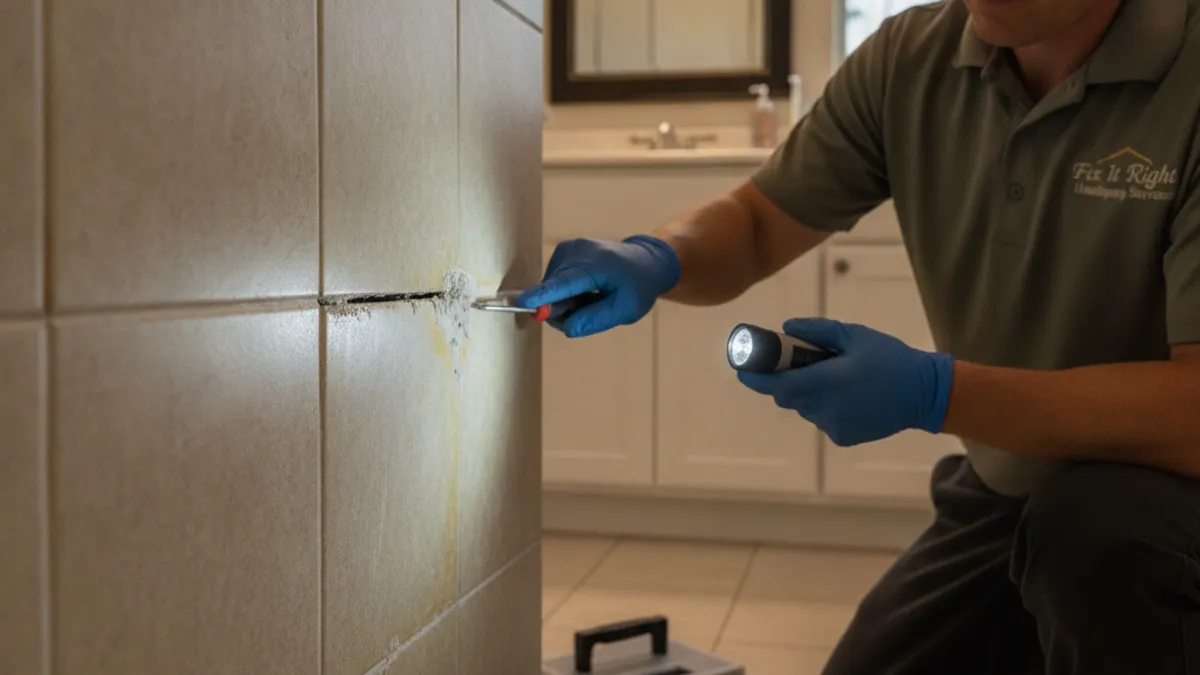
Tile water damage almost never announces itself the way a burst pipe does. It shows up quietly, a slightly hollow-sounding tile, a grout line that looks a shade darker than the others, a faint musty smell near a shower or tub surround, and by the time it’s obvious, moisture has usually been working its way behind the tile for months. Catching the early signs can keep the request at tile repair instead of a larger moisture project. It does not guarantee the cavity is dry.
The hollow-tap test
Tap a few tiles with a knuckle or the handle of a screwdriver. Tile that’s still well bonded sounds solid and consistent. Tile that’s come loose from the substrate underneath, usually because water has broken down the thinset or adhesive, sounds noticeably hollow or flat by comparison. This is one of the most reliable early indicators of water damage, and it’s worth checking periodically in showers, around tubs, and near any exterior door threshold where water intrusion is more likely.
Discoloration that spreads past the grout lines
Some grout discoloration is normal wear. What’s worth paying attention to is staining or darkening that spreads beyond the grout itself into the tile surface, or shows up in a pattern that doesn’t match where water would sit during normal use, for example, discoloration climbing up a wall well above where shower spray would typically reach. That kind of spread usually means water is moving behind the tile through a path you can’t see from the surface.
A musty smell that doesn’t go away with cleaning
A musty or mildewy smell near a tile surface that persists even after a normal cleaning is one of the clearer signs that moisture has reached the substrate or the wall cavity behind the tile, where mold can establish itself out of sight. This is different from a smell that clears up after scrubbing visible mildew off the grout surface. If cleaning the visible surface doesn’t resolve the smell, the source is probably not on the surface at all.
Where to look first in a San Diego house
Check shower and tub surrounds, especially where the original caulk bead has split. The caulking guide covers those joints. Then check entry and exterior-adjacent floors at a worn threshold. Then kitchen backsplashes near a sink or dishwasher, which can be a supply-line leak rather than splash. Those are inspection routes, not a ranked frequency study.
What happens if you wait
Left alone, water behind tile eventually causes the substrate to deteriorate further, tile to fully detach, and, given enough time and moisture, mold to establish in the wall cavity or subfloor where it’s much harder and more expensive to remediate than a straightforward tile repair would have been. Once a repair reaches that point, it typically also involves addressing whatever is generating the moisture in the first place, not just replacing the tile itself.
When it’s still a simple repair
If you catch a hollow tile or early discoloration before it spreads, the next step is still an inspection: remove the affected tile only if the pro includes that in the written scope, confirm the substrate is dry and sound, then reset or replace with sealed grout. The tile repair service page is the match. A smaller area does not automatically mean a cheaper ticket if waterproofing has failed.
What to do the moment you suspect water damage
If you find a hollow tile or spreading discoloration, resist the urge to simply reseal or recaulk over it and hope the problem stops there. First, identify and stop the moisture source if one is obvious, a failed caulk joint, a dripping supply line, or standing water after showers. Second, avoid sealing the surface tightly shut, for example with a heavy caulk bead over a suspicious area, before confirming the substrate underneath is actually dry, since trapping moisture behind a fresh seal makes the hidden problem worse rather than better. Third, take photos of what you’re seeing and when you noticed it, which is useful both for tracking whether the issue is spreading and for any insurance conversation if the source turns out to be a covered event like a supply line failure.
Frequently asked questions
How do I know if my tile has water damage?
Tap the tile. A hollow or flat sound compared to surrounding tile is one of the clearest early signs, along with discoloration that spreads past the grout lines or a musty smell that persists after cleaning.
Can water damage under tile lead to mold?
Yes. If moisture reaches the substrate or wall cavity behind the tile and isn’t addressed, mold can establish in that hidden space. That is a larger project than the original tile issue.
Is tile water damage always visible from the surface?
Not always. Early on, the clearest signs are a hollow sound when tapped or a smell that doesn’t clear with cleaning, both of which can appear before any visible discoloration shows up.
What’s the fix for water-damaged tile?
If caught while the substrate is still dry, the finish repair is removing the affected tile, confirming the substrate, and resetting or replacing it with sealed grout. If the cavity is wet, the quote has to include drying and whatever trade owns the leak.
If a tile in your San Diego home sounds hollow, looks discolored, or smells musty, call Fix Pro San Diego at (858) 400-4611. We match you with a licensed independent local pro. We do not inspect the wall ourselves.
Would you rather hand this one to a pro than do it yourself? Call (858) 400-4611.
Request a quote