A split plank in Ocean Beach is a different request than a scored composite board in Rancho Bernardo. Before you ask for deck repair in San Diego, say whether the walking surface is wood or a manufactured composite. That single note changes matching, fasteners, and what an independent local pro can quote.
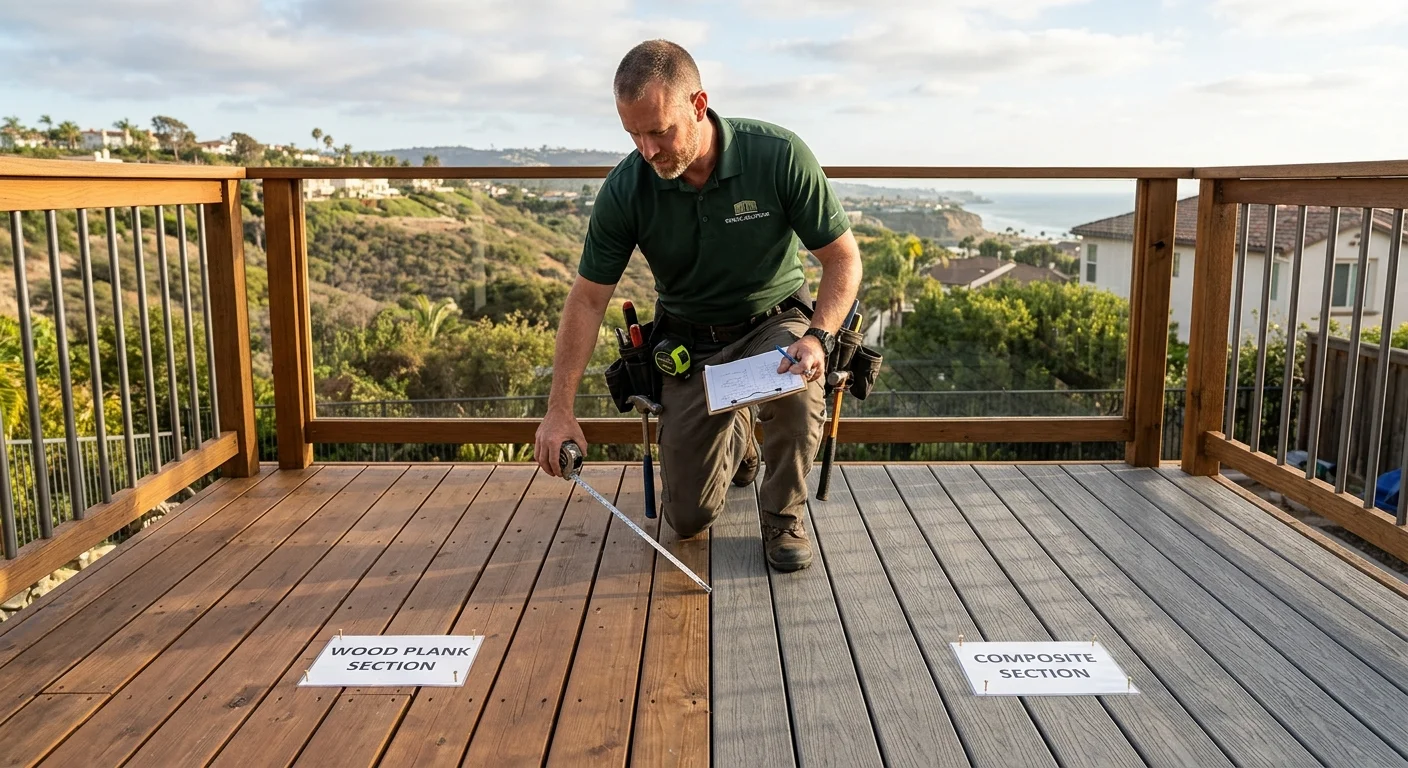
Identify whether the boards are wood or composite
Walk the deck in daylight, not at dusk. Start at a cut end, usually at the outer rim or where a board meets a stair. Wood shows fibers through the full thickness. Composite often shows a thin cap over a different-colored core. If you only see the top face, you can still tell a lot. Wood grain wanders, and knots interrupt it. Composite grain repeats. Wood splinters at the edges. Composite usually scuffs or scores.
You do not need the brand name to request deck repair. You need to say wood, composite, or mixed. Many San Diego decks are mixed. A Clairemont ranch may keep original wood stairs and have a later composite field. A Carlsbad HOA rebuild may be all composite on top, with wood still in the frame below. Write both on your note.
Coastal boards and inland boards weather in different ways. La Jolla, Encinitas, Coronado, and Imperial Beach sit in salt air. Cut ends stay damp longer in the marine layer, and metal hardware stains. El Cajon, Santee, Poway, and Escondido see hotter, drier stretches and harder sun on west-facing runs. That is local geography. Our verified facts list does not rank wood against composite for lifespan, so do not guess which one lasts longer. Name what you have.
Look at a shaded north edge and a west edge that takes afternoon sun. Color alone can fool you. Gray wood still has grain. Faded composite still has a cap. If the walking surface is a smooth coated sheet with few board gaps, treat it as a balcony or coated deck, not a board-for-board wood job. Downtown, Hillcrest, and Pacific Beach condos often use that system. Start with what to inspect on a San Diego balcony for those.
Stay off any board that feels spongy. Record what you can see from a firm board or from the yard. You are describing the surface for a quote. You are not proving the frame is sound.
Record fasteners, cut ends, and neighboring boards
The hardware tells the pro how the boards were installed. Face screws leave a visible head on the walking surface. Nails leave a smaller head and often sit in a rust halo, especially near the coast. Hidden clips sit in grooves along the long edges. Composite systems use those grooves a lot. Wood can use any of the three. Write what you see: screw, nail, or clip. Note whether heads are proud, flush, or sunken. Note rust, white powder, or staining that runs down the board.
Photograph one typical fastener close, then one that looks worse. Coastal runs in Coronado, Imperial Beach, and La Jolla often show stained metal first. Inland runs in Poway and El Cajon more often show sun-baked heads and cracked wood around the shank. Record the pattern. Do not turn it into a cause.
Cut ends matter for matching. At the rim, look straight at the end of a board. Wood end grain looks fibrous. Composite often shows a core that does not match the cap. If a neighbor already replaced one board, the new end is your best color sample. Write whether that replacement is the same width and the same profile. Grooved edges do not swap cleanly with square edges.
Neighboring boards set the real scope. Count how many boards in the damaged run look like the bad one. Note the boards on both sides. A single split in an otherwise even field is a different request than a whole bay that cups. Measure width with a tape if you can do it from a sound board. Common deck boards are not all the same size, and a pro cannot order a match from “a brown plank” alone.
Write the house side. A west-facing run off a Mission Hills kitchen takes a different sun load than a north patio in Encinitas. Shade from a neighbor’s eave changes color. A note that reads like a map saves a wasted trip for the wrong board.
Compare surface wear with board damage
Surface wear sits on top. Board damage changes the piece. Gray, faded stain, and film on wood are wear. Fine scratches in a composite cap are wear. A split that opens when you step near it is damage. A mushroomed hole around a screw is damage. An edge that crumbled at the rim is damage. Keep those lists apart when you decide whether a damaged board is a repair or a replace.
San Diego dirt and mildew can make a sound board look failed. Leaf stain under a patio table in North Park is not the same as a board that flexes. Sweep the grit out of the gaps and look again. Our deck maintenance guide for San Diego covers cleaning and sealing as upkeep, which is a different request than swapping boards. Do not mix a wash into a repair list unless the same pro will do both, and even then list them as two lines.
Cupping, checking along the grain, and raised splinters are wood-board problems you can photograph. Composite problems look different: scored caps, lifted ends at hidden clips, and crushed grooves. A faded composite field with tight clips may need no board work at all. A bright wood field with one rotten bay still needs that bay named. Color is not the job.
If a pro will sand or scrape painted wood on a home built before 1978, the EPA Lead-Safe renovation rule can apply. Confirm the home’s age. Older bungalows in North Park, South Park, and Golden Hill often have painted wood outdoors. Composite caps are a different material, so say so in the note.
Do not use photos to call the frame. A board can look tired while the joist below is fine. A board can look even while the joist is not. If a section feels soft, mark it on a sketch and stay off it. The on-site pro decides what is surface, what is the board, and what is structure.
People searching deck repair near me often want a single number. Wear and damage do not share a price. We do not publish a brand rate, and no verified county average lives in our facts ledger. For how quotes get built, read deck repair cost in San Diego for 2026. Ask the pro to price the worn surface separately from damaged boards.
Note railings, stairs, and framing as separate items
Do not fold rails, stairs, and framing into the board note. Each one is its own line on a quote. A wobbly rail in Point Loma is not a composite-board match. A cracked stair tread in La Mesa is not a hidden-clip repair. Write them apart even if they sit on the same deck.
You can replace boards on a deck when the walking pieces are the problem and the frame still does its job. That call belongs to someone standing on the structure, not to a photo of the top face. If you see sag, a gap at the house wall, or movement when someone walks a firm section, write it as an observation. Do not diagnose joists, posts, or the ledger from a picture.
For City of San Diego addresses, in-kind replacement of stair stringers and treads can be eligible for a no-plan building permit. That still means a permit, not a skip. Confirm the current path with San Diego Development Services before anyone starts. Historic homes and historic districts can need extra review even for small work. Outside the city proper, check the city or county that actually issues the permit. Chula Vista, Oceanside, and the unincorporated pockets do not share one counter.
Licensing follows the job, not the word handyman. California’s minor-work exemption under Business and Professions Code section 7048 applies only to casual, minor, or inconsequential work with an aggregate price under $1,000 for labor, materials, and everything else, and only when no building permit is required. It does not apply if the work is part of a larger operation, split to dodge the threshold, advertised as contractor work, or done by hired employees. The CSLB tells consumers a license is required for projects that need a permit, use employee labor, or cost $1,000 or more. Check a license number on the CSLB license lookup before you hire. Price alone is not permission to skip a license.
CSLB also tells homeowners to get at least three written bids, and that a down payment on a licensed home-improvement contract cannot exceed 10% of the contract price or $1,000, whichever is less. Keep rails, stairs, and boards as separate lines so those bids compare the same work.
Homeowners insurance is not a single county rule we can confirm. Coverage depends on your policy and on what caused the damage. Ask your insurer. Keep the same photos you send the pro.
Photograph the deck before requesting inspection
Take pictures before anyone pulls a board. A wide shot from the yard shows the whole layout, the house wall, and the stairs. A second wide shot from the opposite corner catches what the first one hides. Then move in. One close frame of a typical board. One of the worst board. One of a cut end. One of a typical fastener. One of the worst fastener. One of the rail post at the deck. One of the stair stringer from the side if you can shoot it from the ground.
Hold a tape or a note card in at least one close shot so width is obvious. Write wood, composite, or mixed on the note. If you searched balcony repair San Diego because the platform is a second-story walk-out, say balcony in the filename. Keep the board material in the caption anyway. The same photo habit we use for other home repairs before quotes applies here: wide, then close, then the odd detail.
Do not climb onto a spongy run to get a better angle. Shoot from a sound board or from the ground. Mark north on a quick sketch so sun and shade make sense. List every item you want quoted: boards, fasteners, rail, stairs, and anything you noticed at the house connection. The pro still has to stand on the deck. Your photos just keep the first conversation honest.
When to call us
If the boards, rails, or stairs are past a cleaning, or if the job may need a permit or a licensed contractor, hand it to a pro rather than guessing at matching or framing. Fix Pro San Diego matches you with independent local handyman professionals. Call us at (858) 400-4611 and we’ll match you with a local pro who quotes the job before starting.
Would you rather hand this one to a pro than do it yourself? Call (858) 400-4611.
Request a quote