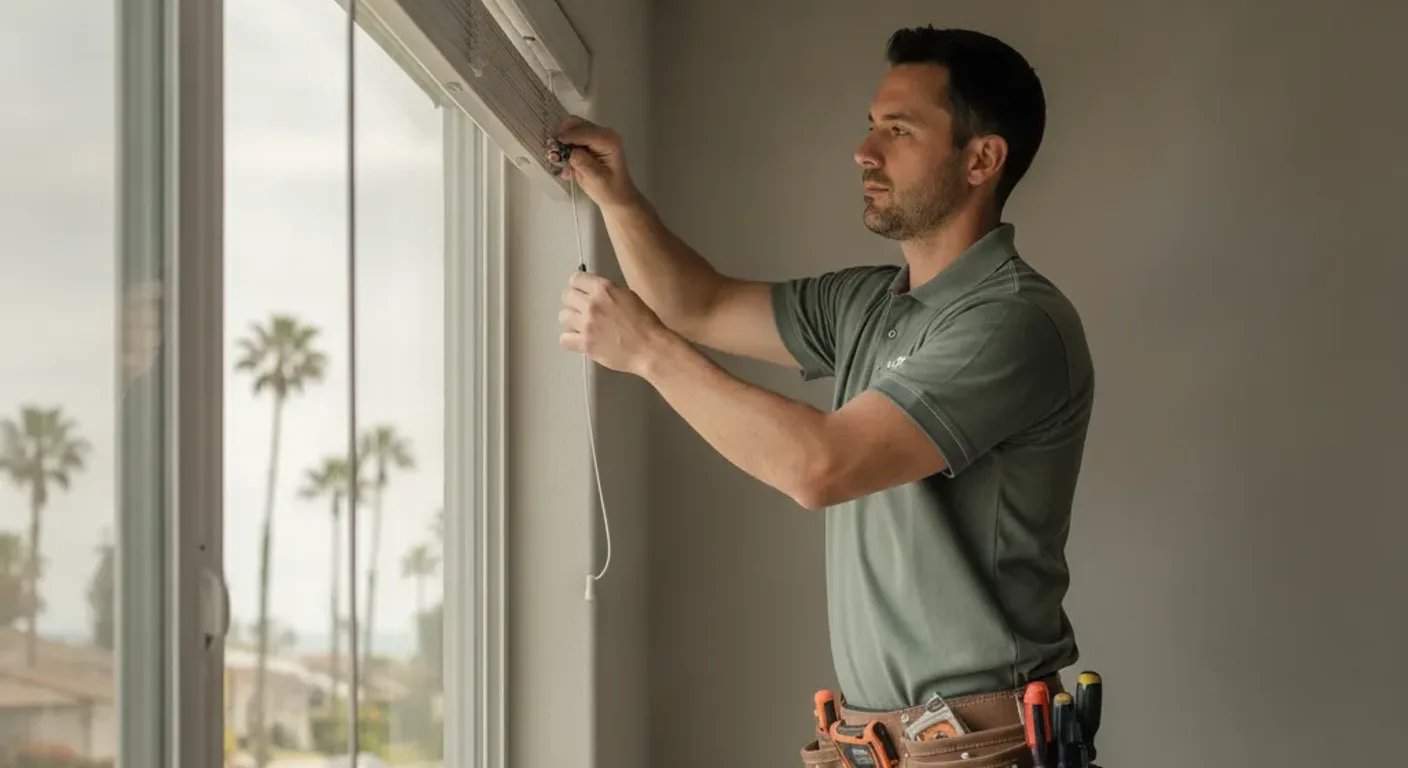
Most blind repairs in San Diego run $45–$150, and the majority are worth doing rather than replacing the whole blind. A broken tilt rod, frayed lift cord, or fallen headrail are fixable problems that take thirty minutes to an hour. Whether repair or replacement makes sense depends mostly on what the blind is made of and how much it cost originally.
Here’s what actually breaks on San Diego blinds, what it costs to fix in 2026, and how to know when you’re better off with a fresh set.
What breaks and what it costs to fix
Broken tilt mechanism. The tilt rod is the wand or cord that rotates slats open and closed. The plastic tilt mechanism inside the headrail cracks or strips with regular use, especially on cheaper aluminum mini blinds. Replacing the tilt mechanism typically costs $35–$75 in labor, and the part itself runs $8–$15. On a $25 vinyl mini blind, that math doesn’t work. On a quality faux-wood or wood blind, it’s an easy call to repair.
Frayed or broken lift cord. The lift cord threads through every slat and loops over a pulley inside the headrail. When it frays, knots, or snaps, the blind won’t raise or lower evenly. Recoriding a standard blind takes about forty-five minutes and costs $55–$110 depending on width and number of cord runs. The cord itself is inexpensive; labor is most of the cost.
Bent or broken slats. Individual slats on aluminum or faux-wood blinds can be replaced without touching the rest of the blind. Slat replacements run $20–$50 depending on width, material, and how many slats need swapping. You need the exact width and color, which is sometimes the harder part. Bring a slat sample when ordering.
Fallen or loose headrail. The headrail is the top housing that holds the whole blind. Mounting brackets fail when anchored into drywall without hitting a stud, or when the screw holes strip out over years of use. Re-mounting a headrail into solid material or installing toggle anchors properly costs $45–$85 and takes under an hour. This is one of the most common calls we get, and it’s almost always a quick fix.
Broken or missing pull cords and wands. Pull wands crack and break at the connector. Replacement wands are $5–$10 in parts and a ten-minute swap. Braided pull cords fray at the cord lock, and replacing just the cord lock mechanism costs $30–$55 in labor.
Repair versus replace: the honest answer
The type of blind tells you most of what you need to know.
Replace these: Cheap vinyl or aluminum mini blinds in the $20–$60 range. When the tilt mechanism goes or the headrail warps, the repair cost exceeds the replacement cost. These are designed to be swapped, not serviced. If you’ve had them more than five years in a sunny San Diego room, replacement is the right move.
Repair these: Quality wood blinds ($150+), faux-wood blinds ($80+), cellular or honeycomb shades, and any blind with a custom cut to fit an odd-sized window. Custom-cut blinds in particular are worth repairing because a replacement requires a new custom order that takes weeks and costs significantly more than a repair call.
| Problem | Repairable? | Typical handyman cost | Replace instead when |
|---|---|---|---|
| Broken tilt mechanism | Yes | $35–$75 | Blind cost under $40 |
| Frayed or broken lift cord | Yes | $55–$110 | Cord damage on a $30 blind |
| Bent slats (1–3 slats) | Yes | $20–$50 | Slat color no longer available |
| Fallen headrail | Yes | $45–$85 | Headrail is warped or cracked |
| Broken pull wand | Yes | $30–$55 | Usually always repair |
| Full mechanism failure | Sometimes | $75–$130 | Blind is under $60 original cost |
| Coastal humidity warp (wood blinds) | Depends | $65–$120 | Severe warp across all slats |
Coastal humidity and wood blinds near the beach
Real wood blinds look great but struggle within two miles of the San Diego coast. The marine layer humidity that rolls in most mornings causes wood slats to absorb moisture, expand, and warp. Once a wood slat warps, it won’t tilt flat against its neighbors, which leaves gaps and reduces privacy.
If your real wood blinds are in a room that faces the ocean or gets regular marine layer exposure in Coronado, Ocean Beach, Pacific Beach, Del Mar, or La Jolla, faux-wood blinds are the better long-term choice. Faux-wood is PVC-based, doesn’t absorb humidity, and holds up in coastal rooms without warping. When coastal wood blinds warp only partially, across two or three slats near a window edge, slat replacement plus a dehumidifier in the room can extend life significantly. When warp is uniform across the whole blind, replacement with faux-wood is the practical call.
Cordless conversion and child safety
Since 2018, federal standards have required that new window covering products sold through major retailers meet cordless or inaccessible-cord requirements. The change was driven by child safety concerns around accessible lift cords, which posed a strangulation risk for young children.
If you have older corded blinds and young children at home, cordless conversion is a straightforward upgrade. Many blinds can be converted by replacing the internal cord mechanism with a cordless lift system. Conversion costs $65–$120 per blind depending on width and mechanism type. When the existing blind isn’t well-suited to conversion, replacement with a new cordless model often makes more financial sense, since new cordless faux-wood blinds start around $40–$70 per window at standard sizes.
If you’re in a rental property or managing a multi-unit building, addressing corded blinds in rooms occupied by young children is worth doing proactively.
Measuring and installing new blinds
Getting the measurement wrong is the most common mistake with new blind installation. The key decision is inside mount versus outside mount.
Inside mount sits inside the window frame opening and gives a cleaner, built-in look. Measure the exact inside width at three points (top, middle, bottom) and use the narrowest measurement. Measure height from the top of the opening to the sill. Most manufacturers deduct a small amount for clearance, but confirm with whoever you order from.
Outside mount covers the window trim and mounts to the wall or trim above the window. It’s the right choice when your window has shallow depth that won’t fit inside-mount hardware, when you want to make a window look larger, or when your inside measurement would produce a blind under 12 inches wide. For outside mount, add 2–3 inches beyond each side of the opening and 3–4 inches above.
Mounting the headrail into solid material matters for both mount types. Drywall anchors work for lighter blinds, but heavier wood or cellular shades benefit from hitting a stud or solid window trim. A handyman will locate solid material before drilling, which prevents the fallen-headrail call six months later.
Installation for a standard blind runs $45–$85 per window for labor, assuming the blind arrives measured and ready to mount. Measuring, ordering, and installing multiple windows on the same visit reduces the per-window cost.
What a handyman handles vs. what needs a specialist
A handyman handles: tilt mechanism replacement, cord repair and restringing, slat replacement, headrail re-mounting, cordless conversion on compatible blinds, and new blind installation across all standard blind types.
A window covering specialist is the right call when you want motorized shades, automated smart-home integration, or custom-fabricated shutters that require professional templating and installation. Those projects involve products and installation protocols that go beyond standard handyman scope.
For window frame issues connected to your blind installation, like damaged sill or trim that won’t hold mounting hardware, our window repair post covers frame and sill repairs. Door-adjacent blind work, including sliding door panels and vertical blinds on patio doors, falls under our door repair service. For anything that’s a broader home repair task alongside the blind work, our general repairs service handles it all in one visit.
Frequently asked questions
How much does blind repair cost in San Diego?
Most repairs run $45–$150 depending on what’s broken. A fallen headrail re-mount is typically $45–$85. Cord restringing runs $55–$110. Tilt mechanism replacement is $35–$75. If multiple repairs are needed on the same blind, a handyman will often quote a flat rate for the whole job.
Is it worth repairing blinds or should I just replace them?
It depends on what the blind originally cost and what’s broken. Quality wood, faux-wood, or cellular blinds are almost always worth repairing. Cheap aluminum mini blinds are usually not, since repair cost can exceed replacement cost. Custom-cut blinds are worth repairing because replacing them requires a new custom order.
Can a handyman install blinds I’ve already purchased?
Yes. If you bring your own blinds, a handyman can install them. Make sure you’ve measured correctly for inside or outside mount before ordering. Returning a cut-to-size blind that doesn’t fit is usually not possible, so getting the measurement right before purchasing matters.
What’s the difference between inside and outside mount?
Inside mount sits inside the window frame opening. Outside mount covers the frame and mounts to the wall or trim above. Inside mount looks cleaner; outside mount works better for shallow windows or when you want to cover more of the wall for a larger look. A handyman can help you decide based on your window depth.
Do coastal San Diego homes need different blinds?
Near the coast, real wood blinds warp from marine layer humidity over time. Faux-wood blinds hold up better in rooms that face the ocean or get consistent morning humidity. Aluminum mini blinds also corrode faster in salt air. For beach-area homes, faux-wood or cellular shades are the more durable choice.
How long does blind installation take?
A single standard blind takes 20–30 minutes to install once the hardware and blind are ready. A full room of four to six windows typically takes two to three hours. Repair work is usually 30–60 minutes per blind depending on what’s needed.
Call (858) 400-4611 for blind repair and installation across San Diego County. Tell us when you need it and we’ll match you with a pro who has that slot open.
Would you rather hand this one to a pro than do it yourself? Call (858) 400-4611.
Request a quote