A damaged deck stair can involve the tread, stringer, railing, or landing. If you’re searching for deck stair repair near me, identify the visible area and photograph the whole stair run. A local pro still needs to inspect it before diagnosing the problem.
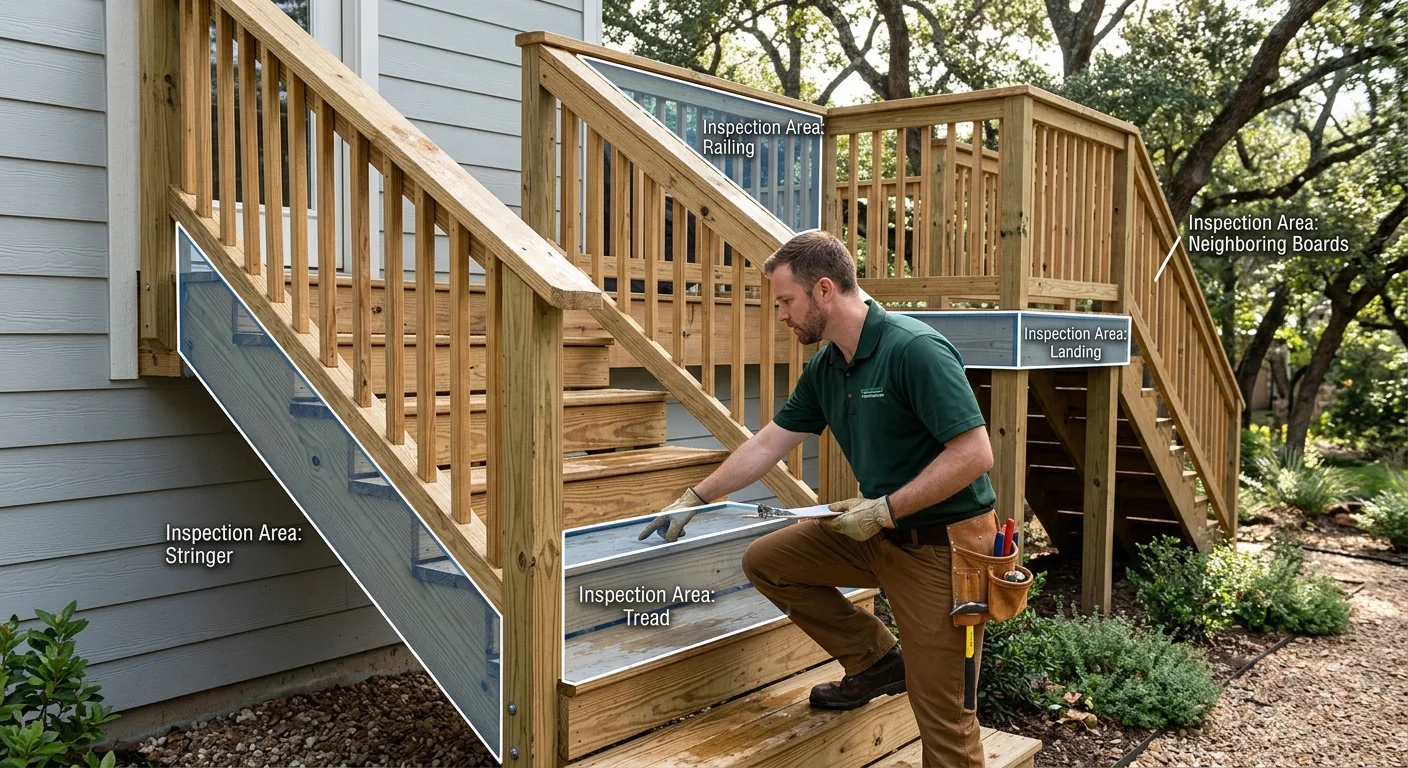
Locate movement or damage within the stair assembly
Start by naming where you first noticed the problem. Don’t try to name the cause. Your first goal is simply to place the visible change within the stair assembly.
The tread is the horizontal surface beneath your foot. The stringer is the sloped support visible along the side or beneath the treads. The railing includes the posts, rails, and smaller pieces between them. The landing is the flat area where the stairs meet the deck or ground-level platform.
Stand far enough away to see the entire stair run. Note whether the visible change appears near the top, middle, or bottom. Then record which side is involved. “Third tread from the bottom, left edge” is more useful than “the stairs are bad.”
Movement also needs a location. You might see a tread move while the railing remains still. The railing post might shift near the landing instead. Record only what you can observe without forcing or removing anything.
Don’t call a condition structural, cosmetic, rotten, or stable from appearance alone. Those words suggest a diagnosis that photographs can’t establish. Use plain descriptions such as cracked, split, discolored, separated, raised, or moving.
Fix Pro San Diego serves communities across San Diego County’s 67 cities. When requesting deck and fence repair, include the property location with your notes. The pro can then review the visible concern within the full stair assembly.
Separate tread damage from stringer concerns
A tread problem usually appears on the horizontal stepping surface. Photograph cracks, lifted edges, missing sections, visible gaps, or movement at that surface. Include both ends of the tread so the pro can see where it meets the stair supports.
Next, photograph the visible stringer area separately. Look from the side of the staircase without crawling underneath or taking anything apart. Record splits, gaps, discoloration, missing material, or a connection that looks different from neighboring connections.
The distinction matters when describing the request. “One tread has a split near its right end” identifies a visible surface problem. “A gap is visible where that tread meets the side stringer” tells the pro that the connection also needs attention. Neither description claims to know the repair.
Compare the affected step with the tread above and below it. Matching photos can reveal whether one piece looks different. Keep the camera position similar for each comparison. This helps the pro understand what caught your attention.
A damaged tread may be the only obvious concern, but that doesn’t confirm the scope. Likewise, a visible mark along a stringer doesn’t prove that the stringer needs replacement. An in-person inspection separates surface damage from a broader repair.
For a closer look at the horizontal deck surface, read our guide to deck board damage and repair scope. Deck boards and stair treads occupy different parts of the assembly, so describe them separately when both appear affected.
Record railing, landing, and nearby board conditions
Deck stair requests often focus on the step that looks damaged. The railing, landing, and nearby deck boards may also show visible changes worth documenting. Include them without assuming they share one cause.
Begin with the railing beside the affected tread. Photograph the nearest post from several feet away. Then take a closer image of its visible connections. Note any movement you personally observed, but don’t estimate how much force caused it.
Follow the same process at the landing. Capture where the stair run meets the landing and where the landing meets the deck. A wide image preserves context. A close image records the specific gap, crack, stain, or damaged edge.
Nearby boards deserve their own photographs. Identify whether they’re part of the deck surface, the landing, or the stairs. This prevents a repair request from grouping every horizontal board under the word “tread.”
Keep railing concerns distinct as well. A loose handrail, a changing gap, and a damaged post connection describe different visible locations. Our deck railing inspection guide explains what to record before requesting a quote.
San Diego County includes City of San Diego properties and addresses handled by other local jurisdictions. Confirm which building department covers the property before relying on permit information. Don’t assume guidance for a City of San Diego address applies to an address in Oceanside, Chula Vista, Escondido, or El Cajon.
These notes aren’t a diagnosis. They give the independent pro a clearer starting point for an on-site review.
Compare one visible repair with a broader inspection
One cracked tread creates an obvious repair request. The full scope may remain unclear until a pro inspects the stair run. Describe the visible item first, then ask the pro to evaluate the surrounding connections and adjacent parts.
Keep the request narrow but complete. You could write: “The fourth tread from the top has a split near the left edge. A gap is also visible beside the stringer. Please inspect the tread, its connections, the nearby railing post, and the upper landing.”
That description doesn’t tell the pro what to replace. It identifies the observed condition and the areas needing inspection. It also avoids turning one photograph into a structural conclusion.
The City of San Diego’s Information Bulletin 203 lists in-kind replacement of stair stringers and treads as work eligible for a no-plan building permit. That category still requires a permit. A photograph alone can’t establish whether proposed work qualifies as replacement in kind.
Permit requirements depend on the actual work and the property’s jurisdiction. Ask the pro to identify the proposed scope before work begins. For a City of San Diego property, current permit information is available through Development Services.
California’s minor-work licensing exemption applies only when the entire project is less than $1,000, the work is casual, minor, or inconsequential, and no building permit is required. Permit-required work needs a licensed contractor regardless of price. You can check a contractor’s license through CSLB.
Fix Pro San Diego is a referral service. We match homeowners with licensed, independent local pros. The customer contracts with and pays the selected professional directly.
Photograph the full stair run before requesting service
Create a short photo sequence before searching for deck repair near me. Start with the entire staircase. Include the top landing, all visible treads, both sides, and the bottom connection when possible.
Next, take a medium view of the affected section. Show at least one tread above and below the visible damage. This gives the pro reference points and helps distinguish the problem area from neighboring materials.
Finish with close photos. Capture the crack, gap, split, discoloration, missing piece, or moving connection that prompted the request. Keep one familiar object near the area only if it can be placed without covering the damage. Don’t remove trim, fasteners, boards, or railing pieces for the photograph.
Take separate images of the following areas when they’re visible:
- The top, edge, and underside of the affected tread
- The exposed portion of each nearby stringer
- The closest railing post and its visible connections
- The landing where the stairs begin or end
- Neighboring deck boards that look different
- Any prior patch or replaced piece you can identify
Add a short note to each image. Use location-based labels such as “top landing,” “middle tread,” or “right stringer.” If movement occurs, a brief video can show where you observed it. The recording still can’t establish the cause or the correct repair.
Include access details that affect the inspection. Mention gates, occupied units, pets, or furniture near the stairs. Don’t estimate materials, labor, price, or completion time. The independent pro can define those details after reviewing the site and proposed scope.
A clear photo set won’t replace an inspection. It will make the first conversation more specific and reduce confusion about which deck component needs attention.
When to call us
Hand the work to a pro when the damaged part isn’t clear, several stair components show changes, or the proposed repair may require a permit. Fix Pro San Diego can connect you with a licensed, independent local professional who can inspect the stairs in person. Call us at (858) 400-4611 and we’ll match you with a local pro who quotes the job before starting.
Would you rather hand this one to a pro than do it yourself? Call (858) 400-4611.
Request a quote