Damage at the bottom of a doorway isn’t always a threshold problem. A loose horizontal piece belongs in a threshold request, while a torn sweep, separated trim, or split jamb points to a different repair area. If you’re searching for door threshold repair near me, name the exact component and describe how the door moves.
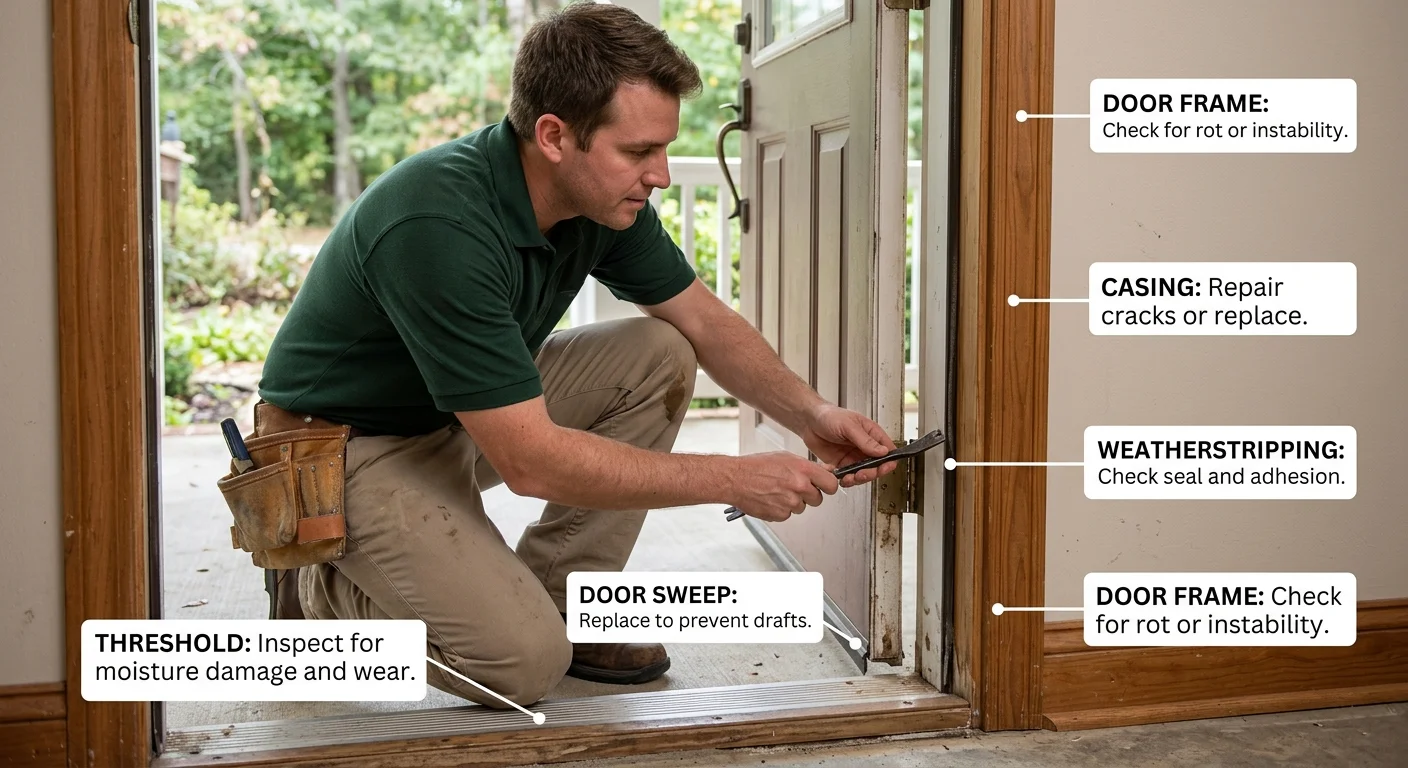
Identify the threshold and nearby door components
Start by locating the part that looks damaged. Several separate components meet within a few inches at the bottom of a doorway. Their names often get mixed together in repair requests.
The threshold is the horizontal piece crossed when entering the doorway. It sits below the closed door and spans the opening. Depending on the doorway, it may meet tile, concrete, wood, laminate, carpet, or another finished surface.
The door sweep is attached to the bottom edge of the moving door. It travels with the door when you open it. Weatherstripping is the flexible material found along the sides or top of the opening. Some doorway assemblies also place sealing material close to the threshold.
The frame includes the vertical jambs and the top section around the door. Casing is the visible trim covering the joint between that frame and the finished wall. Baseboard may terminate beside the casing, but it isn’t part of the door frame.
A quick movement check can separate these pieces:
- If the part moves with the door, photograph the sweep or door edge.
- If it stays on the floor, photograph the threshold.
- If it runs vertically inside the opening, photograph the jamb or seal.
- If it lies flat against the wall, photograph the casing or nearby trim.
Use these component names when requesting door and window repair. You don’t need to identify the cause. Clear location details give the pro a better starting point without treating a photograph as a diagnosis.
Separate seal trouble from damaged trim or frame
Visible gaps don’t identify one repair by themselves. The useful distinction is where the gap appears and which part has changed.
A seal request usually concerns flexible material. Record whether that material is torn, missing, folded, compressed, loose, or pulled away. Note whether the affected section sits below the door or follows a vertical jamb. Our guide to door and window weatherstripping covers that narrower type of request.
A trim request concerns the finished pieces around the opening. Photograph separated corners, open joints, peeling surfaces, dents, chips, or a casing edge pulling from the wall. Include the baseboard connection if the visible trouble continues beyond the doorway.
A frame request concerns the jamb or another fixed part of the opening. Record cracks, splits, missing material, fastener holes, or movement you can see during gentle door operation. Don’t label discoloration as rot, water damage, or concealed decay from appearance alone. A local pro needs to inspect the material before making that call.
A threshold request centers on the horizontal piece at floor level. Show whether the entire piece shifts or only one edge moves. Also record a lifted corner, a visible gap underneath, surface damage, or a joint separating from the adjacent floor.
More than one component may belong in the request. A damaged sweep can sit above a loose threshold. Separated casing can appear beside a jamb that also moves. List each observation instead of forcing the job into one category.
That approach keeps the request distinct from a general door problem. It also helps the matched pro decide what must be inspected at the opening.
Record rubbing, gaps, movement, and surface damage
A useful repair description reports what you can see, hear, and move. It shouldn’t guess at the hidden cause.
Begin with rubbing. State where contact happens during opening or closing. Useful locations include the threshold, lower corner, latch side, hinge side, and top edge. Don’t write only that the door “sticks.” Record the point where resistance begins and whether it continues through the swing.
Next, document visible gaps. Take note of their location while the door is closed. A gap under the door belongs in a different photo than a gap between casing and wall. If the gap changes from one side to the other, capture both ends in the same image.
Movement also matters. State which component moves when touched or when the door operates. The threshold, sweep, casing, and jamb should be described separately. Avoid pulling harder or removing fasteners just to test a part. The pro can inspect connections during the visit.
For surface damage, use literal descriptions:
- chipped edge
- split material
- peeling coating
- raised fastener
- separated joint
- crushed or torn flexible strip
- dark or stained area
- missing section
These words describe the condition without claiming a cause. Staining alone doesn’t confirm where moisture came from. A crack doesn’t establish structural movement. A photograph can’t show what sits behind the frame or below the threshold.
Include the doorway’s location inside the home. Identify it as a front entry, patio door, garage entry, bedroom door, or another opening. Also note the city when requesting a match. Fix Pro San Diego serves homeowners throughout San Diego County, including Oceanside, Encinitas, El Cajon, Chula Vista, and San Ysidro.
Check whether door operation changes the request
Door operation can connect a threshold complaint with another repair category. Open and close the door gently, then describe the movement in order.
Record whether the door clears the threshold through its full swing. Note any contact at the beginning, middle, or end. If the latch doesn’t meet cleanly, include that observation separately. A latch issue doesn’t prove that the threshold caused the change.
Also check the door in its fully closed position. Describe whether the lower edge looks even across the opening. State where you see light or an open line, but don’t treat that view as proof of air or water entry. Those conditions need direct inspection.
If the door rubs away from the threshold, the repair request may need to mention alignment. The separate guide to fixing a sticking door in San Diego explains what to record when movement is the main complaint. Keep the threshold in your request if it also shifts, lifts, or shows visible damage.
Don’t force the door after resistance starts. Instead, record:
- The direction the door swings.
- The first location where contact appears.
- Whether the door reaches the closed position.
- Whether the latch meets without lifting or pushing the door.
- Which fixed components move during operation.
A threshold repair can also expand into replacement or changes elsewhere in the opening. Permit questions depend on the address and final scope. For a property within the City of San Diego, check Development Services permit and inspection information. For another San Diego County city, confirm the current requirements with the authority serving that address.
Send full-opening and close photographs for review
Good photographs show both context and detail. A tight image of one chipped corner can’t show where that corner sits within the doorway.
Begin with one full-opening photograph. Stand far enough back to include the entire door, both jambs, casing, threshold, and nearby floor. Take another image with the door open so the threshold isn’t hidden.
Then photograph the bottom of the closed door from inside and outside, when both sides are accessible. Include the full threshold from end to end. A low angle can show a gap that disappears in an overhead view.
Add close photographs for each visible condition. Place the damaged area near the center, but keep one recognizable edge or joint in view. That reference helps the pro distinguish the threshold from the sweep, jamb, casing, or flooring.
Send a short written note with the images. A useful note might say:
The front entry door rubs near the lower latch-side corner. The sweep has a torn section. The threshold also moves at its left end. The casing doesn’t appear to move.
That wording reports observations without offering a diagnosis. It also identifies two possible work areas instead of calling everything a frame problem.
Photograph labels can help when several doors need attention. Use simple names such as “front entry,” “garage entry,” or “patio door.” If you’re comparing possible scopes, review the existing San Diego door repair cost guide, then ask the matched pro to quote the actual work before starting. Fix Pro San Diego doesn’t set the pro’s prices.
Photos support the first conversation, but they can’t confirm concealed damage, water paths, or movement inside the wall. Leave those conclusions for an on-site inspection.
When to call us
Hand the request to a pro when several doorway parts move, the door won’t operate normally, or the repair scope remains unclear. Fix Pro San Diego will connect you with a licensed, independent local professional who can inspect the opening and define the work.
Call us at (858) 400-4611 and we’ll match you with a local pro who quotes the job before starting.
Would you rather hand this one to a pro than do it yourself? Call (858) 400-4611.
Request a quote