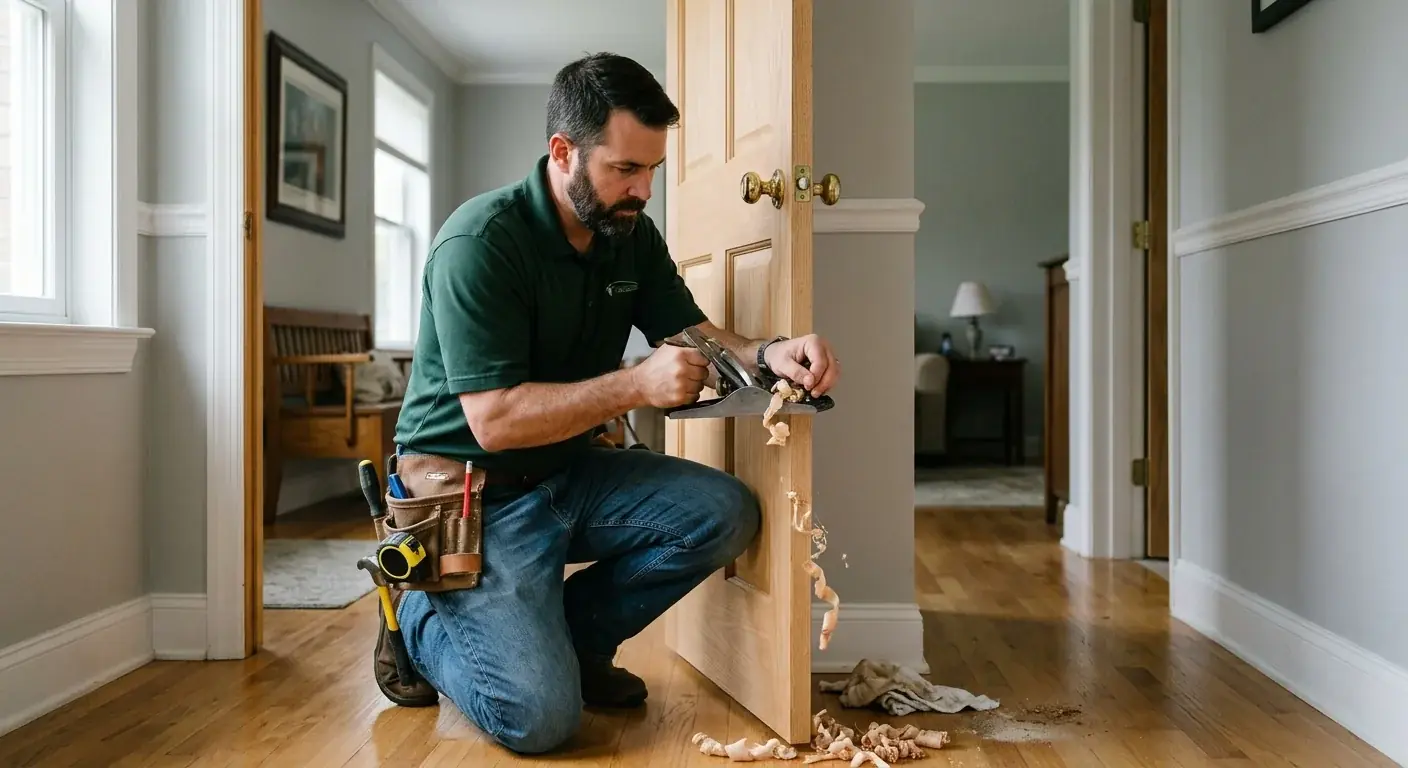
A door that rubs or drags is one of the most annoying problems in any home — and one of the most common in San Diego. You close a door and it catches, binding against the frame. You have to give it an extra shove to get it to shut. Some days it works fine. Other days, especially after heavy humidity or rain, it sticks worse than ever.
The good news: most door rubbing is fixable without replacing the door. The better news: in many cases, you can fix it yourself in 20 minutes.
Why Doors Rub in San Diego
Door rubbing has a few root causes. Which one your door has tells you what to fix.
Humidity and wood swelling. San Diego isn’t dry, especially near the coast. Maritime air brings moisture. Wood swells when it absorbs that humidity, and a door frame or door itself expands just enough to bind against the strike plate or frame opening. This is the #1 cause of rubbing doors in coastal neighborhoods like Del Mar, Coronado, Ocean Beach, and South Mission Beach.
Loose hinges. Over time, the screws holding hinges to the door or frame work loose, a few threads turn with vibration, and the door sags or twists slightly. When a door isn’t perfectly plumb, the edge rubs the frame opening.
Settling or a warped frame. Older homes settle, especially in neighborhoods built on fill like parts of Mission Valley or Linda Vista. When a frame shifts, the opening becomes slightly out of square. New construction can also warp if the HVAC system runs year-round without humidifiers, drying out the lumber unevenly.
Door swelling from the wrong finish. A door with an unfinished edge or back will absorb moisture faster than the front, causing it to cup or warp.
Quick Fixes You Can Do Yourself
1. Tighten the hinges
This works if your door sags slightly or twists.
Grab a screwdriver and check the screws on both hinges. Slowly tighten each one a quarter turn, test the door, and repeat if needed. Don’t overtighten — you’ll strip the screw hole or crack the hinge.
If the screw holes are stripped and the screws spin without biting, fill the hole with wooden toothpicks and a bit of wood glue, break them off flush, and drive the screw again. Or move to a slightly larger screw.
2. Sand the door edge or frame
If humidity is swelling the door, sanding down the rubbing edge is the nuclear option. It works, but you need to be careful.
Identify where it rubs. Usually it’s the top or sides of the door. Close the door gently and watch where it catches. Mark it with pencil.
Use 80-grit sandpaper or a power sander and sand that edge down about 1/8 inch. Then seal that bare wood with paint, stain, or sealant so it doesn’t absorb more humidity and swell again. This is critical. An unsealed edge will absorb moisture faster than before and you’ll be back to square one in a year.
3. Shim the hinge
If the door rubs only at the latch side (where the doorknob is), shim the top hinge outward slightly with cardboard shims. This tilts the door and lifts that corner away from the frame.
Remove the door by driving out the hinge pins with a hammer and nail (tap the nail up through the bottom). Remove the hinge, insert a thin cardboard shim behind it, and reinstall. Test it. Adjust if needed.
When to Call a Handyman
Warped or cracked doors. If the door itself is warped (concave or convex when you look at it edge-on), sanding won’t help — the door has to be replaced.
Structural settling. If the frame is significantly out of square, the door will never seal properly. A handyman can check with a level and determine if the frame needs adjustment or shims inside the wall.
Multiple damaged hinges. If hinges are cracked, the screw holes are enlarged, or the hinge barrel is bent, replacement is the right move.
Moisture damage. If the frame or door has soft spots, mold, or rot, that’s a bigger job. The damage needs to be assessed and repaired before the door can work properly.
Stop the Rubbing From Happening Again
Once you fix it, protect the door from future swelling.
Seal all surfaces. Make sure the top, bottom, and sides of the door are sealed with paint or stain. An unsealed edge is an open invitation for the door to absorb humidity and swell.
Keep humidity stable. In San Diego, summer brings lower humidity and winter brings more. A humidifier in winter and a dehumidifier near the coast can help stabilize indoor humidity, though for most homes this is overkill.
Check hinges annually. Spend 30 seconds a year tightening hinge screws before they work loose enough to cause sagging.
Install a door sweep. A rubber or silicone sweep at the bottom of the door seals the gap and reduces moisture entering from outside.
Frequently Asked Questions
Q: Is door rubbing different from a sticking door?
A: Sort of. A rubbing door binds against the frame opening itself, usually at the top or edge. A sticking door can rub, but it might also be rubbing the strike plate, catching on the latch, or just being tight in the opening. If your door rubs only right at the latch, check the strike plate alignment. If it rubs all along the edge, it’s swelling or sagging.
Q: Why does my door only rub after it rains?
A: Because wood absorbs moisture from humidity. After rain, humidity inside and outside the home rises, the wood swells, and the door rubs. As it dries out, the rubbing stops. This is especially true in coastal San Diego where the marine layer brings moisture.
Q: Can I fix door rubbing with a plane or belt sander?
A: Yes, but with caution. A power sander removes material much faster than hand sanding. Let the sander do the work — don’t force it — and check your progress frequently. You can always take more off, but you can’t put it back.
Q: Should I sand the door or the frame?
A: Sand whichever surface is accessible and doesn’t affect the structure. If it’s the edge of the door that’s rubbing, sand the door. If it’s a swollen frame, you can carefully sand the frame, but be very conservative — the frame is structural.
Q: How much should I sand?
A: Aim for about 1/8 inch or just enough to clear the rub. The less material you remove, the less you expose new wood that needs sealing.
Q: Will sealing the door edge really stop the rubbing from coming back?
A: Not entirely — wood will still expand and contract with humidity changes. But a sealed edge swells much more slowly than an unsealed one. You’re buying yourself years of trouble-free operation instead of dealing with it every other year.
Q: Is door rubbing a sign of bigger problems?
A: Usually no. It’s just humidity and gravity doing their thing. But if rubbing happens suddenly, or if multiple doors in the home start rubbing at once, that’s worth having a handyman look at. It could indicate settling or HVAC problems.
Would you rather hand this one to a pro than do it yourself? Call (858) 400-4611.
Request a quote