A doorknob ding in a Chula Vista hallway and a brown ring over a La Mesa dining table look like the same drywall problem. They are not. One sits on a vertical plane with different texture, paint, and access than the other, and mixing them into one vague request is how quotes miss half the room.
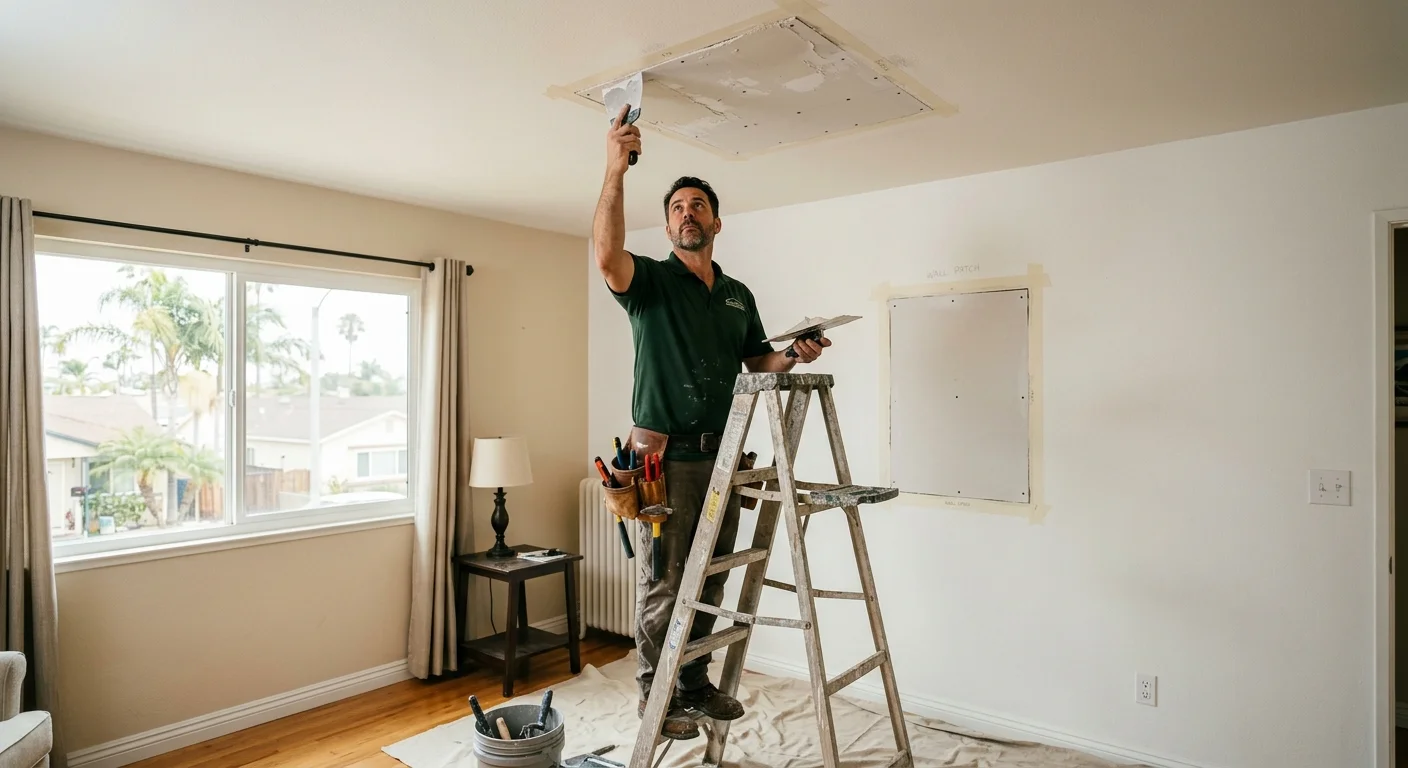
Map holes and cracks on walls versus ceilings
When you search drywall patching near me, start by naming the plane. Walls take impact from furniture, mounts, and door swings. Ceilings take gravity, fixtures, and whatever sits in the room above. A drywall patch near me request that skips that split leaves a pro guessing which surface to bid.
Walk each room with a notepad and a simple sketch. Label the four walls and the ceiling. Mark every hole, crack, dent, and stain on the face where it actually sits. A fist-sized opening at doorknob height in a Clairemont bedroom is a wall note. A crack that climbs from a window head in an El Cajon ranch and then turns onto the lid is both planes.
Write the height on the sketch. A crushed corner behind a door in a National City condo is wall work. A gap around a fan box in a Rancho Bernardo great room is ceiling work. A hole in wall repair near me search still needs that ceiling check, because one room can hold both. Can lights, fans, and registers live in the lid. Screw pops and picture-anchor blowouts stay on the wall unless the damage runs up and over.
Look at the taped joint where wall meets ceiling. In a lot of San Diego tract housing that joint is a paper or mesh seam. A hairline can open on the wall, on the ceiling, or right on the bead. Write which face broke. Inland East County houses in Alpine, Lakeside, and El Cajon show those joints more than a coastal Encinitas bungalow, where indoor temperatures stay closer together.
If you are in North Park, Golden Hill, South Park, or older Ocean Beach stock, the broken edge may look hard and sandy instead of paper-faced. Photograph that edge. Do not label it plaster or drywall from a phone photo. Vaulted ceilings in Carlsbad and Poway are still ceilings. If two rooms share a damaged wall, record both rooms.
Record texture, paint, and stain boundaries
Texture and paint decide whether a patch reads as a patch. San Diego walls are often orange peel or knockdown. Ceilings in the same house may be smoother, heavier, or still popcorn. Write the pattern on each plane. A wall patch that matches orange peel will still flash if the ceiling above it is flat or acoustic.
Note sheen on both surfaces. Ceilings are often flat. Walls may be eggshell or satin in kitchens and baths. A ceiling patch painted in wall paint will glare under a can light. A wall patch in flat ceiling paint will scuff. Photograph the sheen in raking light. West-facing rooms in Mission Valley and Point Loma show that mismatch in the afternoon.
Stain boundaries matter more than stain color. Draw the outline of any discoloration on the ceiling and on any wall it touches. A ring over a dining table in La Mesa may stop in the lid, or it may run down a chase into the wall. Photograph the outer edge, not only the darkest center. Do not diagnose a roof, a shower, or a slab from that photo. You are recording where the finish changed.
If paint peels in a circle around an old fill, note that. If a picture-frame of newer paint sits around a hole, say so. If the ceiling is popcorn and the walls are knockdown, write both and leave the popcorn in place. Keep stain maps separate from hole maps. A clean impact hole in a wall and a yellow ceiling ring are two records even when they share a room. That split is what makes a later drywall repair quote match the surfaces you actually have.
Compare a wall-only request with ceiling work
A wall-only request is vertical work. The pro fills, tapes if the opening needs it, textures, primes, and paints on a standing plane. Dust falls onto baseboards. Protection is floor plastic and furniture covers. Access is usually a step stool or none.
Ceiling work is overhead. Compound wants to sag, texture has to hang, and light from cans shows every ridge. The pro needs a taller ladder, more plastic, and more dry time between coats. Mixing a wall ding and a ceiling ring into one sentence hides that difference.
If only the wall is open, keep the request to that wall, that room, and that height. If the ceiling is stained, cracked, or holed, name the ceiling as its own surface. If both are damaged, ask for both. Do not assume one visit covers the lid because the wall is in the same room.
City of San Diego Information Bulletin 203 lists drywall patches up to 100 square feet related to electrical, mechanical, or plumbing repairs as work that does not require a building permit, except on designated historical resources or in historic districts. Confirm the current rule with City of San Diego Development Services for your address, especially in historic areas such as Mission Hills.
A handyman can patch drywall. Fix Pro San Diego matches you with independent local handyman pros across San Diego County and does not perform the work. If the aggregate price for labor, materials, and everything else reaches $1,000, California contractor licensing applies under Business and Professions Code section 7048, with its casual, minor-work, and no-permit conditions. You can verify a license with CSLB. Work that needs a permit still needs a licensed contractor even when the dollar amount is lower. Price alone is not permission to do the job.
How long the work takes depends on coats and dry time. A small wall fill can be a short visit. A ceiling rebuild with tape, several coats, texture, and paint often needs drying between steps. Nobody honest can promise that every drywall patch finishes in one day. Ask the pro how many visits the surfaces you mapped will need. What you pay is covered in drywall repair cost in San Diego. This page is which plane you are quoting.
Separate patching from the damage source
A patch is finish work. It covers a hole, a crack, or a cut. It does not stop a leak, a rubbing door, or a failing fan box. If you only send a photo of a brown ceiling, a careful pro will not treat that as a closed leak.
Name the source as unknown unless you already had it repaired. If a plumber opened a wall in a Kearny Mesa hall, say so and point to the cut. If a roof was replaced last year, say so, and still do not declare the stain dead. If furniture hit the wall during a move, that is impact, and the ceiling may be unrelated.
Keep electrical and plumbing out of the drywall request unless those trades already finished. Types of drywall damage in San Diego helps you label impact, moisture staining, joint cracks, and fixture holes without treating a photo as a diagnosis.
When the board itself is soft, crumbling, or open to a large void, a surface fill may not be the right repair. That is the patch or panel decision, and it is separate from wall versus ceiling. A ceiling panel over a tub, or a wall panel behind a TV, can still be one plane.
If you live in a pre-1978 house, paint work around a patch can disturb older coatings. The EPA’s Lead Renovation, Repair and Painting program is the federal rule for that setting. Mention the home’s age when you request work. Many central San Diego neighborhoods, from University Heights to parts of Pacific Beach, have housing from before that year.
Photograph each surface before requesting repair
Take a wide shot of the whole wall. Take a wide shot of the whole ceiling. Then take a close shot of each defect with a tape measure in the frame. Save wall files and ceiling files separately. Label the room. A single blurry photo of a corner does not tell a pro which plane to bid.
Stand so window light rakes across the surface. In a south-facing Carlsbad living room, noon sun will show texture mismatch that overhead lamps hide. In a dark East County hallway, turn on every fixture, including cans. Take one photo straight on and one from the side. Side light shows ridges a head-on flash will flatten. Do not stand on furniture to get the shot.
Photograph the damaged edge. If it looks like hard plaster rather than paper-faced drywall, capture that edge and leave the material unlabeled. People searching for plaster wall repair near me still help the pro by showing the break. If the room has a ceiling fan, photograph the canopy and the drywall around it as its own set. If the wall has a cluster of small holes from a TV mount or a gallery, shoot the whole cluster, then one close frame.
Include the stain outline, the nearest corner, and any fixture within a few feet. Do not open walls. Do not peel popcorn. The photo set is for scoping, not for remote diagnosis. If you already have a punch list from a move-out or a sale, keep wall items and ceiling items on separate lines. That is the same discipline as mapping the room.
When to call us
When a hole, crack, or stain sits on more than one plane, or when texture and paint have to match overhead, it is worth handing the work to a pro rather than guessing with a kit. Bring the wall-versus-ceiling map and the photos so the quote matches both surfaces. Call us at (858) 400-4611 and we’ll match you with a local pro who quotes the job before starting.
Would you rather hand this one to a pro than do it yourself? Call (858) 400-4611.
Request a quote