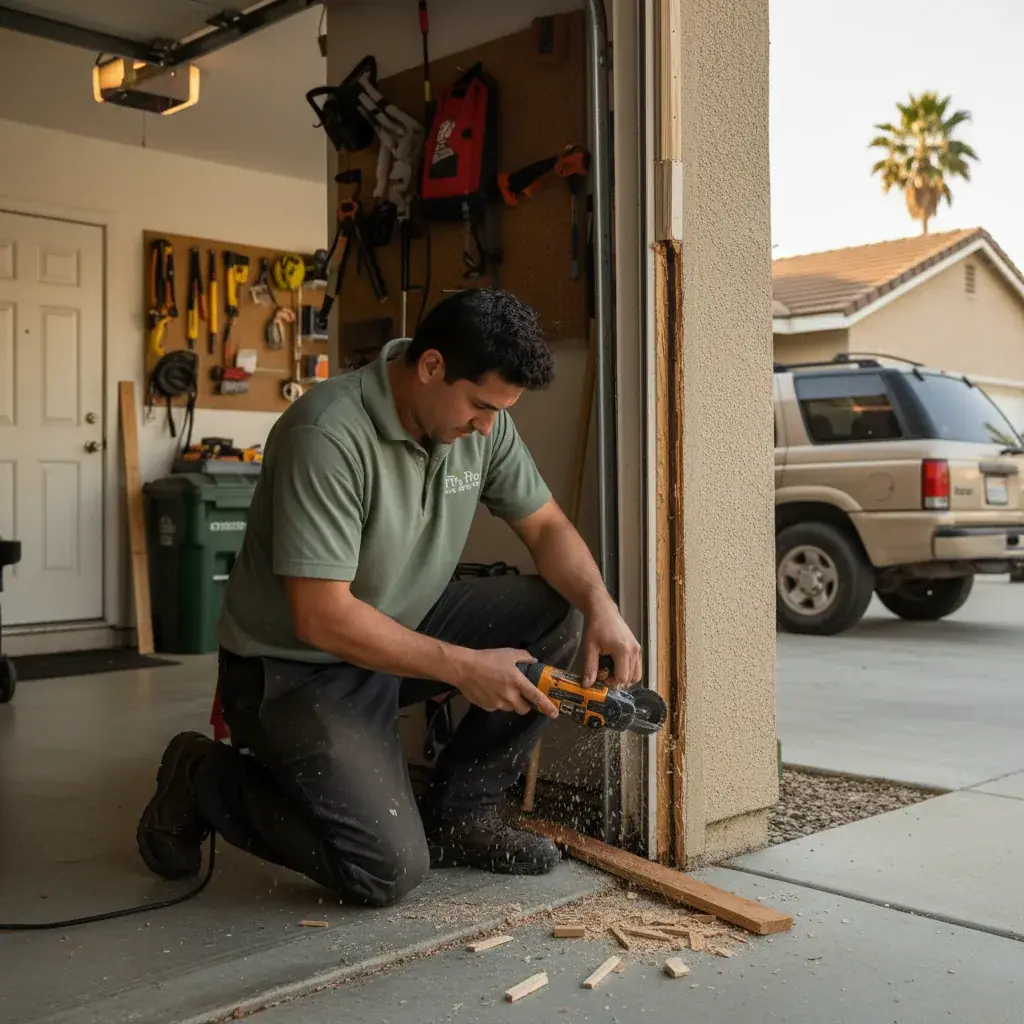
Your garage door works fine, but the wood around it is soft, split, or falling apart. That’s not a garage door problem. It’s a carpentry problem, and the distinction matters a lot when you’re calling around for quotes.
What’s a handyman job vs a garage door company job
Garage door companies specialize in mechanical systems: springs, cables, tracks, openers, and panels. The wood that surrounds the door opening is a different trade entirely, it’s finish carpentry, and most garage door companies won’t touch it.
A handyman handles everything structural about the frame itself. That includes the side jambs (the vertical boards that run up each side of the opening), the head jamb (the horizontal piece across the top), the exterior trim boards that give the frame its finished look from the driveway, and the stop molding that the door closes against on the interior side.
If the wood is rotted, cracked, split, or pulling away from the wall, that’s a carpentry repair. If the door itself won’t open, won’t close, or makes grinding noises, that’s a garage door company.
The clearest sign you need wood work: you can press your thumb into the jamb and it feels spongy, or you can see paint peeling up and dark staining at the base of the frame. Sometimes the door starts binding not because anything mechanical is wrong, but because a swollen or deteriorated jamb has shifted the door’s clearance. Fix the wood and the binding often resolves itself.
One caveat: if the frame damage is extensive enough that the door’s mounting hardware has shifted, you may need both a handyman and a door tech. We’ll tell you honestly if that’s the case when the pro assesses the job. For general door hardware and alignment issues, our door repair service covers most of what a homeowner needs short of replacing springs.
Rotted jamb, split trim, and damaged stop molding
These are the three most common wood repairs we see on San Diego garages.
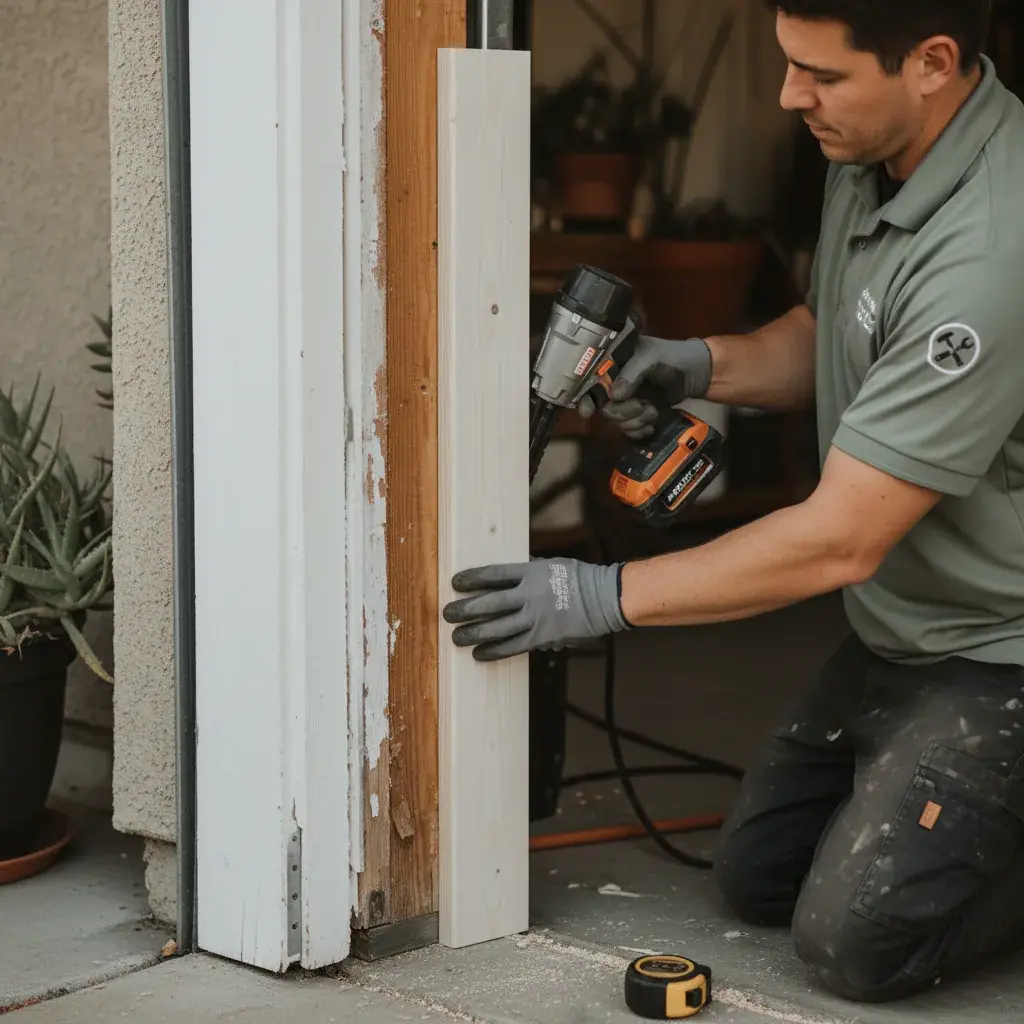
Rotted jamb. The vertical jamb boards take the most abuse. Water wicks up from the concrete slab, sits in the joint between the jamb and the floor, and slowly breaks down the wood from the bottom up. In mild cases, the bottom 6–12 inches can be cut out and replaced with a scarf joint, new wood is sistered in, screwed and glued, and you’d never know from the driveway. In worse cases, the full jamb board needs to come out and a new one goes in.
Split or cracked trim. Exterior trim on older homes in San Diego is often finger-jointed pine that’s had decades of sun and irregular watering from sprinklers. It splits along the glue lines, gaps open at the mitered corners, and caulk eventually fails. Trim repairs range from filling and recaulking minor splits to replacing full boards. The work pairs naturally with a fresh coat of paint on the surrounding area.
Damaged stop molding. The stop is the narrow strip of wood on the interior face of the jamb that the garage door closes against. It takes repeated impact every time the door cycles. When stop molding is cracked or missing, the door seal fails and you get drafts, dust, and insects. Stop molding is one of the fastest repairs on this list, usually under an hour of labor.
Termite and dry rot patterns in older SD garages
San Diego’s older housing stock, roughly anything built before 1985 in neighborhoods like Normal Heights, North Park, City Heights, and Lemon Grove, has a predictable dry rot and termite profile in the garage.
Dry rot (technically a fungal decay, not rot caused by water alone) thrives in the cycle of morning coastal moisture and afternoon heat that’s common within about 10 miles of the coast. Garages in Pacific Beach, Ocean Beach, and Point Loma see this constantly. The fungus colonizes wood that stays at 20–30% moisture content, not soaking wet, just damp enough. Once the hyphae spread, the wood loses structural strength even when it looks fine on the surface. Cutting it back to sound wood is the same dry rot repair the pros we send do on decks, fences, and fascia.
Termites follow similar geography. Subterranean termites in San Diego travel up from soil contact points, which is exactly why the base of a garage jamb, sitting on or near a concrete slab with a dirt apron outside, is a common entry point. You’ll often find a mud tube running up the back face of the jamb or hollowed-out channels just beneath the painted surface.
Coastal salt air accelerates both problems. Salt deposits on painted wood surfaces over years, drawing moisture and degrading the paint film faster than it would inland. A garage in Carlsbad or Encinitas near the water may need frame maintenance every 8–10 years where an equivalent garage in El Cajon might go 20 years without issues.
If you’re seeing any of this on a fence or gate in addition to the garage, the same decay patterns apply, we wrote about the decision framework in our post on fence repair vs replacement in San Diego.
Repainting and resealing after the repair
New wood doesn’t match old painted wood, that’s just physics. A proper frame repair includes priming all cut and bare surfaces before the finish coat goes on, and feathering the paint to blend with the existing field color as closely as possible.
For exterior garage trim, the pros we send typically use a 100% acrylic exterior paint in a satin or semi-gloss finish. Semi-gloss holds up better to the UV load San Diego delivers year-round and it’s easier to wipe down. If the whole garage face is chalking or fading, it sometimes makes more sense to paint the entire section rather than spot-patch, the pro will call that out in the estimate.
Caulking matters just as much as paint here. Every joint where the new jamb meets the wall, where trim meets trim, and where wood meets concrete should be sealed with a paintable exterior caulk. That bead is what keeps water from tracking back behind the new wood and starting the decay cycle again. The pros we send use a siliconized acrylic caulk in most cases, it stays flexible through temperature swings and takes paint cleanly.
If your garage sits in direct afternoon sun, a penetrating wood sealer on the backside of the new jamb board before installation adds years of life. It’s a 10-minute step that most people skip and then wonder why the repair didn’t last.
Cost ranges for frame and trim work in 2026
These are honest working ranges for San Diego, not national averages from a cost aggregator.
- Stop molding replacement (one side): $95–$175 labor, plus $15–$30 materials
- Partial jamb repair (cut-out and scarf joint, bottom 12 inches): $175–$325 labor, plus $25–$60 materials
- Full jamb replacement (one side, up to 8 ft): $275–$475 labor, plus $40–$90 materials
- Exterior trim replacement (one or two boards): $150–$350 labor, plus $30–$80 materials
- Paint touch-up and caulking after repair: Usually bundled into the repair estimate, or $85–$150 standalone if that’s all that’s needed
Most single-side garage jamb repair jobs in San Diego come in between $250 and $500 total, parts and labor. Both-side work with trim and paint typically runs $600–$950. These numbers assume standard residential construction with accessible framing, if there’s a brick or stucco exterior that requires patching around the new frame, add $100–$200.
For broader context on what handyman labor runs in the county right now, our handyman cost guide for San Diego in 2026 breaks down hourly vs flat-rate pricing across different job types.
When the door itself needs a specialist instead
Wood frame work stays squarely in handyman territory. But a few situations push the job toward a garage door company.
If the torsion spring is broken, the cable is off the drum, or the door tracks are bent, stop, those repairs involve stored mechanical energy that can cause serious injury if mishandled. That’s a garage door tech’s job, full stop.
If the mounting hardware that’s bolted through the jamb has pulled free and the door is misaligned, you need the wood fixed first and the hardware reset after. The pro we send can handle the carpentry portion and coordinate with a door tech for the hardware, or you can sequence it yourself.
If you’re seeing water intrusion not just at the frame but through the garage wall itself, that’s a waterproofing conversation before it’s a carpentry conversation. And if the opener itself is acting up, our guide to garage door opener repair in San Diego covers what a handyman can fix and what needs a specialist.
When to call us
Soft jambs, split trim, and failed stop molding are exactly the kind of repairs that are frustrating to live with but straightforward to fix when you have the right person on the job. Putting it off lets moisture and termites keep working. A same-week repair is almost always cheaper than a same-month one.
Call us at (858) 400-4611 and we’ll match you with a handyman across San Diego County.
Would you rather hand this one to a pro than do it yourself? Call (858) 400-4611.
Request a quote