Most San Diego homeowners pay $150 to $600 for a typical siding repair, when the damage is limited to a few boards or one section. A single cracked or rotted board sits at the low end. Several boards, hidden wood rot, or hard-to-match material push toward the top, and re-siding a whole wall or house is a much larger job that belongs to a siding or general contractor, not a handyman patch.
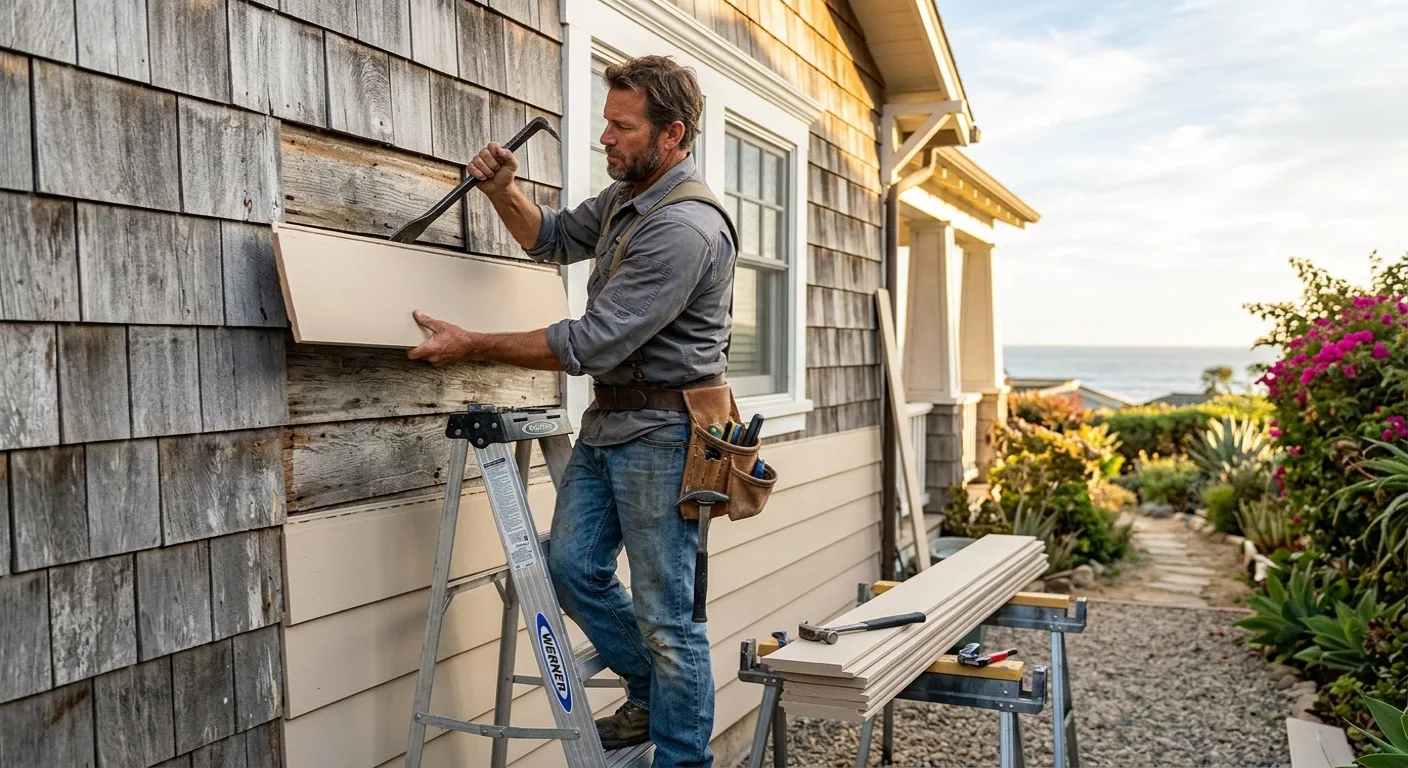
What does siding repair cost in San Diego?
For a localized fix where a handful of boards need attention, a handyman in San Diego County usually charges $150 to $600 in labor and materials for the repair itself. That covers removing the damaged pieces, checking the wall behind them, cutting and fitting replacement boards, and sealing the seams. The cost climbs when rot has spread into the sheathing or framing, because then it’s a structural repair and not just a cosmetic swap.
Three things move that number more than anything else: the siding material, how many boards are affected, and whether moisture has reached the wall behind the siding. A single sun-cracked board on a stucco-and-wood-trim home in Escondido is quick. A soft, spongy section low on a north-facing wall in coastal Bonita often hides rot that spreads further than it looks. San Diego’s mild, salty coastal air and dry inland heat wear siding differently across the county, so treat the ranges below as planning numbers, not a final price.
Siding repair cost by type of job
Different repairs carry different labor because of access, material matching, and how much of the wall has to come apart. Here’s what siding repair typically runs in San Diego.
| Repair type | Typical cost | What’s involved |
|---|---|---|
| Single board patch | $150 to $350 | Remove and replace one cracked, warped, or holed board |
| Small section repair | $350 to $700 | Replace several boards, reseal, prime for paint |
| Wood rot repair | $500 to $1,500 | Cut out rot, treat or replace boards and any soft sheathing |
| Trim and corner repair | $200 to $600 | Fix rotted corner boards, fascia, or window trim |
| Re-side a full wall | $3,000 and up | Larger project, usually a siding or general contractor |
Single board and small section repairs
If the problem is a cracked, cupped, or woodpecker-holed board or two, this is the cheapest and most common fix. A handyman removes the damaged pieces, inspects the wall for moisture, cuts new boards to match, fastens and caulks them, and primes the raw wood so it’s ready for paint. The main challenge is color and profile matching, which we cover below.
Wood rot repair
Rot is where San Diego siding costs jump. Wood siding, corner boards, and fascia soak up moisture at the bottom edges and behind failed caulk. Once a board turns soft, the rot often reaches the trim, the sheathing, or the framing behind it. Repairing rot means cutting back to solid wood, letting the wall dry, and rebuilding. This overlaps with our dry rot repair work, and it’s worth doing early because a $600 rot repair left alone can turn into a $3,000 one.
Trim, corners, and fascia
A lot of what people call siding damage is actually the trim around it. Rotted corner boards, window casing, and fascia are common on older San Diego homes and are a straightforward carpentry fix that keeps water out of the wall.
When to repair siding, and when to replace it
The honest test is simple: repair when the damage is local and the rest of the wall is sound, replace when the failure is spread across the whole surface. A patch that costs a few hundred dollars almost always beats a full re-side when most of your siding is still doing its job.
Signs that a repair is the smarter move:
- Isolated damage. Only one or two boards or a single section show cracks, holes, or soft spots. The rest of the wall is solid.
- Surface issues. Peeling paint, minor warping, or a few impact cracks with no moisture behind them.
- Trim-only problems. Rotted corner boards or fascia while the field siding is fine.
Signs that replacement is the better call:
- Widespread rot or moisture across a whole wall, not just one spot.
- Repeated failures where you patch one board and another goes soft a season later.
- A material that can’t be matched or reasonably sourced anymore.
When a wall genuinely needs re-siding, that’s a larger project than a handyman patch. We’re upfront about it, and for a full re-side we’ll point you toward a siding or general contractor rather than pretend a patch will hold.
How San Diego’s climate wears siding
Siding fails differently across the county. Near the coast in areas like Coronado, Ocean Beach, and Bonita, salt air and marine moisture speed up rot and rust fasteners, so bottom edges and north-facing walls go first. Inland in Escondido, Poway, and Alpine, intense summer sun and heat dry out and crack wood and fade paint, which lets water in the next time it rains. Either way, the fix starts with sealing the wall against water, so we pair most siding repairs with fresh caulk and primer. If you’re already planning to repaint, our guide to exterior paint prep on San Diego stucco and siding walks through doing it in the right order.
Matching siding by material
Getting a repair to disappear depends on the material, and each type has its own logic.
Wood siding is the most repairable. Cedar, redwood, and pine boards are easy to source, and a skilled carpenter can blend a new board into the run. The one catch is weathering, since a fresh board looks brighter than the sun-greyed boards around it until it’s primed and painted.
Fiber cement, like Hardie board, is durable and common on newer San Diego builds. It’s repairable, but it’s heavier, needs the right blade to cut, and profiles have to match, so it’s more involved than swapping a wood plank.
Stucco is a different system entirely, not a board siding. If your exterior is stucco, our stucco repair guide covers cracks and patching, which is a separate skill from board siding.
Vinyl and aluminum siding are less common here but do show up. Vinyl cracks from impact and sun, and matching an older color can be tough, so repairs are often section swaps rather than clean patches.
How to get an accurate siding repair quote
The fastest way to a real number is a few clear photos and a short description. Note how many boards look damaged, whether any feel soft or spongy, the material if you know it, and which direction the wall faces. That tells us whether you’re likely looking at a simple patch or a rot repair before anyone drives out. For small jobs, this often turns into a same-visit fix. Larger or spreading damage gets a walk-through first, because pricing rot you can’t see yet helps no one.
Frequently asked questions
How much does siding repair cost in San Diego?
Most localized siding repairs in San Diego run $150 to $600 in labor and materials for a few boards or one section. Hidden wood rot that has reached the sheathing or framing can push a repair to $1,500, and re-siding a full wall starts around $3,000 and is a contractor-scale job.
Can a handyman repair siding, or do I need a contractor?
A handyman can handle most localized siding repairs: single boards, small sections, rotted trim and corners, and sealing. You need a siding or general contractor when a whole wall or the entire house needs re-siding, or when rot has spread into the structural framing.
How do I know if my siding just needs a repair or a full replacement?
Push on the damaged area and check the boards around it. If only one or two spots are soft or cracked and the rest of the wall is solid, it’s a repair. If moisture and rot show up across a whole wall, or you keep patching new failures each season, it’s time to replace that section or wall.
What causes siding to rot in San Diego?
Moisture is the cause almost every time. Near the coast, salt air and marine layer humidity keep bottom edges and shaded walls damp. Inland, sun cracks the wood and paint, then rain gets into the cracks. Failed caulk around trim and windows lets water behind the siding in both climates.
How long does a siding repair take?
A single board or small section repair is usually a few hours. A wood rot repair takes longer because the wall has to be opened, dried, and rebuilt, and primed wood needs time before it’s painted. Most non-structural siding repairs are done in a day.
Should I repair siding before painting?
Yes. Always fix damaged boards, rot, and failed caulk before you paint. Paint over a rotted or gapped board just hides the problem while water keeps working behind it. Repair first, seal and prime the new wood, then paint the wall as one finished surface.
Got a cracked board, a soft spot, or rotted trim you want looked at? Call Fix Pro San Diego at (858) 400-4611 for a straightforward quote on siding repair anywhere in San Diego County.
Want a flat-rate quote for this instead of doing it yourself? Call (858) 400-4611.
Request a quote