
Picking a paint color sounds straightforward until you bring the sample home and watch it turn a completely different shade by noon. San Diego’s light is intense, directional, and full of UV, and it plays tricks on colors that look perfect in the store. Getting this right means understanding how local light behaves before you open a single can.
Why San Diego light changes how paint reads
Southern California light is bright and high in UV intensity for most of the year. That matters because paint reflects light, and stronger light amplifies whatever undertone is sitting in the color.
A white with a faint blue undertone looks crisp and neutral in a showroom lit by standard fluorescents. Put that same white on a west-facing wall in Pacific Beach or Rancho Bernardo and the afternoon sun will push that blue undertone hard. The room starts to feel cold and clinical, not what most people wanted when they chose “soft white.”
The effect works in reverse too. Warm tones, creamy whites, greige, sage green, absorb San Diego’s natural light without reflecting it back in unexpected ways. They stay closer to what you saw on the swatch.
There’s also the coastal marine layer to consider. In neighborhoods close to the coast, La Jolla, Point Loma, Ocean Beach, morning light filters through overcast for several months. That gray diffused light flattens cool colors dramatically. A blue-gray that looks sophisticated in June morning photos can feel like a waiting room by 8 a.m. from November through March.
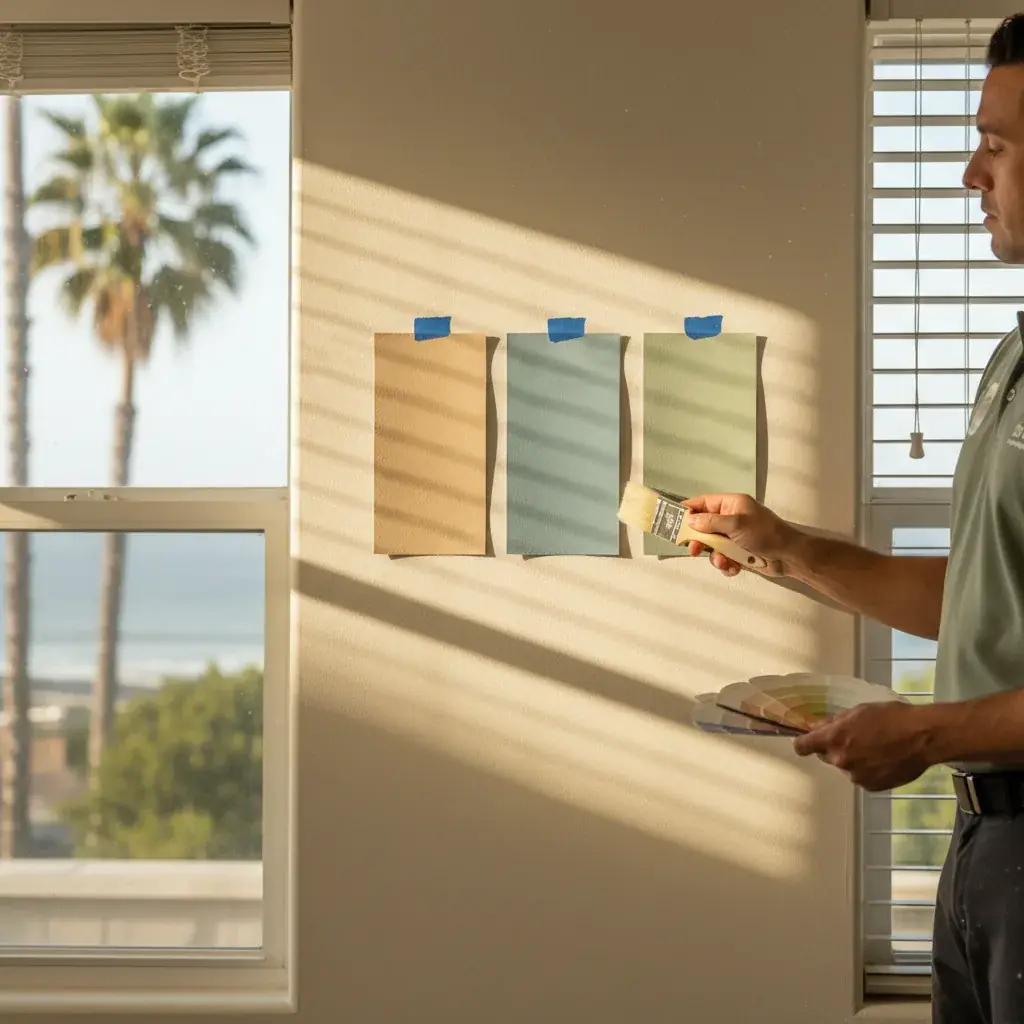
The fix is simple but requires patience: tape 12-inch swatches directly to your wall and observe them at 8 a.m., noon, and 4 p.m. on two different days. Don’t rely on the swatch card alone. The wall is the only accurate test surface you have.
Warm whites that don’t go yellow under coastal sun
The goal with whites is finding a balance between warm and clean. You want enough yellow or pink undertone to stay neutral under strong sun, but not so much that the room starts to look like aged paper.
Look for whites with a red-yellow undertone rather than a green-yellow one. Red-yellow reads as creamy and warm without going brassy. Green-yellow whites tend to look dingy in strong light, they pick up the harshness of midday sun and hold onto it.
Whites with a slight pink or blush undertone are performing well in San Diego interiors right now. They read as neutral in most light conditions and work particularly well in rooms with wood floors or terracotta tile. The pink keeps the warmth alive without competing with natural materials.
If you want something cooler but not cold, look for whites described as having a “greige” or taupe undertone. These hold up under coastal diffused light better than true blue-based whites. They read as sophisticated without the clinical coldness problem.
One practical rule: if a white looks perfect under the store’s lighting, it probably has too much blue in it. The artificial light in most paint stores tends to flatter cool undertones that later struggle in real San Diego conditions.
Greens, terracottas, and the Spanish revival palette
San Diego’s architectural heritage gives homeowners a built-in reference point. Spanish revival, Craftsman bungalows, and mid-century stucco homes all point toward earthy, saturated palettes that happen to work extremely well with local light.
Terracotta is having a moment that’s less trend and more return to form here. The reddish-orange tones echo the clay roof tiles and stucco exteriors common across Mission Hills, North Park, and Hillcrest. Used on an accent wall or a single room, terracotta grounds a space without overpowering it. The key is going slightly darker than you think you want, terracotta often reads lighter on large surfaces than on a small swatch.
Sage and olive greens complement the same palette without competing with it. These mid-value greens absorb natural light well and pair cleanly with both wood tones and white trim. In east-facing rooms that get bright morning light and dim afternoon, green reads consistently throughout the day in a way that blue-grays simply don’t.
Dusty blues and warm lavenders are worth considering in interior rooms without direct sun, hallways, dining rooms, home offices. They need to be anchored with warm trim colors or natural wood; otherwise they drift toward cold in San Diego’s filtered light.
North-facing rooms vs west-facing rooms
Direction matters more in San Diego than in cloudier climates because you’re dealing with consistent, predictable sun angles most of the year.
North-facing rooms get the least direct sun. Light is soft and cool, which makes warm colors essential. A greige or warm white that looks slightly too yellow in a south-facing room will look exactly right in a north-facing bedroom or bathroom. Cool grays go ashy fast in these rooms, avoid them unless you’re adding a lot of artificial warm-toned lighting.
West-facing rooms take the hardest hit. Afternoon sun in San Diego is direct and intense from March through October. Saturated colors hold up better here than pale ones, a deep terracotta or a rich sage reads as intentional, while a pale blush can look washed out by 3 p.m. If you want lighter walls in a west-facing room, choose warm neutrals with strong undertones, not pastels.
East-facing rooms get brilliant morning light that softens quickly. Most color families work well here. This is a good room to experiment with greens or blues that might struggle elsewhere.
South-facing rooms get the most consistent light all day. They’re the most forgiving, both warm and cool undertones can work depending on how much sun the windows let in.
Sheen choices: matte, eggshell, satin, where each one belongs
Sheen affects how light bounces off your walls, which means it compounds the direction and intensity issues above.
Matte absorbs light. It makes imperfections and texture less visible, which is a real advantage in older San Diego homes with plaster walls or surfaces that have been patched multiple times. The tradeoff is cleanability, flat paint marks easily and doesn’t wipe down well. Reserve it for low-traffic bedrooms and ceilings.
Eggshell is the workhorse finish for living rooms and dining rooms. It has just enough sheen to be wipeable without catching light at harsh angles. In a bright west-facing room, eggshell manages reflected light better than satin.
Satin is right for kitchens, bathrooms, laundry rooms, and hallways, anywhere moisture or heavy hand traffic is a factor. It’s noticeably shinier than eggshell, which makes it unforgiving on uneven walls. If the surface has dings, nail pops, or old texture inconsistencies, you’ll see every one of them under satin in direct sunlight. This is exactly why prep work matters so much before a paint job.
When to bring in a handyman for prep and patching
Paint itself isn’t usually the problem. The prep underneath it is. Cracks along crown molding, nail pops in drywall, gaps at baseboards, old tape seams telegraphing through the surface, all of these get worse under a fresh coat of paint, not better.
Before any paint project, walk your walls in raking light, a single lamp held at an angle, parallel to the surface. You’ll see every imperfection your eyes normally skip past. Most San Diego homes built before 1990 have at least a few areas that need drywall repair before paint goes on. Newer homes often have settling cracks at corners and around door frames.
Our post on how long interior painting takes walks through timelines including prep, it’s worth reading before you plan your project schedule. Skipping prep to save a day almost always creates a repaint situation within two or three years.
If you’re getting quotes for paint work, ask specifically what’s included in surface prep. A proper job includes filling holes, skim-coating rough areas, sanding, and caulking along trim and transitions. Our interior painting service covers all of it before a drop of paint goes on the wall.
When to call us
If your walls need patching, caulking, or skim work before you can paint, that prep is often faster and cleaner with a pro, especially when you’re working around textured surfaces or multiple rooms. Trying to feather a drywall patch into a textured wall is one of those tasks that looks simple and isn’t.
Call us at (858) 400-4611 and we’ll match you with a local handyman anywhere in San Diego County.
Would you rather hand this one to a pro than do it yourself? Call (858) 400-4611.
Request a quote