That one cabinet door that just won’t stay closed. The drawer that fights you every time you need a spatula. These small annoyances can make your whole kitchen feel worn out, tempting you to start browsing expensive, full-scale remodels. But often, a targeted repair is all you need to restore function and make your kitchen feel new again.
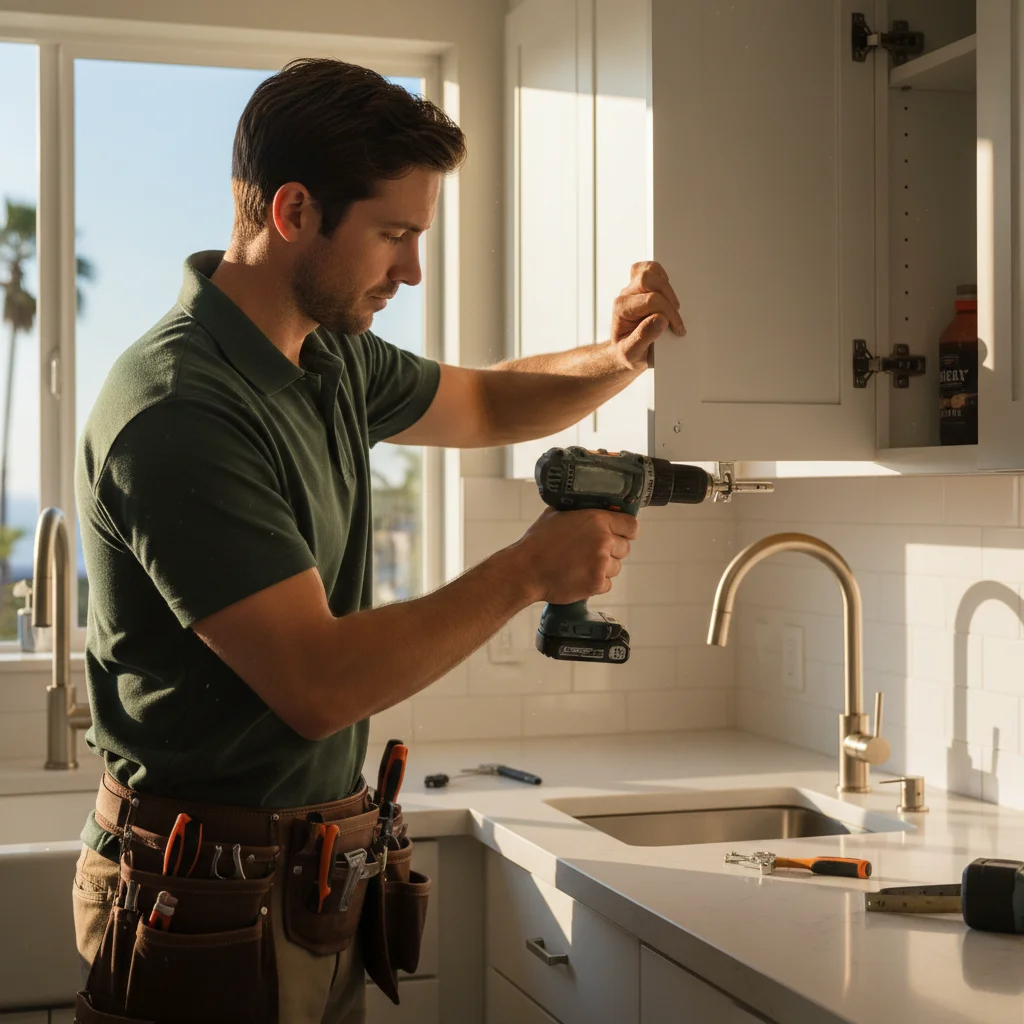
Most cabinet problems aren’t a sign that your kitchen is failing; they’re just normal wear and tear on hardworking mechanical parts. Before you call a demolition crew, let’s look at what’s actually fixable.
The five most common kitchen cabinet failures
Years of opening, closing, and storing heavy dishes take a toll. In San Diego, we see the same handful of issues in kitchens from Chula Vista to Oceanside, regardless of age. Understanding the specific point of failure is the first step toward a fast, affordable fix.
-
Broken or Stripped Hinges: This is the number one reason we get calls for cabinet repair. Hinges get loose, screws strip out of the particleboard or wood, and doors start to sag or hang crooked. Sometimes the metal hinge itself cracks from fatigue.
-
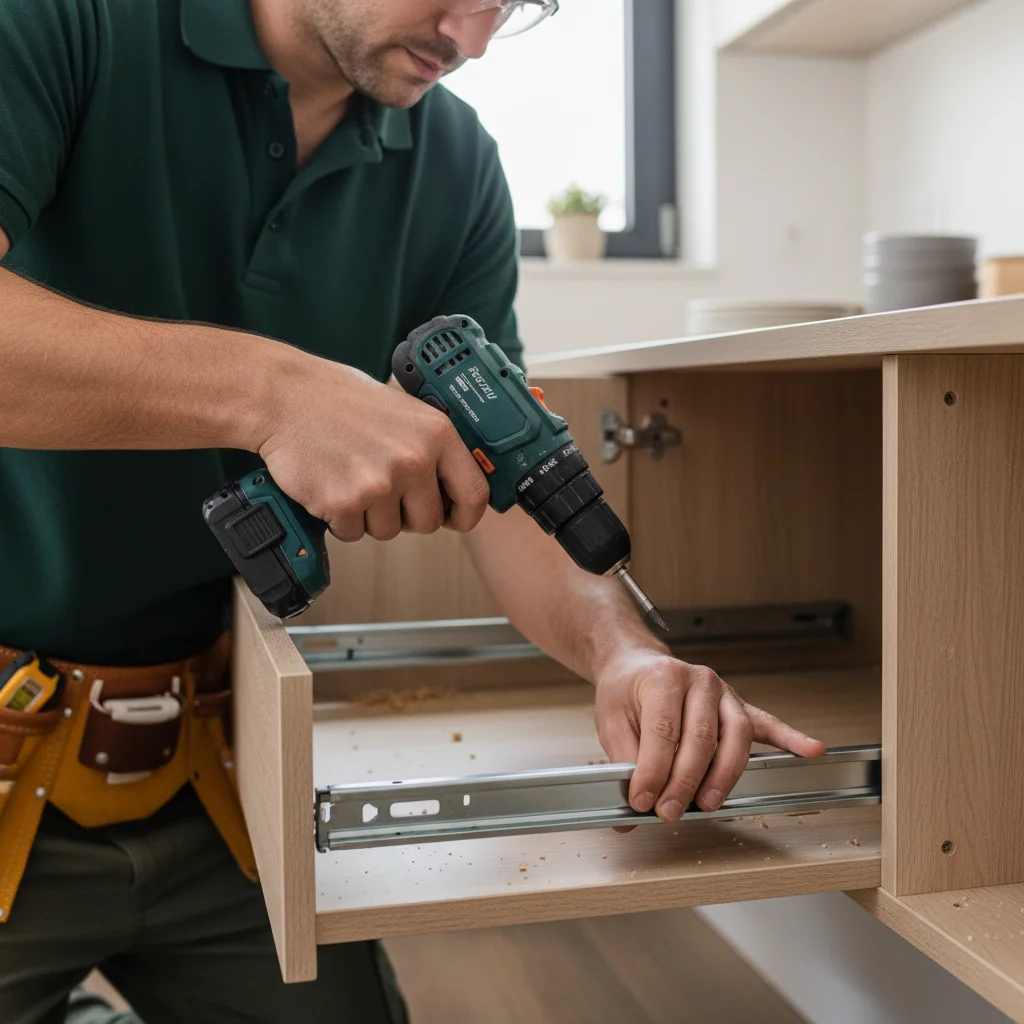
Failing Drawer Slides: A drawer that jams, wobbles, or doesn’t close flush is almost always a drawer slide problem. The old-school, single-wheel plastic rollers are notorious for breaking, while even modern ball-bearing slides can get gummed up or bent.
-
Chronic Door Misalignment: When doors knock against each other or have uneven gaps, it’s a clear sign of a problem. While it’s often a simple hinge adjustment, it can also point to a cabinet box that has settled out of square or a door that has warped slightly over time.
-
Sagging Shelves: This is especially common in San Diego tract homes from the ’70s and ’80s. Wide spans of original particleboard shelving simply can’t handle the weight of a full set of ceramic plates and bowls forever. They eventually bow in the middle, creating an unsightly curve.
-
Finish Wear and Water Damage: The area under the sink is the prime suspect, often from a slow supply line or a failing garbage disposal. A slow leak or condensation can cause cabinet floors to swell and delaminate. Elsewhere, you might see peeling thermofoil, chipped paint, or worn stain, especially around high-touch areas like knobs and pulls.
Hinge replacement and soft-close retrofits
The humble hinge does all the heavy lifting, and when it fails, the whole system breaks down. A professional cabinet hinge replacement is one of the most satisfyingly effective repairs you can make.
Hinge Types
Most modern San Diego kitchens use European-style concealed hinges. These are hidden inside the cabinet door and offer three-way adjustability (up/down, left/right, in/out), which is essential for getting those perfect, even gaps between doors. When these fail, it’s usually because the screws have stripped the cabinet frame or the internal mechanism has worn out.
Older or more traditional kitchens might have surface-mount hinges, where the hinge is visible on the face frame of the cabinet. These are less adjustable but often simpler to replace with an exact match.
The Soft-Close Upgrade
One of the best upgrades you can make during a repair is a soft-close retrofit. Instead of replacing a broken hinge with a standard one, we can install a soft-close version. This small change eliminates slamming doors, reduces wear on the frames, and gives your entire kitchen a more premium, modern feel. For most cabinet types, this is a straightforward swap that dramatically improves daily use. It’s a perfect example of a small job that falls under our expert carpentry services.
Drawer slides: side-mount, undermount, and when to upgrade
A frustrating drawer can sour your entire cooking experience. A drawer slide repair or upgrade restores smooth, reliable function and can even increase your drawer’s capacity and accessibility.
Common Slide Types
The most common workhorse is the side-mount ball-bearing slide. You’ll see brands like Accuride in many custom and semi-custom kitchens. They are durable, can handle heavy loads (think pots and pans), and provide full extension, meaning you can pull the drawer all the way out to reach items in the back.
For a high-end look and feel, undermount slides like those from Blum are the top choice. These are mounted beneath the drawer box, making them completely invisible when the drawer is open. They almost always include a soft-close mechanism and provide the smoothest action available. Installing these as an upgrade requires precision, as the tolerances are much tighter.
When to Upgrade
If you have the old-style, single-wheel roller slides, an upgrade is a no-brainer. These are prone to breaking and don’t allow the drawer to open fully. Swapping them for modern, full-extension ball-bearing slides is a night-and-day difference. You’ll gain better access to your drawer’s contents and a much more sturdy mechanism that won’t fail under the weight of your silverware or kitchen tools.
Door alignment and sagging shelf fixes
Sometimes, the problem isn’t broken hardware but rather things shifting out of place. These fixes require a keen eye and a steady hand.
Mastering Cabinet Door Alignment
Proper cabinet door alignment creates the clean, uniform lines that define a well-kept kitchen. On European hinges, there are typically three screws that control the door’s position. One moves it up and down, another moves it left and right, and a third adjusts the depth, pushing it closer to or further from the frame.
It’s a process of small, incremental adjustments to get the gaps (called “reveals”) perfectly consistent. If a door still won’t align after adjusting the hinges, it could mean the cabinet box itself isn’t perfectly square on the wall, which requires a more advanced approach to solve.
Curing the Sag
For sagging shelves, you have a few options. The simplest fix is often just to flip the shelf over and let gravity work in the other direction. For a more permanent solution, we can add a stiffening brace. This involves gluing and screwing a thin strip of hardwood or plywood along the front and/or back edge of the shelf, creating a “beam” that prevents it from bowing. In cases of extreme sag or heavy loads (like a stack of Le Creuset cookware), replacing the particleboard shelf entirely with 3/4-inch cabinet-grade plywood is the best long-term solution.
Refacing vs replacing: where the math actually breaks
Many homeowners assume that when their cabinets look dated or worn, their only option is a complete tear-out. But if the underlying structure is sound, refacing offers a compelling alternative. This is where you can save thousands over a full remodel.
Refacing involves keeping your existing cabinet boxes and replacing all the “skins”, the doors, drawer fronts, and hardware. Often, a matching veneer or paint is applied to the visible exterior of the cabinet boxes to complete the new look.
The math for refacing makes sense when your cabinet “bones” are good. We see this all the time in San Diego homes built in the 70s and 80s. The original particleboard cabinet boxes might look dated, but if they’ve been kept dry and are structurally intact, they are perfect candidates for refacing. You get a brand-new-looking kitchen for a fraction of the cost and disruption of a full replacement.
So, when does the math break? You should lean toward a full replacement if:
- The layout is dysfunctional. If you hate where your stove is or need to move the sink, you’ll need new cabinets to change the footprint.
- There’s extensive water damage. If the cabinet boxes are swollen, moldy, or falling apart, there’s nothing sound to build upon.
- The boxes are low-quality and failing. If the frames are cracked or the joinery is coming apart, it’s better to start fresh.
For everything else, a combination of smart repairs and refacing can be the most cost-effective path to the kitchen you want.
Cost ranges for handyman cabinet repair in 2026
Cabinet repair costs in San Diego depend entirely on the scope of the problem. A single adjustment is very different from retrofitting an entire kitchen with new hardware. Here are some ballpark figures to help you budget.
- Service Call & Minor Adjustments: For a few misaligned doors or a sticky drawer, expect to pay $125 - $225. This covers the visit and about an hour of diagnostic and adjustment work.
- Hinge or Slide Replacement: On a per-item basis, replacing a single set of hinges or drawer slides typically costs $45 - $80 per unit, plus the cost of the hardware itself. The price per unit drops when you do multiple at once.
- Soft-Close Hinge Retrofit: To upgrade an entire small-to-medium kitchen (15-20 doors) to soft-close hinges, the cost is usually in the $450 - $950 range, including hardware and labor.
- Shelf Reinforcement/Replacement: Fixing a single sagging shelf might cost $80 - $160, depending on the method and materials used.
These are considered general repairs, but for a more comprehensive look at how handyman projects are priced, check out our full 2026 San Diego handyman cost guide.
When to call us
If you’ve tried adjusting a hinge and the screws just keep spinning, or if a drawer slide has completely collapsed, it’s time to call a professional. Diagnosing the root cause of cabinet failure, whether it’s the hardware, the door, or the cabinet box itself, is what we do best. We can quickly determine the most effective repair, source the right parts, and get your kitchen working smoothly again.
Call us at (858) 400-4611 for a same-day estimate.
Want a flat-rate quote for this instead of doing it yourself? Call (858) 400-4611.
Request a quote