A plumber, electrician, or other trade may leave one wall opening or several exposed areas. The next step isn’t simply covering the hole. Good San Diego drywall repair starts with documenting why the wall was opened, what remains unfinished, and which visible finishes must meet the patch.
Record why the wall was opened
Start with the reason for access. Write one plain sentence describing the original problem and who opened the wall. Avoid diagnosing the concealed system yourself.
Keep the work order, invoice, inspection record, and messages from the original trade. If the wall was opened during plumbing or electrical work, record that connection. If several trades visited, note which company handled each part. A drywall professional needs a clear scope, not a reconstructed story based on memory.
Ask the original trade to state whether its assigned work is complete. Get that answer in writing when possible. A photograph can show pipes, wires, framing, or an empty cavity. It can’t confirm that concealed work is complete, approved, or ready to cover.
Use simple labels for multiple openings. “Kitchen sink wall” is clearer than “hole one.” Add the room, wall direction, and nearby landmark. Examples include “hall wall beside the thermostat” or “garage wall behind the utility sink.” Match each label to its photographs.
Also record who expects to close the opening. Some paperwork may address the source repair without mentioning wall finishing. Don’t assume the original scope includes drywall, texture, primer, paint, trim, or access-panel work. List each requested finish separately and ask the quoting professional to confirm what their proposal covers.
Fix Pro San Diego doesn’t inspect concealed plumbing or electrical work. We connect homeowners with licensed, independent local pros for the requested repair scope.
Measure the opening and surrounding damage
Measure every opening at its widest horizontal and vertical points. Record the dimensions beside the opening label. If the cut is irregular, include a quick sketch showing corners, narrow sections, and nearby obstacles.
Take one photograph with the measuring tape visible. Then write the measurements separately. Photos can distort scale, especially when taken at an angle. Written dimensions give the person preparing a quote another reference.
Don’t measure only the empty area. Record loose edges, cracked finish, lifted tape, nearby fasteners, and any section that moves when lightly observed. You don’t need to decide what must be removed. Your notes simply show that the affected area may extend beyond the original cut.
Count separate openings individually. Two openings on one wall may involve different paint or texture boundaries. Openings on opposite sides of a wall should have separate labels, photographs, and measurements.
Note nearby features that could affect access. These may include cabinets, shelving, baseboards, door casing, outlets, switches, wall-mounted items, or built-ins. State what’s still attached and what has already been removed. Don’t promise that an item can remain in place. Let the pro define the working area in the quote.
Opening size alone doesn’t decide whether the scope is a patch or a broader section. The surrounding condition and finish also matter. Our guide to a drywall patch or panel replacement explains how to organize that comparison without choosing the repair from a photo.
Identify texture and paint boundaries
Photograph the wall finish before anything else is moved. Begin with a straight-on image of the entire wall. Follow it with closer images of the opening, surrounding texture, corners, and transitions.
Use side lighting only to make the existing surface easier to see. Don’t edit the images, smooth shadows, or apply filters. The goal is an honest record of the current wall.
Write down every visible boundary. A boundary may occur at an inside corner, outside corner, ceiling line, door casing, cabinet edge, baseboard, or change in wall color. Mark whether the opening sits near that boundary or in the middle of a broad wall.
Paint information is useful when it’s available. Save the can, label, color code, finish notation, or purchase record. Don’t guess a color name from appearance. If no reliable paint record exists, say that plainly when requesting the quote.
Treat texture the same way. Photograph it closely, but don’t assign a texture name unless it was documented. Different people may use different labels for the same visible pattern. Clear images and a wide wall view are more helpful than an uncertain name.
Ask each pro to describe the finishing boundary included in the proposal. The patch area, texture area, and paint area may not share the same edge. Those details should appear in the scope rather than being assumed during the visit.
For more preparation details, see our guide to drywall texture matching in San Diego. You can also review the drywall repair and patching service before requesting a match.
Separate wall repair from unfinished source work
Keep the wall-closing scope separate from the work that required access. This distinction prevents a drywall request from becoming an informal approval of concealed plumbing, electrical, mechanical, or other work.
Ask the original trade a direct question: “Is your assigned work complete and ready for the wall-closing step?” Keep the reply with the project records. If an inspection or another visit remains pending, write that beside the opening label.
Don’t ask a drywall pro to decide from photographs whether another trade finished correctly. Instead, give the pro the completion record you received. If that record is missing, state that the source work hasn’t been confirmed.
Permit questions also belong with the correct authority. Within the City of San Diego, Development Services Information Bulletin 203 lists drywall patches up to 100 square feet related to electrical, mechanical, or plumbing repairs as not requiring a building permit. The bulletin identifies exceptions for designated historical resources and historic districts. That statement addresses the drywall patch, not every concealed task that may have caused the opening.
For an address outside the City of San Diego, confirm the current requirements with the local building authority. For a City address with uncertain property status or scope, ask Development Services rather than relying on a photo or an informal opinion.
Fix Pro San Diego matches customers with licensed, independent local handyman professionals. You can verify a contractor’s license through the CSLB license check before contracting for work.
Save panels, labels, and wide photographs
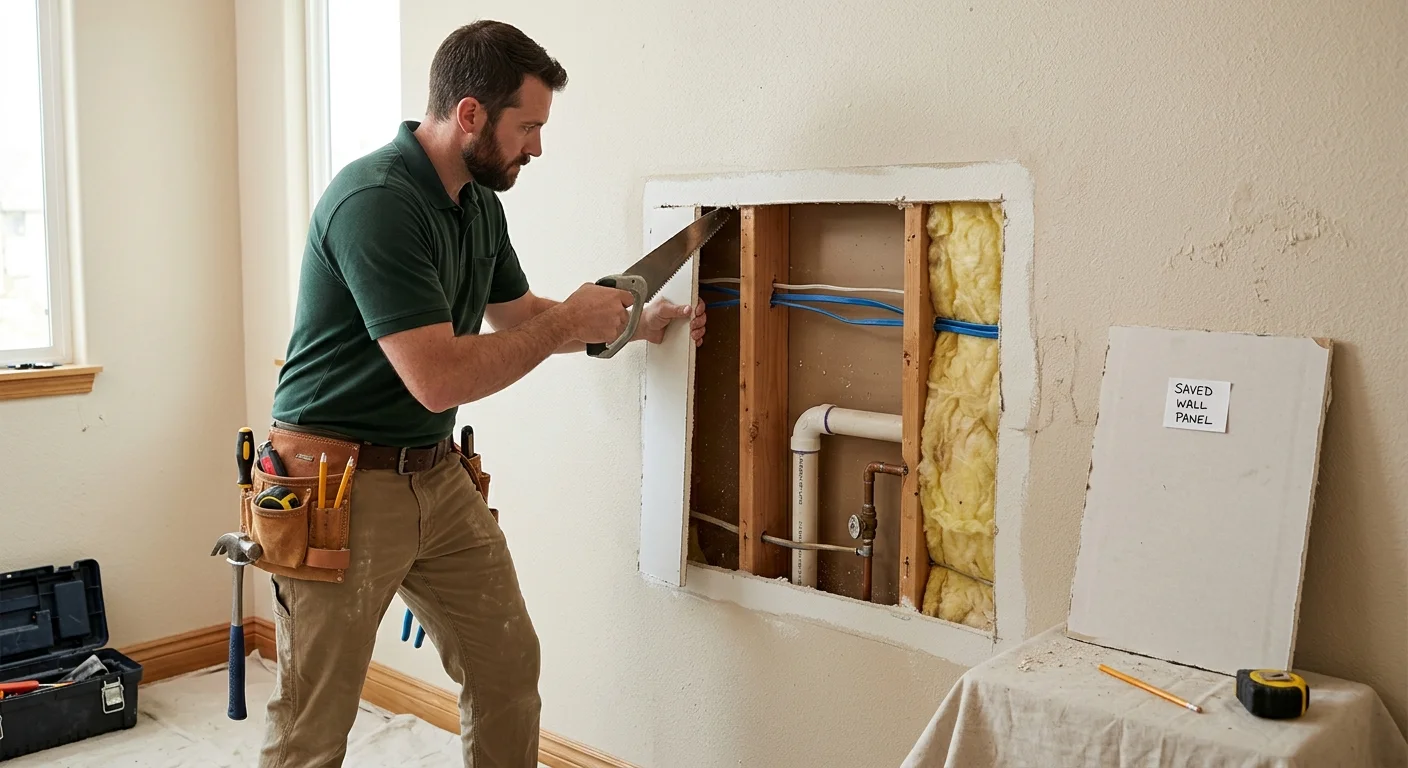
Keep any removed wall panel that remains available. Don’t clean off writing, tape, labels, or markings placed by the trade that opened the wall. Store separate pieces with the same room label used in your notes and photographs.
A saved panel can preserve visible information about the opening and finish. It may also show where the original cut was made. The repair professional should decide whether any saved piece belongs in the proposed scope.
Build a short photo set for each opening. Include the full room, the complete wall, the opening with nearby features, a straight-on close view, a texture close-up, and a measurement image. Add another image when the opposite side of the wall is relevant.
Wide photographs matter because close-ups remove context. A tight image may hide a nearby corner, cabinet, opening, or color transition. Send both views so the pro can understand the visible boundaries before discussing scope.
Use file names that match your written labels. “Bedroom north wall wide” communicates more than a camera-generated number. If there are several openings, place each group in its own folder.
Add a short note describing what isn’t known. Examples include “paint code unavailable,” “source-work completion not confirmed,” or “historic status not checked.” These aren’t failures. They tell the quoting professional which details still need confirmation.
When searching for “plaster and drywall repair near me,” send the same organized record to each candidate. Comparable information makes it easier to compare written scopes. Check whether each proposal identifies the openings, finish boundaries, exclusions, and any questions that must be resolved before wall closing.
When to call us
Hand the project to a pro when the opening is irregular, several finish boundaries are involved, or you want the patch, texture, and paint scope stated clearly. Fix Pro San Diego performs no drywall work itself and matches homeowners with licensed, independent local pros.
Call us at (858) 400-4611 and we’ll match you with a licensed, independent local pro.
Would you rather hand this one to a pro than do it yourself? Call (858) 400-4611.
Request a quote