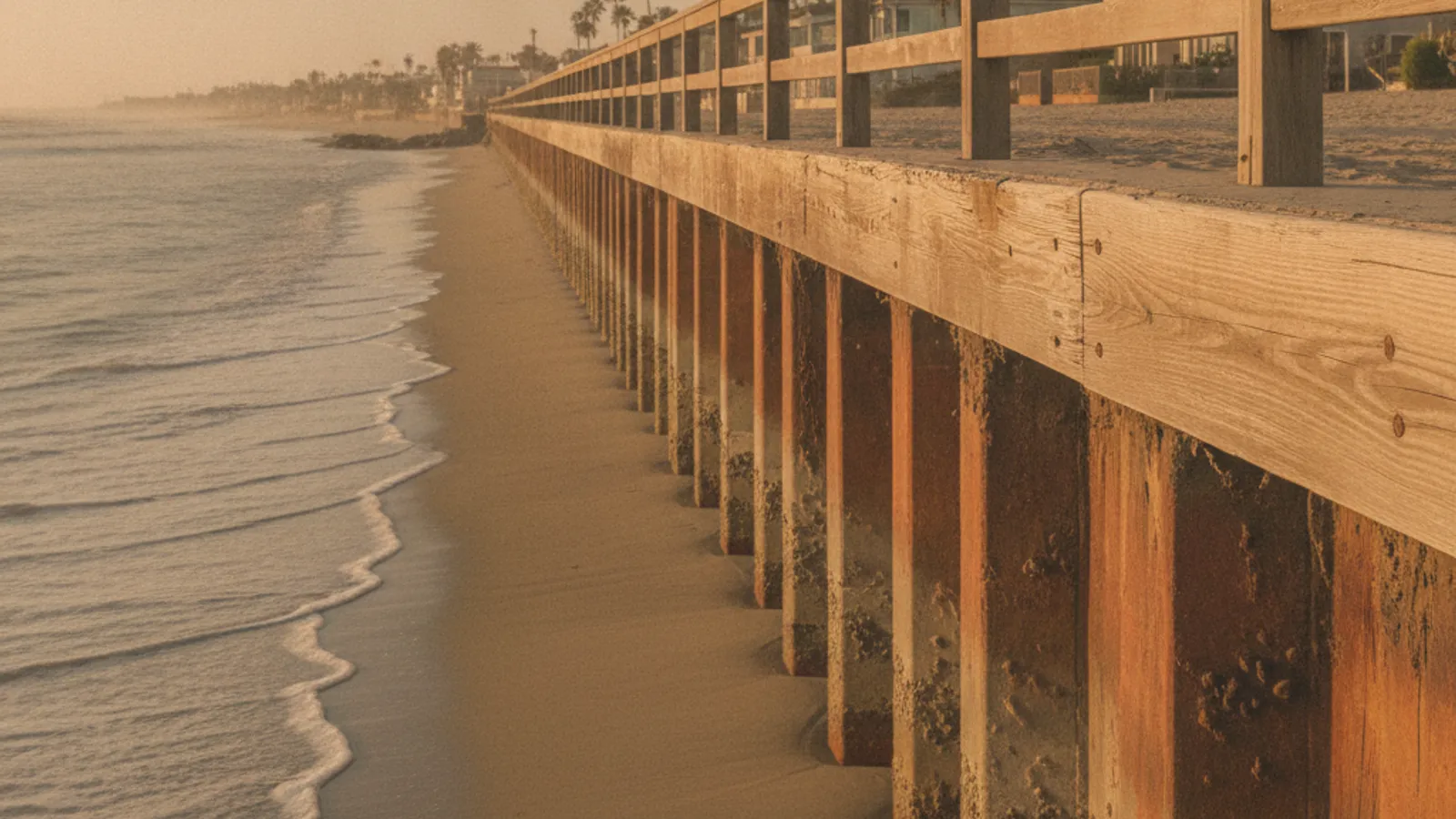
Seawall repair in San Diego usually runs $100 to $250 per linear foot, and a full residential job commonly lands between $15,000 and $60,000. But the more useful answer is who to call, because coastal walls fail in two very different ways. Real structural damage to a seawall or bulkhead is a licensed marine or structural contractor’s job, and along the open coast it needs a Coastal Development Permit. The smaller stuff, a rotted wood cap, a loose railing, a clogged drain, a hairline crack in a low garden wall, is honest handyman work. Knowing which one you’re looking at saves you thousands of dollars and weeks of waiting.
What seawall repair costs in San Diego
Cost depends on the material, the length of the wall, and how far the damage has gone. These are typical San Diego ranges for 2026.
| Scope of repair | Typical San Diego cost |
|---|---|
| Minor concrete crack or surface patch | $100 – $200 per linear foot |
| Wood or timber bulkhead repair | $150 – $500 per linear foot |
| Vinyl seawall repair | $150 – $300 per linear foot |
| Steel seawall repair | $200 – $450 per linear foot |
| Major structural repair or full replacement | $400 – $600 per linear foot |
| Full residential job, all in | $15,000 – $60,000 |
| Marine or structural engineer plans for a permit | $2,000 – $3,000 |
Wood is the cheapest to install but the first to go, since saltwater rots timber faster than anything else on the coast. Concrete and steel cost more up front and hold up longer. The single biggest swing in your bill is timing: a hairline crack caught early is a patch, while the same crack ignored for two winters becomes a structural rebuild.
Seawall or coastal retaining wall? They’re not the same job
The word people search for is usually “seawall,” but many San Diego homes are actually dealing with a coastal or hillside retaining wall, and the difference matters for both cost and who you hire.
A true seawall holds back the ocean and takes direct wave energy, so it’s engineered, permitted, and repaired by marine specialists. A retaining wall holds back soil on a slope, which describes a huge share of walls across our hilly county, from Point Loma down to the canyons inland. Retaining walls fail more gently and, at the small end, they’re often repairable without a full structural crew.
| Repair | Typical San Diego range |
|---|---|
| Small crack or a few replacement blocks | $200 – $1,000 |
| Drainage or minor structural repair | $220 – $1,200+ |
| Rebuilding a failed wall | $3,000 – $18,000+ |
Signs your seawall or retaining wall is failing
Catch these early and you’re looking at a repair, not a rebuild. Fixing a wall while its lean is still under two inches costs roughly 70% less than waiting until it’s leaning badly.
- Leaning or tilting. Any wall that’s moved more than a couple of inches is losing the fight against the load behind it.
- Bulging. An outward belly in the face means soil pressure is building where water can’t drain.
- Stair-step or horizontal cracks. These signal structural stress, not just cosmetic aging.
- Water seeping through the face, or white chalky deposits (efflorescence). Both point to a drainage problem behind the wall.
- Gaps opening between blocks, or soil washing out at the base.
Poor drainage is the number one cause of failure. Water builds up behind the wall, pushes outward, and the wall slowly gives. That’s also why some of the most valuable repairs are the cheapest ones.
When coastal wall repair is a handyman job, and when it isn’t
Here’s the honest line, and it’s the part most homeowners get wrong. A handyman can legally and safely handle the small, non-structural pieces. Anything load-bearing, leaning, or facing waves belongs to a licensed contractor.
| If the work is… | Who handles it | Why |
|---|---|---|
| A rotted wood cap board, loose top rail, or worn stair tread | Handyman | Small, non-structural, usually under California’s $500 rule |
| A clogged weep hole or missing drainage at the base | Handyman | The simplest fix, and the one that saves the whole wall |
| Resealing a cap or patching a hairline surface crack in a low garden wall | Handyman | Cosmetic and preventive, not holding back a load |
| A leaning, bulging, or cracked structural wall, or any seawall taking waves | Licensed structural or marine contractor | Safety-critical and over $500 by law |
| Shoreline armoring on the open coast | Marine contractor plus a Coastal Development Permit | Requires engineering and Coastal Commission review |
California draws its line at $500. Any single home-improvement project under $500 in combined labor and materials doesn’t need a state contractor’s license, which is exactly why a handyman can swap a rotted cap board or clear a drain without one. Once a project crosses that limit, or the moment it becomes structural, you need a licensed contractor. The handymen in the Fix Pro network handle the small, honest end of this work across all of San Diego County, from the coast to East County, and they’ll tell you plainly when a wall is past their scope. If you’re weighing that call, our handyman vs. general contractor comparison lays the line out clearly.
For the wood side of these repairs, a soft or crumbling cap board is almost always rot, and our guide to dry rot repair in San Diego covers how it spreads and what stops it. The same carpentry skills that fix a deck or a wood fence apply to the wood cap and railing on a coastal wall.
Do you need a permit to repair a seawall in San Diego?
For structural seawall work on the coast, yes. San Diego sits in California’s coastal zone, so shoreline armoring generally requires a Coastal Development Permit before work starts. Under the Coastal Act, seawalls are permitted mainly to protect structures that existed before January 1, 1977, and individual permit applications can be denied when the city favors a broader, community-scale adaptation plan. For bluff-top properties with short setbacks, sand mitigation fees alone can run from $50,000 to well over $200,000, since San Diego doubled that fee schedule in 2025.
Small, non-structural fixes usually don’t trigger any of this. Swapping a cap board, re-securing a railing, or clearing a drain is maintenance, not development. The rule of thumb: if the repair keeps the ocean out or holds back a load, expect a permit and an engineer. If it’s cosmetic or a simple drainage fix, it’s normal upkeep.
How to hire the right pro for coastal wall repair
Start by naming what you actually have. Take a photo of the wall, the cap, and the base, and note whether it’s holding back water, soil, or nothing structural at all. That one step tells you whether you’re calling a marine contractor, a structural contractor, or a handyman.
For the handyman-scope work, ask for a rough range over the phone, confirm they’ll flag anything that turns out to be structural, and bundle the small coastal fixes with the rest of your home’s punch list. Homeowners in Coronado, Oceanside, and La Jolla call most often for exactly this kind of cap, railing, and drainage work, and it’s some of the cheapest maintenance you can do on a coastal property.
Frequently asked questions
How much does seawall repair cost in San Diego?
Seawall repair typically runs $100 to $250 per linear foot, and a full residential job usually lands between $15,000 and $60,000. Concrete cracks start around $100 to $200 per foot, while major structural repairs or replacement can reach $400 to $600 per foot. Add $2,000 to $3,000 for engineer plans if the job needs a permit.
Can a handyman repair a seawall or retaining wall?
For the small, non-structural pieces, yes. A handyman can replace a rotted wood cap, re-secure a loose railing, clear a clogged drain, or patch a hairline crack in a low garden wall, work that usually falls under California’s $500 rule. Anything leaning, bulging, load-bearing, or taking direct waves needs a licensed structural or marine contractor.
Do I need a permit to repair a seawall in San Diego?
For structural coastal work, almost always. San Diego is in California’s coastal zone, so shoreline armoring generally requires a Coastal Development Permit and engineered plans before work begins. Small maintenance fixes like swapping a cap board or clearing a drain don’t typically require a permit.
What causes a retaining wall to fail?
Poor drainage is the leading cause. Water builds up behind the wall, creates pressure, and slowly pushes it outward until it leans, bulges, cracks, or collapses. That’s why adding or clearing drainage is often the highest-value repair you can make, and one of the least expensive.
How do I know if my wall problem is serious?
Look for movement. A wall leaning more than a couple of inches, bulging outward, or showing stair-step cracks is under real structural stress and needs a licensed pro. Hairline surface cracks, a worn cap, or a little seeping water are usually minor and handyman-scope, especially if you catch them early.
Not sure whether your coastal wall is a quick fix or a bigger job? The handymen in the Fix Pro network cover all of San Diego County and can handle the cap, railing, and drainage work, and point you to the right specialist when it’s structural. Call (858) 400-4611 for a free quote, or see everything we handle on our general repairs page and our carpentry and deck repair services.
Want a flat-rate quote for this instead of doing it yourself? Call (858) 400-4611.
Request a quote