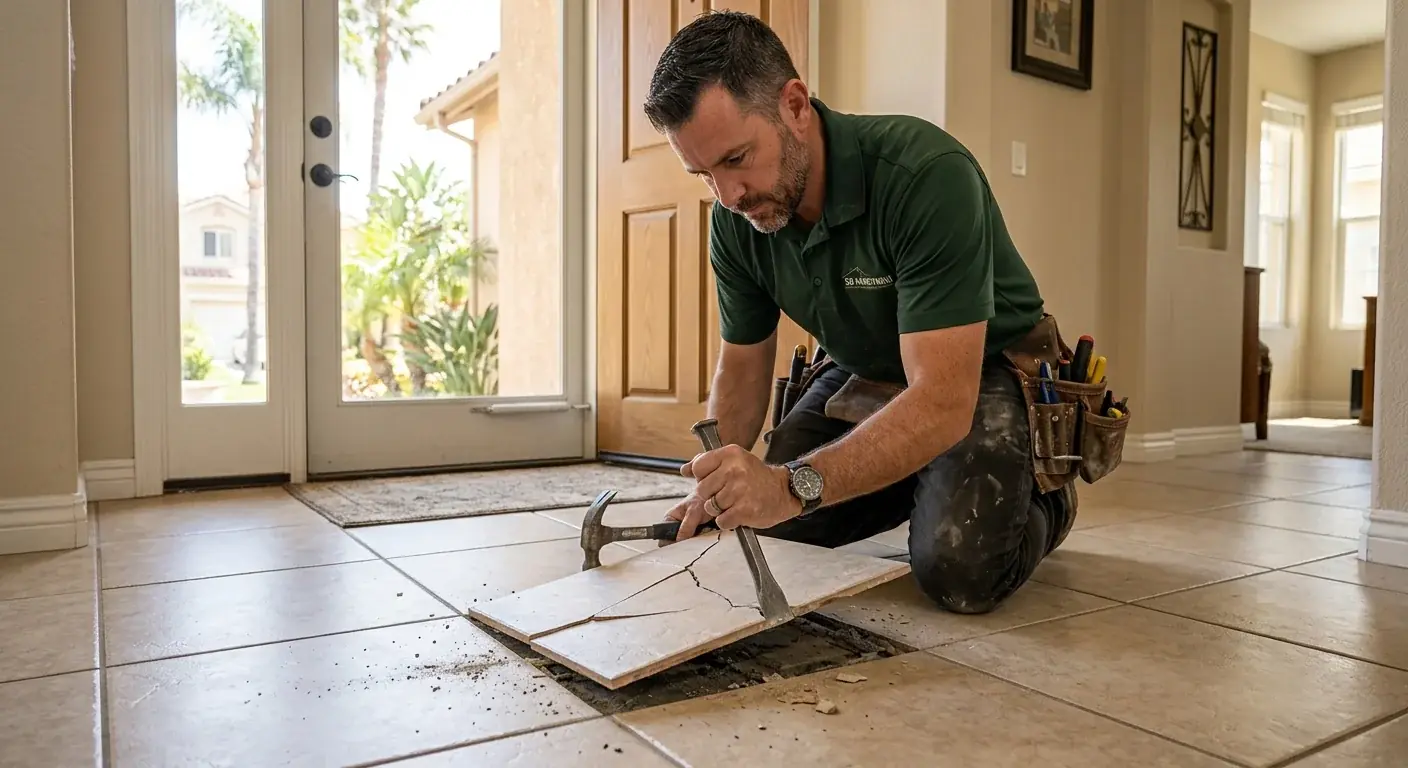
Discovering a cracked floor tile can be frustrating for any San Diego homeowner. Your first thought might be to just swap out that single broken piece. But sometimes, that cracked tile is a warning sign of a larger issue lurking beneath your floor. Understanding the cause helps you decide if a quick patch is enough, or if it’s time to consider a bigger project.
Why one tile cracked, and what it predicts
A single cracked tile often feels like bad luck, maybe a dropped pot or a heavy piece of furniture. While direct impact is a common cause, it’s not always the full story. Sometimes, a tile cracks due to underlying structural movement, improper installation, or even issues with the concrete slab itself. If the crack appears in a high-traffic area, or if you’ve had similar cracks before, it’s worth investigating further.
Understanding why a broken floor tile appeared can save you from repeat repairs. If the problem is simply isolated damage from an impact, a single tile replacement might be effective. However, if the crack stems from a shifting subfloor or an inadequate base, replacing just one tile is a temporary fix at best. The new tile will likely crack again in the same spot, wasting time and money. We see this often in older homes where original installation methods didn’t account for San Diego’s unique climate and soil conditions. Always consider the “why” before committing to the “how” of your cracked tile floor repair.
Hairline crack vs full break vs popped tile
Not all tile damage is created equal, and the type of damage can tell you a lot about its origin.
A hairline crack is typically thin and superficial. It might be due to minor stress, a small void in the thinset, or slight thermal expansion and contraction. While less alarming, multiple hairline cracks in different tiles could point to a larger subfloor issue.
A full break means the tile has completely fractured, often into multiple pieces. This usually indicates a direct, heavy impact, or significant pressure on the tile. However, a full break can also occur if there’s a major void in the thinset directly beneath the tile, leaving it unsupported and vulnerable to everyday foot traffic.
A popped tile, or a tile that has tented up or come loose, is a clear sign of adhesive failure or excessive movement. This can happen when the thinset didn’t bond correctly, due to moisture issues, or because the underlying substrate is expanding and contracting without proper isolation. Popped tiles are a strong indicator that the forces acting on your floor are more widespread than just one isolated spot. Each type of damage requires a different diagnostic approach to ensure a lasting repair.
Slab movement, missing isolation membranes, and SD’s clay soils
San Diego’s unique geology plays a major role in floor tile longevity. Many areas, particularly neighborhoods like Mira Mesa, Otay Mesa, and parts of Poway, are built on expansive clay soils. These soils absorb and release moisture, causing them to swell and shrink. This movement can put immense stress on your home’s concrete slab, leading to cracks. When a concrete slab cracks, that movement often telegraphs directly up through your tile, causing it to crack or pop.
Another common culprit is the absence of a crack-isolation membrane. This flexible layer is installed between the concrete slab and the thinset mortar. Its purpose is to absorb and neutralize minor slab movement, preventing those cracks from reaching your tile. Older homes often lack these membranes, leaving their tile floors vulnerable. If your tile cracked along a straight line, it’s very likely a slab crack beneath it. Replacing just the tile in these situations without addressing the slab or adding an isolation membrane is a temporary fix that will inevitably fail again. Addressing these foundational issues is crucial for any long-term tile repair solution.
Single-tile replacement: when it works
A single-tile replacement is the ideal solution when the damage is truly isolated and not indicative of a larger underlying issue. This often applies to cracks caused by a direct, heavy impact in an otherwise stable floor. The process involves carefully removing the damaged tile without harming its neighbors, cleaning out the old thinset and grout, applying new thinset, setting the new tile, and then regrouting.
For this fix to be successful, you need a stable, sound substrate underneath, and crucially, a matching replacement tile. If your floor has a good crack-isolation membrane and the slab isn’t moving, then an isolated incident like a dropped cast-iron pan is a prime candidate for a single-tile swap. This is a much less invasive and less costly procedure than redoing an entire floor, making it a popular choice for homeowners. It effectively fixes the immediate “broken floor tile fix” problem without escalating costs. Many homeowners also consider a light regrouting around the repair area to blend it in perfectly with the rest of the floor, giving it a refreshed look.
Color and lot-match problems with older tile
Finding a replacement tile that perfectly matches your existing floor is often the biggest hurdle in a single-tile repair, especially with older installations. Tile colors and glazes can vary significantly even within the same product line, depending on the manufacturing batch, or “lot.” What might have been a perfect match 10 or 15 years ago is now likely discontinued. Even if you find a tile with the same pattern or name, slight differences in shade, texture, or sheen can make a new tile stand out like a sore thumb.
Sunlight exposure and everyday wear also cause existing tiles to fade or subtly change color over time, making a new, unaged tile appear much brighter or darker. We’ve seen homeowners search hardware stores and specialty tile shops for weeks, only to find a tile that’s “close enough” but not truly invisible. If an exact match is critical for the aesthetic of your home, and you cannot find one, this alone might push you towards considering a larger section replacement or even a full floor overhaul, despite the higher tile floor crack repair cost. It’s a hard reality, but an important factor in your decision.
Cost: one-tile swap vs full floor replacement
The cost difference between replacing one cracked tile and installing an entirely new floor is substantial, but it’s important to weigh more than just the upfront price. A single-tile replacement is significantly less expensive, primarily covering labor for removal, setting, and grouting, plus the cost of one tile and materials. It’s a quick fix that often takes just a few hours.
A full floor replacement, on the other hand, is a major investment. It involves demolition of the old floor, extensive subfloor preparation (including addressing any slab cracks or adding crack-isolation membranes), the cost of new tiles for the entire area, thinset, grout, and significantly more labor. However, if the cause of your cracked tile is a widespread issue like slab movement or poor installation, a full replacement can be the more cost-effective solution in the long run. It prevents recurring damage and provides a durable, problem-free floor for years to come. Sometimes, fixing underlying general repairs is an opportunity to improve the overall resilience and value of your home. Always factor in the longevity of the repair when evaluating the cost.
When to call us
Deciding between a quick patch and a full floor replacement can be complex, especially when considering underlying issues like slab movement. If you’re unsure about the cause of your cracked tile, if matching tile seems impossible, or if you suspect deeper structural problems, it’s time to call in a professional handyman. A pro can diagnose the root cause and recommend the most effective, lasting solution for your San Diego home.
Call us at (858) 400-4611 and we’ll match you with a pro who can quote the job.
Would you rather hand this one to a pro than do it yourself? Call (858) 400-4611.
Request a quote