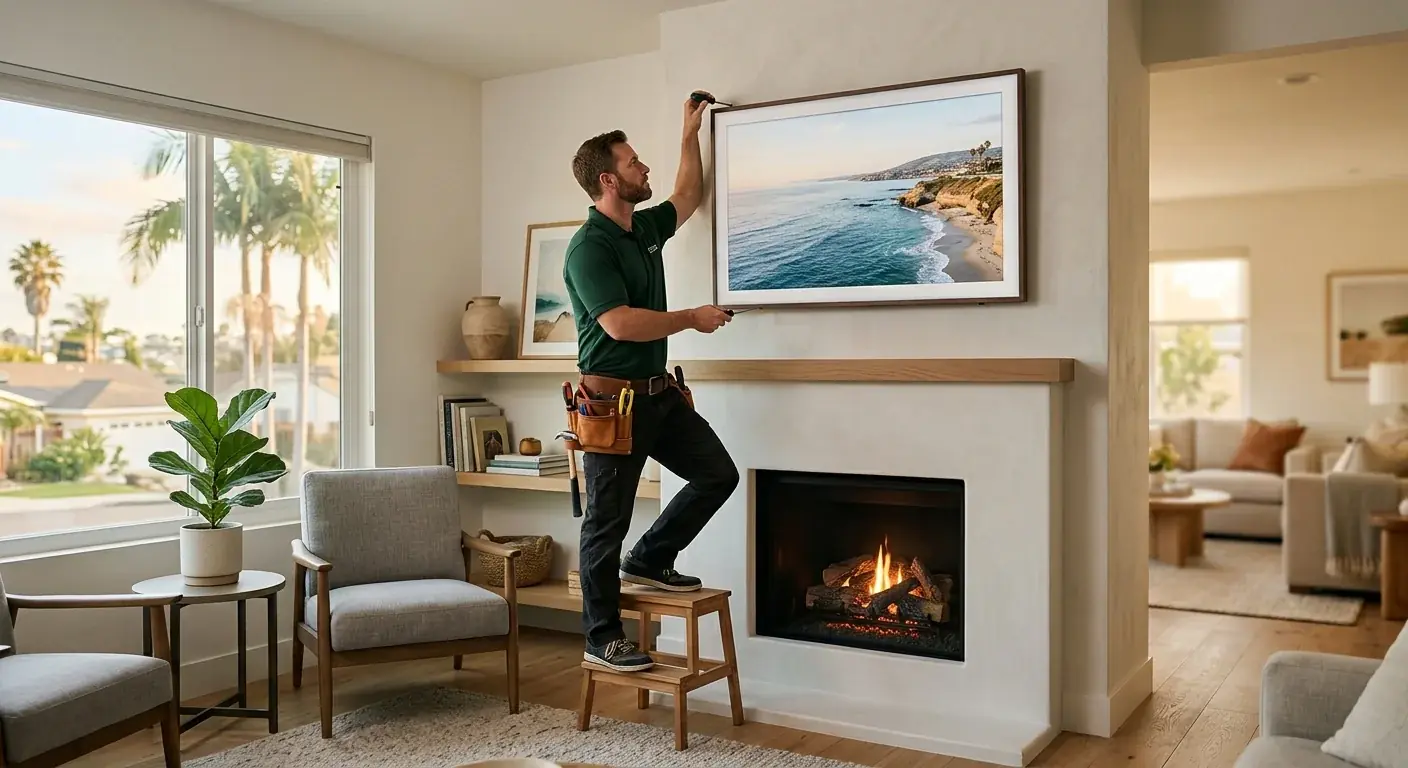
Mounting a TV above a fireplace offers a sleek, space-saving aesthetic that many San Diego homeowners love. It can become a natural focal point for your living room, especially when the fireplace is already a central feature. However, this popular choice comes with its own set of challenges, from ensuring your TV’s safety from heat to achieving a comfortable viewing angle and completely concealing those unsightly cables.
If you’re considering this setup for your home, it’s wise to understand the crucial factors involved before you start drilling. Proper planning prevents common pitfalls and ensures a professional, durable, and enjoyable installation.
The three things to check before mounting above a fireplace
Before you even pick up a drill or order a mount, you need to assess three fundamental aspects of your fireplace area. Skipping these preliminary checks can lead to serious issues, including potential TV damage, an uncomfortable viewing experience, or an unstable installation. We call these the “Big Three”: heat exposure, structural integrity for mounting, and ergonomic viewing height.
First, you must evaluate the heat generated by your fireplace and its potential impact on your TV’s electronics. Flat-screen TVs are sensitive to high temperatures, and excessive heat exposure can shorten their lifespan or even cause immediate damage. Second, you need to confirm that you have adequate, secure mounting points behind your fireplace’s finish, especially with common San Diego materials like stucco or stone veneer that can hide traditional stud locations. Finally, you have to consider the height. Most fireplaces sit quite high, which often means mounting the TV at a position that is simply too elevated for comfortable, long-term viewing. Addressing these three points upfront will guide your decision-making and help you achieve the best possible outcome.
Heat check: is it safe for your TV?
The biggest concern for any TV mounted above a fireplace is heat. Modern flat-screen TVs are designed to operate within specific temperature ranges, typically between 32°F and 100°F (0°C to 38°C). Exposing them to temperatures consistently above this can degrade internal components, leading to pixel issues, reduced lifespan, or even catastrophic failure.
Start by identifying your fireplace type. A gas fireplace generally produces less ambient heat than a wood-burning one. If you have a wood-burning fireplace, the heat generated can be significant, especially directly above the firebox opening. For either type, pay close attention to whether you have a mantel. A well-constructed mantel acts as a crucial heat deflector, redirecting hot air upwards and away from the TV. Without a mantel, your TV will be directly in the path of rising heat. You can use an infrared thermometer to measure the temperature on the wall where the TV would hang while the fireplace is running at its maximum typical heat. If the temperature consistently exceeds 90°F, you need to rethink the placement or consider additional heat shielding. Manufacturers typically recommend at least a 12-inch clearance above a mantel or 20-36 inches above the firebox opening itself, but always check your specific TV manual for exact heat tolerances and recommended clearances. Don’t risk damaging an expensive piece of electronics for a mounting aesthetic.
Finding studs behind stucco or stone veneer
San Diego homes often feature beautiful fireplaces clad in materials like stucco or stone veneer. While aesthetically pleasing, these finishes pose a unique challenge when it comes to finding secure mounting points for a heavy television. Traditional stud finders struggle with the density and uneven surfaces of these materials, often giving inaccurate readings or failing to detect studs at all. You can’t just drill into the veneer or stucco; you need to anchor your mount directly into the wood or metal studs behind the wall for safety and stability.
For stucco, the thickness of the material can overwhelm standard electronic stud finders. A strong magnetic stud finder can sometimes work better by detecting the nails or screws used to attach the lath and stucco. For stone veneer, the irregular surface makes accurate readings even more difficult. A common professional approach involves using small, exploratory drill bits. A handyman can carefully drill tiny pilot holes in discreet locations, such as grout lines for stone or along potential stud lines for stucco, to confirm the presence and exact center of a stud. Once located, these small holes are easily patched and hidden, particularly if they’re behind the TV’s footprint or within the finished surface. If you do need to make exploratory holes, remember that any damage to the wall might require some drywall repair to make it look perfect again. We’ve also detailed the specifics of TV mounting on stucco in San Diego in another guide. This careful, methodical approach ensures your TV mount is anchored securely, preventing any risk of it falling and causing damage or injury.
The right height (and why most people get it wrong)
One of the most common mistakes people make when mounting a TV above a fireplace is installing it too high. While it might seem like a logical place for your TV, the average fireplace mantel height often places the center of the screen well above a comfortable eye level when you’re seated. The ideal viewing height for a TV is typically when the middle of the screen is at your eye level, or slightly below it, when you’re sitting in your primary viewing position. This allows you to watch without craning your neck upwards, which can lead to discomfort, strain, and even chronic neck pain over time.
Think about how you watch TV. Most people are relaxing on a sofa or chair. If your eyes are constantly looking up, your neck muscles are working harder than they should. This ergonomic issue is often overlooked in favor of aesthetics. While a TV mounted high above a fireplace might look neat and tidy, a few hours of watching movies or sports will quickly highlight the discomfort. Before deciding on this placement, sit in your usual viewing spot and simulate where your eye line naturally falls on the wall. If it’s significantly below the planned TV location, you’re likely setting yourself up for neck strain. Understanding this common pitfall helps you consider alternative solutions or adjustments to ensure both visual appeal and comfortable viewing.
Wire concealment options: conduits and in-wall kits
Once your TV is securely mounted, the next critical step is concealing the wires. A clean, wire-free look is essential for a truly polished fireplace-mounted TV setup. Dangling cables not only look messy, but they can also be a safety hazard, especially in homes with pets or small children. There are a few effective options for wire concealment, each with its pros and cons.
The most common and aesthetically pleasing solution is to run the wires inside the wall. This typically involves cutting small access holes behind the TV and near an outlet closer to the floor. Specialized in-wall cable management kits and low-voltage pass-through plates are designed for this purpose, allowing HDMI cables, power cords, and other necessary wiring to travel discreetly within the wall cavity. This requires careful planning to ensure compliance with electrical codes, particularly for power cables, which often need to be within a rated conduit or connected via a recessed outlet kit. For those who prefer a simpler, less invasive option, external surface-mounted conduits can be painted to match your wall color. While not as invisible as in-wall concealment, they are a significant improvement over exposed wires. However, most San Diego homeowners prefer the clean look of hidden wiring, which is a standard part of our TV mounting services. Properly concealing wires transforms a functional installation into an integrated, elegant home entertainment feature.
When a pull-down mount is worth the cost
If you’re set on mounting your TV above the fireplace but are concerned about the uncomfortable viewing height, a pull-down or drop-down mount might be the perfect solution, even with its higher cost. These specialized mounts are designed to address the ergonomic issues inherent in high placements. A pull-down mount allows you to physically lower the TV from its fixed position above the fireplace to an eye-level viewing height when you want to watch. When you’re done, you can push it back up, restoring the clean, minimalist look above your mantel.
These mounts use a gas spring or counter-balance system, making the lowering and raising motion smooth and effortless. Many even swivel and tilt, offering full adjustability once the TV is pulled down. While standard mounts might cost under $100-$200, a high-quality pull-down mount can range from $300 to $600 or more. However, for those who frequently use their TV for extended periods, the investment is often well worth it. It eliminates neck strain, enhances comfort, and maintains the desired aesthetic when the TV isn’t in use. For larger, heavier TVs, or for families who want the best viewing experience without compromising their room’s design, a pull-down mount is a smart, long-term investment in your home comfort and enjoyment.
When to call us
Mounting a TV above a fireplace is more complex than a standard wall mount. Dealing with varied materials like stucco or stone veneer, ensuring heat safety, and expertly concealing wires requires specific tools and experience. If you want to ensure your TV is mounted safely, securely, and aesthetically pleasingly in your San Diego home, calling a professional handyman is your best bet. The pros we send handle all the complexities so you can just enjoy your new setup. Call us at (858) 400-4611 and we’ll match you with a pro who can quote the job.
Would you rather hand this one to a pro than do it yourself? Call (858) 400-4611.
Request a quote