The bathroom door in a Clairemont bungalow sags, the latch misses the strike, and one hinge leaf is bent. That can be a hardware job on a single hinge. It can also be a door and jamb job if the mortise is crushed or the screws no longer bite. Broken hinge repairs in San Diego start with that split, not with a guess.
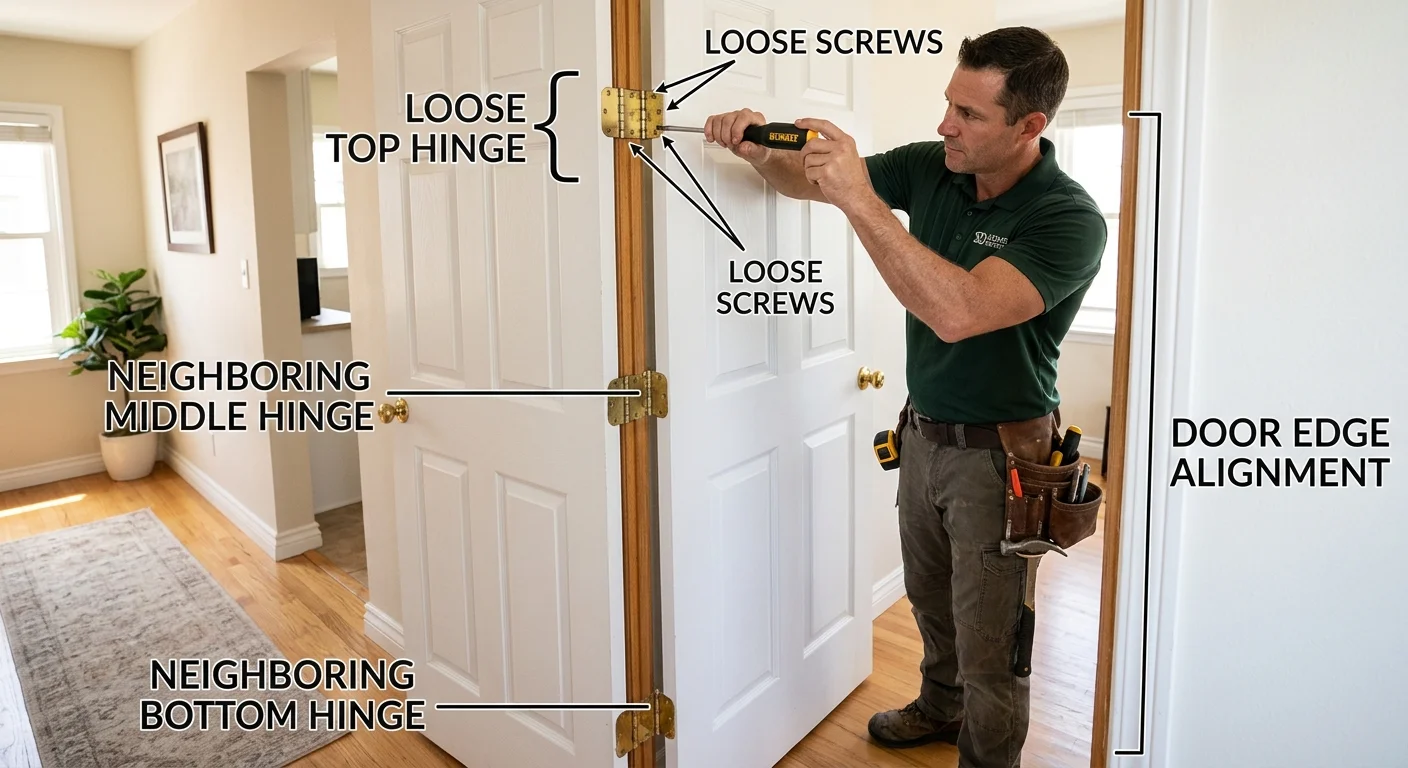
Record how the door hangs and moves
Before anyone talks about parts, stand at the opening and watch the door. Close it slowly. Open it to 90 degrees. Note whether it drops as it swings, binds at the head, or misses the latch. Write those motions down in plain words.
A dropped interior door in a 1960s Serra Mesa tract home often shows a wide gap at the top latch side and a tight gap at the bottom. That pattern can come from one failed top hinge. It can also come from a door that was planed years ago, a strike that was moved, or a jamb that shifted. Recording the hang first keeps those causes from mixing.
Coastal openings behave differently from inland ones. In Pacific Beach and Ocean Beach, exterior hinges sit in salt air and morning damp. The pin can wear. The leaf can rust at the knuckle. The door can drop even when the jamb is still sound. Inland in Escondido or El Cajon, wood dries and shrinks. Screws that once bit into a tight mortise can spin in a slightly larger hole. Same sag, different wood.
Check the latch last, not first. A miss at the strike is a result. It does not tell you which hinge failed. Look at the reveal around the door: the evenness of the gap at the head, latch side, and sill. A single-hinge failure usually shows as a local change at one corner. A whole-door problem shows as a consistent tilt from top to bottom.
If the door also sticks or rubs, keep that as a separate note. A sticking door and a door that rubs can share a sagging hinge, or they can come from humidity, flooring, or casing. Write which motion you saw and on which swing. Fix Pro San Diego matches you with independent local pros for this kind of door repair. The pro still has to see the opening.
Check each hinge, screw, and mortise
Work from the top hinge down. Most swinging doors in San Diego County use three hinges. Closet bifolds use a track and pivot set, so treat those as a different hardware family. For a standard passage or entry door, look at each leaf, each pin, and each screw.
A hinge leaf that is bent, cracked at a screw hole, or standing proud of the mortise is hardware damage. A pin that walks up as the door swings is hardware wear. A screw that turns forever and never snugs is a wood problem at that hole, not always a new hinge. Write which of those you found, hinge by hinge.
Look into the mortise, the pocket cut into the door edge and the jamb. Sharp, square corners with the leaf sitting flush usually mean the cut is still doing its job. Crushed grain, a leaf that rocks, or a mortise packed with toothpicks or filler from an old fix means the pocket itself is part of the repair. That is still often hinge work. It is no longer a simple leaf swap.
In older North Park, South Park, and Golden Hill houses, solid-wood doors and thicker jambs hold screws until the wood splits at the mortise. In many Clairemont, Linda Vista, and Chula Vista condos, hollow-core doors and thin pine jambs give out at the top hinge first. The screw pulls through the skin of the door. The leaf then tears that thin edge. That is still a hinge location, but the door edge may need a repair block before new hardware will hold.
On exterior doors in La Jolla, Point Loma, and Imperial Beach, check for rust at the knuckle and white salt crust on the screws. Coastal hardware fails at the metal as often as it fails at the wood. Matching the hinge size, corner radius, and overlay matters. A replacement leaf that does not sit in the existing mortise will stand proud and restart the sag. Do not strip every screw to test it. Note the ones that already spin. Leave the tight ones tight so the door stays on the jamb until a pro is there.
Compare one failed hinge with the rest
One broken hinge is a hardware job when the other hinges are doing their work. Compare them in place. If the middle and bottom hinges sit flush, hold the door, and show clean screw heads, the failed hinge is the outlier. If every hinge is loose, the door or the jamb is sharing the load badly.
Look at the pin line. On a sound door, the three knuckles stack in a straight vertical. A single bent leaf throws that line out at one point. A door that has warped, or a jamb that has moved, throws the whole line. You can see that from the room side without taking the door down.
Compare the screw patterns too. Factory holes that still match the leaf are a good sign. Extra holes, mixed screw lengths, and a leaf that has been moved up or down by a previous owner mean the hinge location has already been compromised. The next repair has to account for those holes, not ignore them.
A closet bifold in a Mission Valley apartment is a different comparison. Those doors hang from a track and a pivot, not from three butt hinges. A broken bifold hinge or a loose pivot is still hardware, but it is not the same as a passage-door leaf. Mixing those jobs in one request leads to a quote for the wrong opening.
When only the top hinge has failed, many San Diego interiors can stay in service with a matched replacement leaf, longer screws into solid wood, or a small mortise repair at that one pocket. When two hinges have failed, treat the door as a system. The remaining hinge is carrying weight it was not sized for. Asking for one hinge in that case understates the work.
This comparison is also how you keep the request distinct from a full door replacement. A cracked stile, a delaminated hollow core, or a door that no longer meets the stop is door work. A single tired leaf is not.
Separate hinge work from frame damage
Hinge work stops at the leaf, the pin, the screws, and the mortise. Frame damage starts when the jamb itself is split, the stop is crushed, or the opening is out of square in a way a new hinge cannot correct. Those are different scopes. They should not be described as the same job.
Stand back and look at the casing. A hairline at the miter is trim. A split that runs through the jamb at the top hinge, into the drywall, is frame. In stucco-walled houses from National City to Oceanside, the interior jamb can look fine while the rough opening has moved. You will not confirm that from a phone photo of the hinge. You can only flag it: the door hits high on the latch side, the reveal is uneven even with tight hinges, and the casing joints have opened.
City of San Diego Development Services publishes when door and window work needs a permit. For many single-family, duplex, and townhouse units, replacing a door in an unchanged opening does not require a building permit, except on designated historic resources or in historic districts. Hinge replacement is component work. If the job grows into a new opening, a fire-rated door change, or work on a historic property, confirm the current rule with the city before anyone cuts.
California’s contractor rules are separate from the permit desk. Under Business and Professions Code section 7048, casual, minor work under $1,000 in labor, materials, and all other items can be exempt from licensing when no permit is required and the other conditions of that section are met. Price alone does not make a job legal. Work that needs a permit, uses employee labor, or is part of a larger operation is treated differently. Check a license on the CSLB site before you hire.
Do not assume a sagging door means the frame has settled. East County slabs and coastal fill lots both move, but that is a claim you cannot prove from a hinge photo. Record what you can see. Leave concealed movement for the person standing in the opening. If the casing is the only damaged piece, that is trim, not a new door.
Photograph the opening before requesting repair
Photos help a matched pro see the opening before a visit. They do not replace a visit. They also do not prove that a hidden frame has moved. Shoot what is on the surface, then stop.
Take one wide shot of the whole door, closed, with the surrounding wall in the frame. Take a second wide shot with the door open to 90 degrees so the hinge side is visible. Then shoot each hinge close: leaf, screws, mortise edge, and the matching leaf on the jamb. Include a shot of the latch and strike. Include a shot of the gap at the head and at the sill.
On a phone, daylight from the room is enough. Avoid heavy flash that flattens the reveal. If the door is on a west-facing wall in Point Loma or Carlsbad, wait until the sun is off the face so the gap is readable. Label the files: top hinge, middle hinge, bottom hinge, latch, head gap. Write one sentence for each. “Top hinge leaf bent, two screws spinning, middle and bottom hinges tight” is more useful than a dozen similar close-ups.
If you already have a punch list for other openings, keep this door on its own line. A hinge job on a hall door is not the same as a slider, a screen, or an attic hatch. Mixing them hides the real scope. For how those photos get used in a quote, see photographing home repairs before quotes.
When you ask about door repair cost in San Diego, send the hang notes, the hinge-by-hinge comparison, and those photos. Ask the pro to say whether the work is one hinge, several hinges, a door-edge repair, or a jamb repair. That answer is the job. Everything else is a later decision.
When to call us
A spinning screw and a bent leaf are worth handing to a pro when the door hangs on those hinges, the mortise is blown, or you cannot tell hinge work from jamb damage. Call us at (858) 400-4611 and we’ll match you with a local pro who quotes the job before starting. Fix Pro San Diego is a referral service. The independent pro you are matched with does the repair and quotes that scope.
Would you rather hand this one to a pro than do it yourself? Call (858) 400-4611.
Request a quote