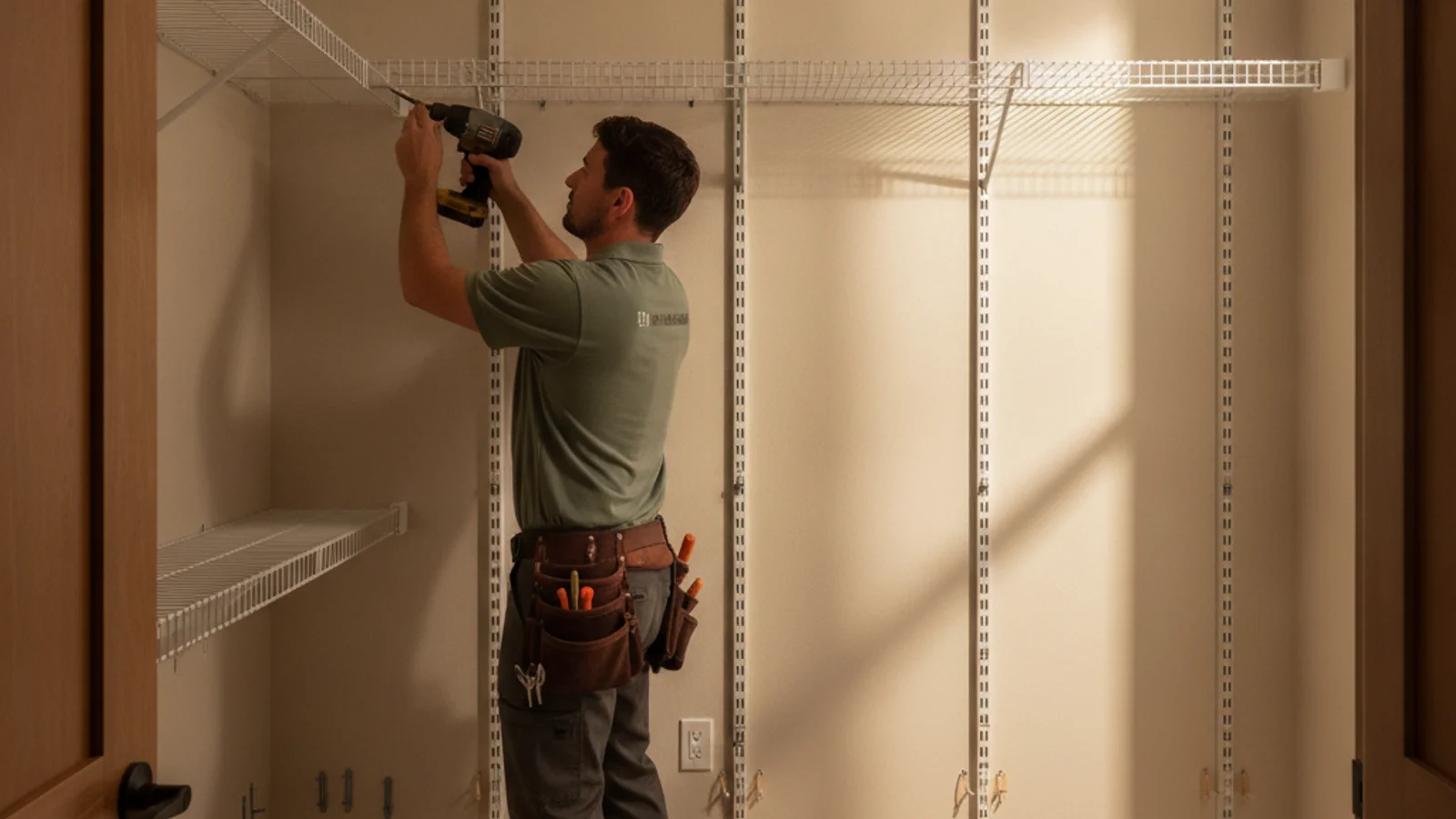
Closet organizer installation in San Diego typically runs $150 to $400 for a wire shelving system in a standard reach-in closet. Custom wood or melamine systems, and anything sized for a walk-in closet, cost more depending on the design. What actually determines whether your install goes smoothly, though, is what’s behind the drywall, and older San Diego homes have more variation there than most homeowners expect.
Wire systems vs. custom builds
Wire shelving is the most common closet upgrade because it’s affordable, adjustable, and fast to install. A standard reach-in closet, typically five to eight feet wide, runs $150 to $400 installed for a full wire system with shelving, hanging rods, and shoe racks. These systems come in modular pieces that get cut and mounted to fit your exact closet dimensions.
Custom wood or melamine systems cost more, both in materials and install time, since they involve precise cutting, finished panels, and often drawers or built-in hampers. Walk-in closets push the price up further simply because there’s more square footage to fill, more wall runs to mount to, and often a mix of shelving heights and configurations on different walls. If you’re planning a full walk-in redesign, it’s worth treating it as a small carpentry project rather than a quick shelving swap, since the design work alone takes real planning time before installation even starts.
What’s actually behind your closet wall matters
This is the part most closet organizer guides skip, and it’s the biggest cost variable in San Diego specifically. Wire and wood shelving systems both rely on solid anchoring into wall studs to hold real weight, especially once the closet is loaded with clothes, shoes, and storage bins.
Homes built from roughly the 1980s forward typically have standard drywall over wood studs, which is straightforward to anchor into with a stud finder and the right screws. Older San Diego homes, particularly those built before the 1970s, often have stucco exteriors with a lath and plaster interior wall system instead of drywall, or a mix of both depending on which addition or remodel touched that room last. Lath and plaster is harder to anchor into than drywall, since the lath strips sit behind a layer of hardened plaster that doesn’t take a standard drywall anchor well.
Before any shelving goes up, a proper install locates the actual stud lines, not just where a stud finder pings through plaster, since plaster’s density can throw off cheaper stud finders. Getting this step wrong is how a wire shelving system ends up pulling out of the wall six months later under a normal load of hanging clothes.
What’s involved in a proper installation
A closet organizer install is more than snapping shelves onto brackets. A full job typically covers:
- Measuring the closet accurately, accounting for any uneven walls or corners common in older homes.
- Locating studs or the correct plaster anchoring points for the wall type.
- Installing the top track or ledger board level and secure, since everything else hangs off this line.
- Mounting vertical supports, shelving, and hanging rods according to the planned layout.
- Adding shoe racks, drawers, or accessories if the system includes them.
- Testing the full system under load before calling the job done.
This kind of work overlaps with general carpentry, especially for custom builds, and it’s worth pairing with a broader look at general repairs if your closet has other issues, like a door that doesn’t close right or trim that needs attention while the closet is already torn apart for the install.
DIY vs. calling a pro
A basic wire shelving kit in a standard drywall closet is a reasonable weekend DIY project if you’re comfortable with a stud finder, a level, and a drill. Most big-box wire systems come with straightforward instructions built around drywall over wood studs.
The calculation changes if your home has plaster or lath walls, uneven stucco framing, or if you’re installing a custom system with multiple configurations. Misjudging stud locations in plaster walls is a common DIY mistake that only shows up once the closet is fully loaded and something starts pulling loose. Custom wood systems also require more precise measuring and cutting than most homeowners have the tools or time for. If your home is older, or the project is a full walk-in redesign, it’s worth having someone experienced handle the anchoring at minimum, even if you’re comfortable doing the rest.
Frequently asked questions
How much does a basic wire closet system cost installed?
For a standard reach-in closet, wire shelving installation typically runs $150 to $400, depending on the closet size and how many components the system includes.
Why do custom closet systems cost more than wire shelving?
Custom wood or melamine systems require precise cutting, finished panel work, and often additional features like drawers or built-in hampers. That extra material and labor time pushes the cost above a standard wire system.
Does my home’s wall type affect the installation cost?
Yes. Homes with plaster and lath walls, common in older San Diego construction, take more time and care to anchor into properly than standard drywall over wood studs. That added labor can affect the final cost.
Can I install a wire closet system myself?
If your closet has standard drywall walls, yes, most wire shelving kits are designed for a confident DIYer with basic tools. If your home has plaster walls or you’re installing a custom system, it’s worth having a pro handle at least the anchoring.
Ready to get your closet organized right the first time? Call Fix Pro San Diego at (858) 400-4611 and we’ll scope your closet before we show up with the right anchors for your walls.
Want a flat-rate quote for this instead of doing it yourself? Call (858) 400-4611.
Request a quote