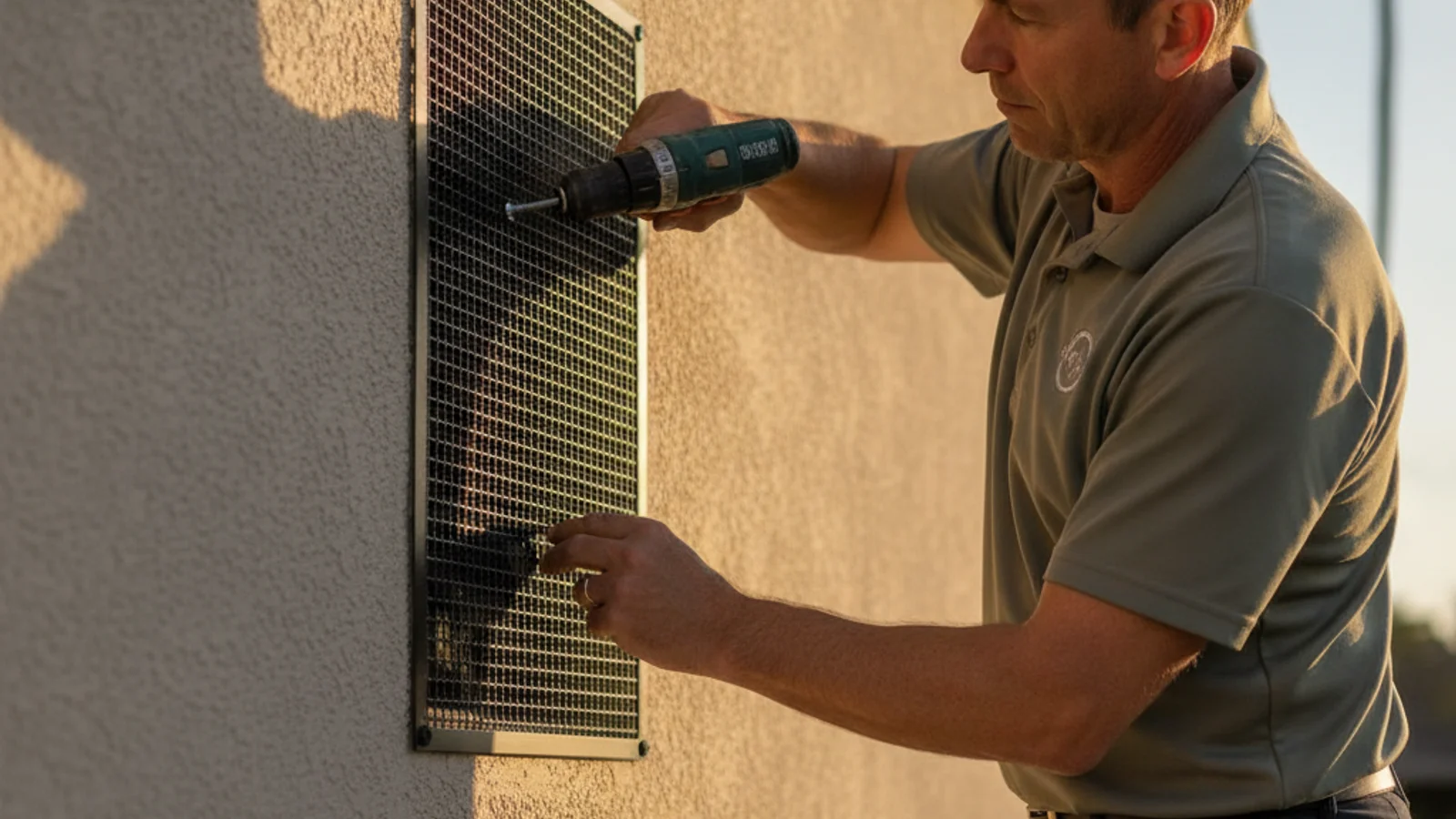
Wind-driven embers, not direct flame contact, cause most home losses in California wildfires. Replacing standard attic and crawlspace vents with ember-resistant vents is one of the most affordable defensive upgrades a San Diego homeowner can make, and it is genuinely handyman-scale work. This guide covers what ember-resistant vent installation actually involves, what a small hardening package includes, and where it stops being a handyman job.
Why embers matter more than flames
Most homes lost in California wildfires do not burn because a wall of flame reaches them directly. They ignite because wind carries burning embers ahead of the fire front, sometimes over a mile, and those embers find a way into the structure through vents, gaps, and combustible material touching the house. CAL FIRE’s home hardening guidance treats ember intrusion as the primary threat to address first, ahead of larger and more expensive defensive measures. Attic vents, foundation vents, and crawlspace vents are common entry points because they are built to let air move, and standard vents use a mesh size too coarse to stop embers.
The California Building Code addresses this directly. Chapter 7A sets construction standards for buildings in designated wildfire hazard areas, including requirements for ember and flame resistant vents on new construction and major remodels. Existing homes are not always required to retrofit, but the same physics apply whether the code mandates it or not. An ember that gets into your attic can smolder for a while before anyone notices.
Which San Diego communities sit in higher fire risk zones
A large share of San Diego County falls inside a Wildland Urban Interface area or a state or local Fire Hazard Severity Zone. The Backcountry and East County carry the heaviest exposure, communities like Alpine, Descanso, and Julian sit close to open wildland with limited road access. North County’s inland communities, Ramona and Valley Center among them, share similar terrain and vegetation risk. Even suburban pockets closer to the coast, Scripps Ranch is a well-known example after the 2003 Cedar Fire, can sit adjacent to canyons and open space that carry real fire exposure.
If your home is in Ramona, Alpine, or Scripps Ranch, hardening work is not a theoretical upgrade. It is a practical response to the terrain you already live next to.
What an ember-resistant vent actually is
A standard attic or foundation vent uses a wide mesh screen, mostly intended to keep out birds and rodents. That mesh does nothing against embers, which can be smaller than a fingernail and still ignite dry material on the other side. Ember-resistant vents use a much finer mesh, commonly 1/8 inch or smaller, or a WUI-listed vent assembly tested specifically to block ember and flame intrusion under wind pressure. Some models close off automatically at high heat.
Swapping a standard vent for an ember-resistant one is straightforward carpentry and fastening work in most cases, removing trim, fitting the new vent body, resealing the edges. It does not usually require rerouting ductwork or touching structural framing.
What a handyman-scale hardening package covers
A realistic small hardening package from a handyman company runs roughly $1,500 to $4,500, well below the $20,000 and up full hardening packages that roofing and general contracting companies sell for whole-house retrofits. At the handyman scale, the work typically includes replacing attic and foundation vents with ember-resistant models, sealing gaps around eaves, soffits, and utility penetrations where embers can collect using proper caulking and sealing methods, weatherstripping doors and windows that have wide enough gaps to let embers or heat through, and touching up or replacing weathered exterior wood trim that has become dry and more combustible over time, work that overlaps with general deck repair and exterior general repairs.
This is the kind of work a homeowner can schedule in a single visit or two, without a permit in most cases, since it is largely maintenance and component replacement rather than structural change.
What this package does not cover
Being honest about the limits of handyman-scale work matters here. A vent swap and a sealing pass will not turn a home into a fully hardened structure. Full hardening typically includes a Class A fire-rated roof, non-combustible or ignition-resistant siding, dual-pane tempered windows, and enclosed eaves, all of which require licensed roofing, siding, or general contracting work and often permits. Defensible space clearing, the vegetation management around your home that CAL FIRE also recommends, is landscaping and brush removal work, not handyman work.
A handyman-scale hardening package is a meaningful, affordable first step. It is not a substitute for a full retrofit if your home sits directly against wildland in a high-severity zone. Anyone selling a complete hardening solution at handyman pricing is not being straight with you.
How to know if your home needs this work
Older homes built before ember-resistant vent requirements became common are the most likely candidates. If you can see daylight or a coarse mesh screen through your attic or foundation vents, that is a visible sign the vent is not ember-rated. Homes in a designated Fire Hazard Severity Zone, which you can check through CAL FIRE’s public zone maps, carry the strongest case for prioritizing this work sooner rather than later.
If you are unsure what your home currently has, a walk-through with someone who does this work regularly is worth the time before fire season builds. Call Fix Pro San Diego at (858) 400-4611 to schedule a look.
Frequently asked questions
Are ember-resistant vents required by law on my existing home?
California Building Code Chapter 7A sets ember and flame resistant vent standards mainly for new construction and major remodels in designated wildfire hazard areas. Existing homes are not always legally required to retrofit, though CAL FIRE recommends it as one of the highest-value hardening steps available.
How much does ember-resistant vent installation cost in San Diego?
A handyman-scale package covering vent replacement plus small hardening upgrades like sealing and weatherstripping typically runs $1,500 to $4,500, depending on the number of vents and the condition of the home. Full-house hardening with roofing and siding work costs significantly more.
Does this work require a permit?
Straightforward vent replacement and sealing work generally does not require a permit since it does not touch structural framing. Larger hardening work involving roofing, siding, or window replacement often does. Confirm with the applicable building department for your address before starting anything beyond vent and sealing work.
Is defensible space clearing part of this service?
No. Defensible space, the vegetation clearing and fuel reduction around a home that CAL FIRE recommends, is landscaping work, not handyman work. Vent and sealing upgrades address ember entry into the structure itself, a separate part of the overall hardening picture.
Want a flat-rate quote for this instead of doing it yourself? Call (858) 400-4611.
Request a quote