The short answer on what makes a floating shelf safe: stud-mounted brackets hold 50 to 80 lbs per shelf; drywall anchors hold 15 to 25 lbs, and that ceiling drops fast if you load them unevenly. Most installation failures happen not because the hardware is bad, but because someone put a 40-lb book collection on a wall they thought was drywall but was actually plaster, or used toggle bolts where the spacing didn’t line up with a stud. Here’s how to do it right in a San Diego home.
How floating shelves actually work
A floating shelf hides its support hardware inside the shelf itself. The two main systems are:
Hidden bracket rods: steel rods extend from a wall-mounted plate into pre-drilled holes in the back of the shelf. The shelf slides on, and nothing is visible from the side. These are strong when the plate hits studs, but if the rods don’t align perfectly with the holes, the shelf rocks.
Keyhole or cleat systems: the shelf has a recessed channel or keyhole slots on the back that hook over wall-mounted screws or a rail. Easier to level but more visible if the gap between shelf and wall widens over time.
Both systems transfer the load back to whatever the screws are anchored into. That’s where wall type matters.
San Diego walls: what you’re actually drilling into
This is where national “how to install floating shelves” guides fall short. They assume 1/2-inch drywall over studs at 16-inch centers. San Diego homes built between the 1950s and mid-1970s often have something different.
Plaster over gypsum lath: common in central neighborhoods like North Park, University Heights, and South Park. The wall feels rock-hard when you tap it. Standard drywall screws won’t bite the way you expect. Stud finders give inconsistent readings because the plaster density throws off the sensor. You need to find studs mechanically (more on that below), and you need a pilot hole before running any screw.
Stucco used as an interior accent wall: less common but not rare in mid-century homes and some 1980s renovations, particularly in the kitchen or near a fireplace surround. Stucco is masonry. A regular drill skates on it. You need a hammer drill and a masonry bit just to get through the surface, and you still need to reach wood or use masonry anchors rated for the load.
Tile backsplash in kitchens: mounting shelves above a kitchen counter where there’s existing tile means drilling through ceramic or porcelain without cracking it. This requires a diamond-tip drill bit, slow speed, no hammer mode, and usually a water cooling trick. One wrong move chips the tile face.
Standard drywall in post-1980 construction: most homes in Rancho Bernardo, Carmel Valley, Santee, and newer neighborhoods. The most straightforward situation. Use a stud finder, hit the stud, done.
Finding studs in plaster
Electronic stud finders struggle with plaster because the material itself registers as a false positive. Three methods that work better:
Rare-earth magnet: drywall screws and nails sit inside the plaster and hit the stud beneath. A strong magnet dragged slowly across the wall will catch on them. Mark those spots, then measure 16 inches in each direction to find the stud pattern. This is the same technique that works well for TV mounting on older San Diego walls.
Sounding: knock your knuckle across the wall in a horizontal line. Over a stud the sound shifts from hollow to slightly dull. It takes a few tries to hear the difference, but once you’ve found it once you’ll recognize it.
Small test hole: drill a 1/8-inch exploratory hole angled slightly sideways. If you hit resistance at 1 to 1.5 inches, that’s stud. If you go through empty air, you’re between studs. Patch the test hole with spackle after.
Weight limits: the honest table
| Mounting situation | Right anchor | Realistic weight capacity |
|---|---|---|
| Two studs, hidden rod bracket | 3-inch wood screws, 2 per stud | 50-80 lbs |
| One stud, one drywall anchor | 3-inch screw + 50-lb toggle bolt | 25-40 lbs |
| Drywall only, no studs accessible | 50-lb toggle bolts or Toggler Snapskru | 15-25 lbs total |
| Plaster wall, studs found | 3.5-inch coarse-thread screws | 40-70 lbs |
| Plaster wall, no studs | Plaster anchors (Zip-It style) | 10-15 lbs, decorative only |
| Masonry or stucco wall | Tapcon screws or sleeve anchors | 30-50 lbs with correct bit |
The failure mode most people don’t expect: anchors rated at 50 lbs each will still fail early if the load is off-center. A stack of books pushed to one end of a shelf creates a lever. That multiplies the force on the anchor nearest the load. Rating the system at its peak is optimistic. Design for 60 to 70 percent of the rated max if you’re loading shelves with books or dishware.
Level: torpedo vs laser
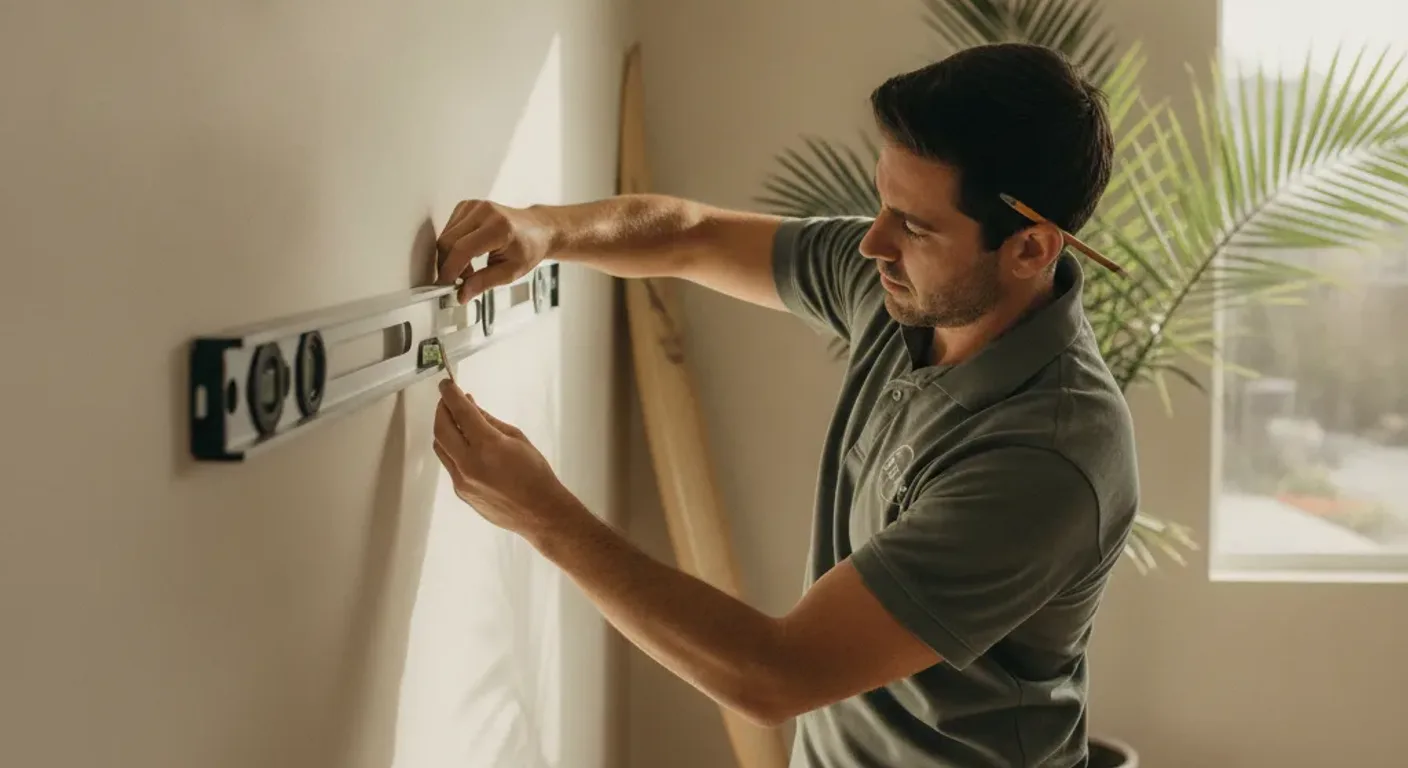
A torpedo level works fine for a single shelf. Hold it against the bracket, adjust until the bubble centers, mark your holes.
A laser level is worth using when you’re running a row of shelves across a wall or installing a gallery-wall arrangement. It projects a reference line across the entire wall so every bracket lands at the same height without remeasuring each time. For anything more than two shelves, it saves rework.
Heavy-duty options when you need real weight capacity
For bookshelves, wine storage, or kitchen shelves holding dishes, you want more than standard hidden rods.
Floating shelf with steel ledger: a horizontal steel tube bolts directly to studs, and the shelf slides over it. Used in commercial installations and increasingly popular for industrial-style home shelving. Can hold 100 lbs or more when properly anchored.
Blocking in the wall: the cleanest long-term solution for a kitchen or pantry shelf wall. A carpenter opens the drywall, installs a horizontal 2x6 or plywood backing between studs, and re-patches. Every anchor from that point forward hits solid wood, not just framing. It’s more work upfront but eliminates load concerns permanently.
French cleat system: two beveled strips of plywood, one on the wall and one on the shelf back, that interlock at a 45-degree angle. Extremely strong, easily adjustable. Not truly floating (the cleat is visible), but load capacity is exceptional.
When to call a handyman instead of DIYing it
Some floating shelf jobs are straightforward: drywall walls, visible stud lines, standard bracket kit. But call us for these situations:
Tile drilling in a kitchen or bathroom: one cracked tile costs more to fix than the shelf installation. Diamond bits and slow drilling technique matter here.
Plaster walls where the stud location is uncertain: probing blind and plugging the wrong anchors into plaster is a mess. Better to have someone who’s done it a hundred times find the stud pattern first.
Gallery walls with multiple shelves: getting six or eight shelves level with each other across an entire wall, especially in an older home where the ceiling line isn’t perfectly straight, takes patience and a laser level. A professional does this in one visit.
Long spans over 48 inches: a single shelf longer than 4 feet will bow under weight unless there’s a center support or the shelf material is thick enough (1.5 inches minimum for solid wood). Getting the bracket spacing right and ensuring every anchor hits a stud takes more planning than most DIY guides cover.
If you’re dealing with a stucco accent wall, tile backsplash, or plaster and you’re not confident in the anchor plan, our carpentry services include shelf installation, and the pro will assess the wall before drilling anything.
Frequently asked questions
How much does floating shelf installation cost in San Diego?
A handyman typically charges $75 to $200 to install a floating shelf, depending on wall type and how many brackets are involved. Tile or plaster walls cost more because of the additional care required. Materials (brackets, shelves) are separate.
Can drywall anchors really hold a shelf?
They can hold light loads. Toggle bolts rated at 50 lbs each will support decorative items and small plants without issue. Where anchors fail is under heavy or uneven loading: a full row of cookbooks on a shelf with three anchor-only brackets will eventually pull. If you’re mounting over a couch or a dining table, stud mounting is worth finding.
How do I find studs in a plaster wall?
A strong rare-earth magnet dragged slowly across the wall will catch on the drywall screws or nails inside the plaster. Mark the spot, measure 16 inches in either direction, and you’ll have the stud pattern. Electronic finders work less reliably in plaster.
What shelf bracket system holds the most weight?
Stud-mounted hidden rod brackets with 3-inch screws into two studs are the strongest standard option, rated for 50 to 80 lbs per shelf. For heavier loads, a steel floating ledger tube or a French cleat with plywood blocking will outperform any standard bracket kit.
What happens if I drill into tile to mount a shelf?
Without a diamond-tip bit and low speed, you’ll chip or crack the tile. If the tile cracks, replacing a single tile in an existing backsplash often means no available match, which turns a shelf install into a full backsplash section repair. The pros in our network handle tile drilling, or you can read more about tile work in our drywall repair services for when things go sideways.
Do I need to patch the wall if the anchors fail?
Yes. A pulled toggle bolt leaves a hole that’s usually too big for spackle alone and may need a proper drywall patch. If that’s where you are, our guide on how to patch a drywall hole walks through the repair, or the pro can handle it as part of the same visit.
If your wall type has you second-guessing the plan, call (858) 400-4611 [tel:+18584004611] and we’ll match you with a pro who can assess it and quote the job before touching anything.
Would you rather hand this one to a pro than do it yourself? Call (858) 400-4611.
Request a quote