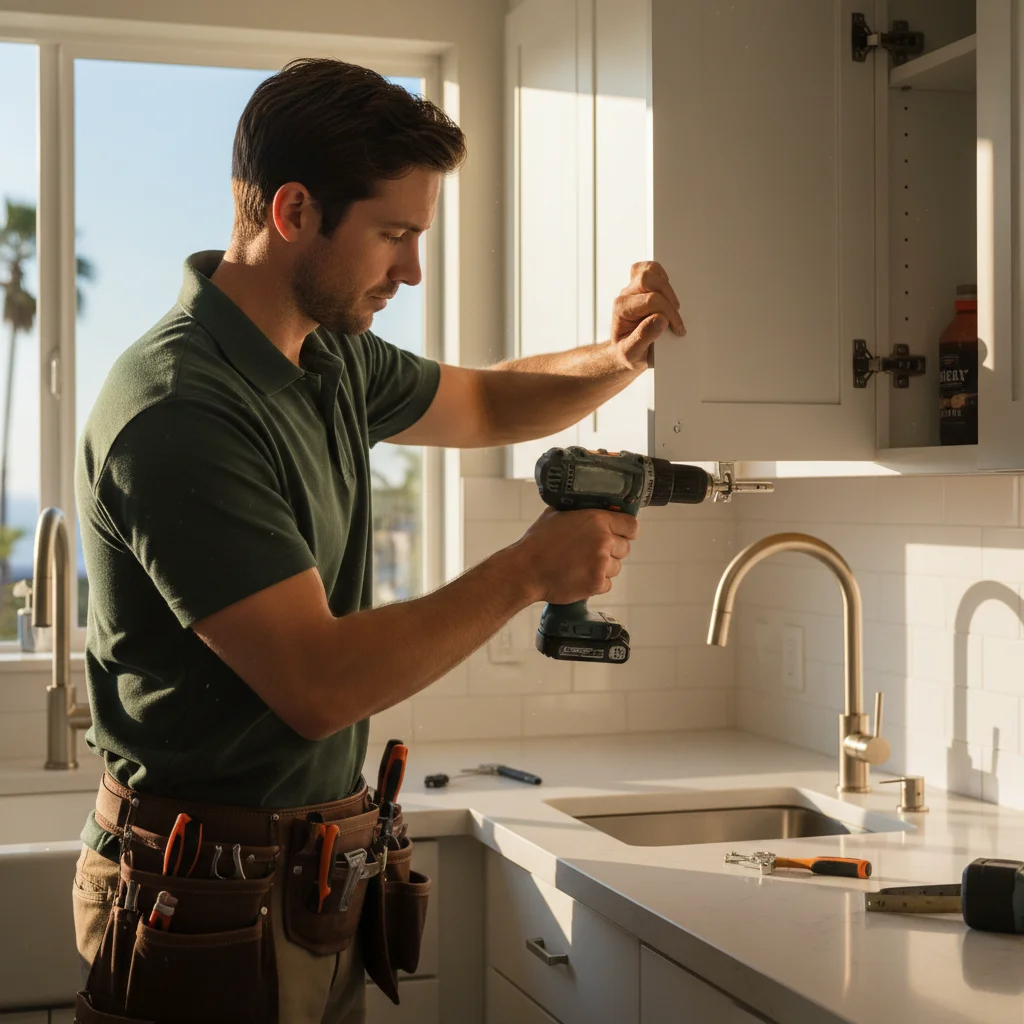
A like-for-like garbage disposal replacement in San Diego runs $150–$350 in handyman labor, not counting the unit itself. That covers removing the old disposal, mounting and wiring the new one to the existing setup, and testing it. Most jobs take 45–90 minutes. If your kitchen already has a disposal, a handyman is the right call. If it doesn’t, read on. That’s a different situation.
What a handyman can actually do
A handyman handles the most common disposal job: swapping an old or failed unit for a new one in the same spot. The drain plumbing, the electrical outlet (or hardwired connection), and the mounting flange under the sink are already there. The handyman disconnects the old unit, installs the new one to the existing mounting assembly, reconnects the drain line, and confirms no leaks.
That’s a clean, contained job with no permits and no licensed trades required in most California jurisdictions.
A handyman can also handle some closely related tasks: replacing a leaking drain collar, tightening a loose mounting ring, resetting a tripped disposal, or replacing a worn splash guard. If the unit hums but won’t spin, that’s often a jam, a five-minute fix with an Allen wrench that you or a handyman can handle.
What a handyman cannot do: install a disposal in a kitchen that has never had one. That work requires adding a drain branch to the p-trap, which is plumbing. It may also need a dedicated outlet under the sink, which is electrical. Both require licensed contractors in San Diego. If you’re unsure which situation you’re in, call us at (858) 400-4611 and describe what’s under your sink, and we’ll tell you straight.
Cost breakdown for San Diego in 2026
| Job type | Labor estimate | Notes |
|---|---|---|
| Like-for-like disposal replacement | $150–$350 | Existing mount, drain, and power in place |
| Disposal swap with new mounting flange | $200–$375 | Add $50–$75 for flange replacement |
| Reset or unjam (no parts) | $75–$125 | Often a service call minimum |
| New disposal where none existed | Not a handyman job | Requires licensed plumber (and possibly electrician) |
These are labor-only estimates. The unit itself is separate. A basic 1/3 HP disposal runs $60–$100 at any hardware store. A mid-grade 1/2 HP unit, which is what most SD households need, costs $100–$175. A heavy-duty 3/4 HP or 1 HP unit for a busy kitchen runs $175–$350.
San Diego’s hard water accelerates corrosion on disposal seals and housing. If your disposal is leaking from the bottom (not the top), the internal seals are gone, and replacement is cheaper than repair. Units over eight years old with bottom leaks are almost always better replaced than fixed.
What HP size do San Diego homes need?
Most single-family homes in San Diego do fine with a 1/2 HP disposal. It handles everyday food scraps, runs quieter than lower-HP units, and lasts 8–12 years with normal use.
Step up to 3/4 HP if you cook frequently, have a large household, or run your disposal multiple times a day. The extra motor capacity matters in older SD homes where drain lines may be slightly undersized, a more powerful disposal grinds finer and reduces clogs.
1 HP units are for heavy-use kitchens. Rarely needed in a residential setting unless you’re running a home catering operation or have a family that generates significant food waste.
Avoid 1/3 HP units entirely. They’re marketed as “basic” but jam easily, wear out faster, and offer little savings over a 1/2 HP after a year or two of service calls.
For more context on how disposal work fits into larger kitchen or repair projects, see our handyman cost guide for San Diego.
Common disposal failures in San Diego
San Diego’s water is among the hardest in California, routinely 270–300 parts per million of dissolved minerals. That mineral load shows up in disposals as:
- Corrosion on the mounting ring and drain collar (causes leaks at the top of the unit)
- Scale buildup inside the grinding chamber (reduces efficiency, causes more frequent jams)
- Accelerated wear on internal seals (causes bottom leaks in units 5+ years old)
Older homes in neighborhoods like North Park, University Heights, and Normal Heights often have galvanized steel drain pipes under the kitchen sink. Those pipes corrode and narrow over time. When a disposal gets replaced in those kitchens, it’s worth having the handyman check whether the drain line is flowing freely before the new unit goes in, a slow drain isn’t a disposal problem, and a new disposal won’t fix it.
Newer builds in Chula Vista, Otay Ranch, and Eastlake typically have PVC drain lines that hold up better. Disposals in those homes usually run clean until the motor goes.
If you’re dealing with related kitchen repair needs, worn cabinet bases from under-sink leaks, loose hinges from repeated access, read our guide on kitchen cabinet repair in San Diego.
How to get a fast estimate
Describe your situation clearly when you call and you’ll get an accurate quote in minutes, not days.
Tell us: Does your kitchen currently have a disposal? Is it hardwired or does it plug into an outlet under the sink? Is it leaking, jammed, or completely dead? Do you already have a replacement unit, or do you need one sourced?
That information lets us confirm whether it’s a standard handyman swap, connect you with a pro who can quote a fair labor rate, and tell you if anything you’ve described requires a different trade. We don’t book jobs we can’t complete correctly.
Call (858) 400-4611 and we’ll match you with a pro for disposal replacement anywhere in San Diego County.
Not sure whether you should DIY this or hire out? Our guide on how to choose a handyman in San Diego covers when professional help is worth it and what to look for.
Frequently asked questions
How much does garbage disposal installation cost in San Diego?
A like-for-like disposal replacement runs $150–$350 in labor for most San Diego homes, not including the unit. The total out-of-pocket cost, labor plus a mid-grade 1/2 HP disposal, typically lands between $250 and $525. Jobs with complicating factors (old mounting flange, corroded drain collar, awkward cabinet access) land toward the higher end of the labor range.
Can a handyman install a garbage disposal, or do I need a plumber?
A handyman can install a disposal when one already exists in that spot, the plumbing and electrical connections are already in place. If your kitchen has never had a disposal, the drain work to add one requires a licensed plumber. The same applies if your drain line needs rerouting or if there’s no outlet under the sink.
What’s the difference between garbage disposal repair and replacement?
Repair makes sense for specific, contained problems: a tripped reset button, a jammed grinding plate, or a loose wire. Replacement is almost always the better call when the unit leaks from the bottom (failed internal seals), when the motor hums but won’t spin even after clearing a jam, or when the unit is over eight years old and having recurring problems. The labor cost difference between a repair visit and a full replacement is usually small enough that replacement wins on value.
How long does a garbage disposal replacement take?
Most like-for-like replacements take 45–90 minutes. The variables are cabinet access (tighter spaces under older sink cabinets take longer), whether the mounting flange needs replacing, and whether there’s any corrosion on the drain connections that needs cleaning up before the new unit seats properly.
What HP garbage disposal should I buy for a San Diego home?
For most San Diego households, a 1/2 HP disposal is the right call. It handles everyday food waste, fits standard drain lines, and lasts 8–12 years. Step up to 3/4 HP if you cook heavily or have a large family. Skip the 1/3 HP units, they’re undersized for real kitchen use and fail faster.
Does San Diego’s hard water affect garbage disposals?
Yes, meaningfully. San Diego water runs 270–300 ppm in dissolved minerals, which accelerates seal corrosion and scale buildup inside the grinding chamber. Units in San Diego homes tend to develop leaks and efficiency problems earlier than units in areas with softer water. Replacing an aging disposal before it fails completely, especially if it’s leaking at the base, is usually the more cost-effective move.
Who to call for what
A disposal swap falls under our general home repairs service. If the disposal still runs but another kitchen appliance is the real problem, a dedicated appliance company like Repair Pro San Diego handles diagnosis and repair of the motor and electronics rather than a straight swap. Hard water wears on more than the disposal, so to slow it across the whole house, a water treatment company like Filter Pros SD installs softeners and filtration.
Would you rather hand this one to a pro than do it yourself? Call (858) 400-4611.
Request a quote