The patch can be sound and the wall can still look unfinished. Paint has to stop somewhere, and that stop line is the real choice after drywall repair in a San Diego home. Afternoon light on a west wall in Point Loma, or a bright east wall in El Cajon, will show that line more than the mud itself.
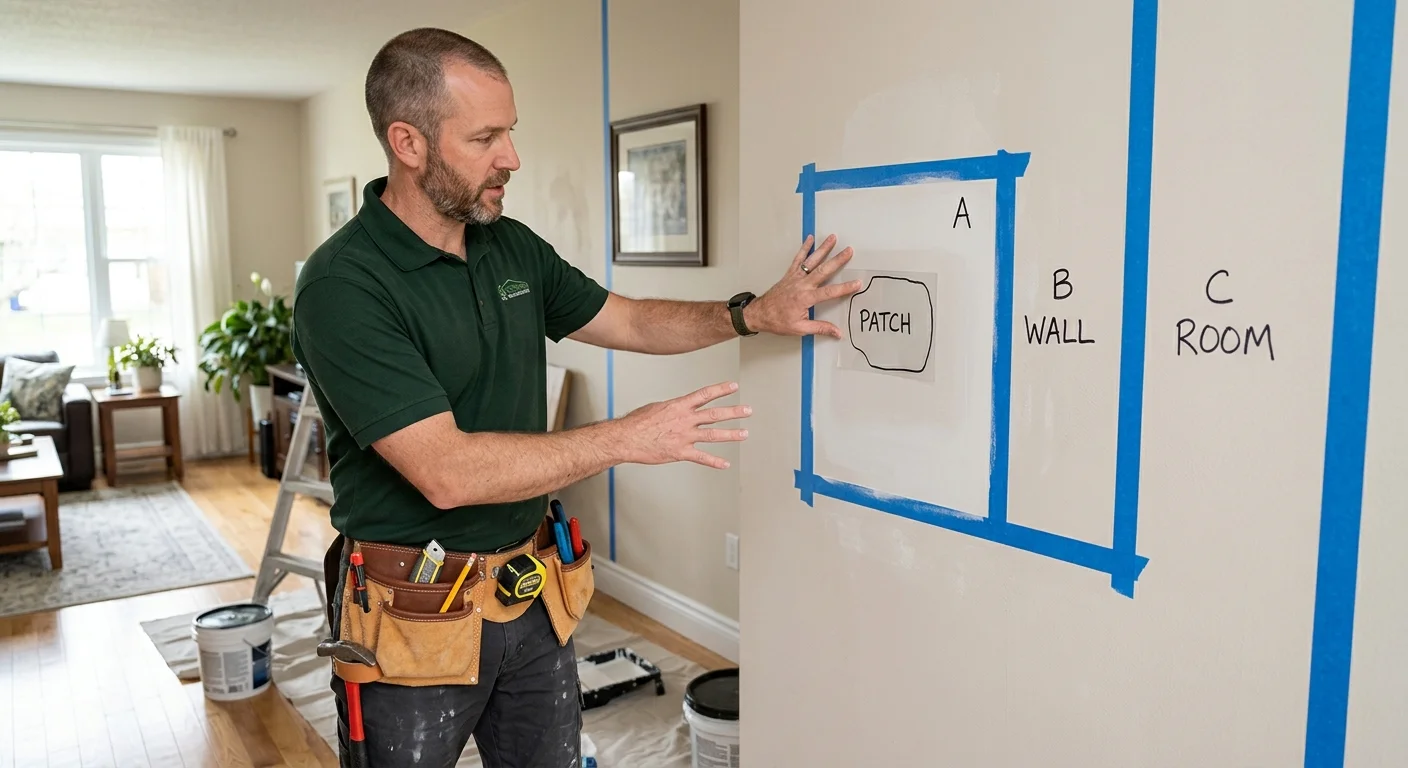
Define the drywall and paint boundaries separately
Keep the two jobs on two lines of the quote. The drywall boundary is the board, tape, and compound that got repaired. The paint boundary is where new finish paint is allowed to end: the patch, one full wall, or the whole room.
A Clairemont homeowner who writes “just finish it” often gets a feathered spot over the mud. A Carlsbad homeowner who writes “paint to the inside corners” gets a full wall. Those are different labor maps. They also fail in different ways when the stop is vague.
The City of San Diego treats some small drywall patches as work that does not need a building permit. That list includes patches up to 100 square feet tied to electrical, mechanical, or plumbing repairs, except on designated historic resources or in historic districts. Confirm the current bulletin with Development Services if the house is historic or the opening was larger than a patch. Interior paint after that repair is still its own scope. A permit answer does not set the roller stop.
San Diego County lighting is not one condition. Coastal rooms in Encinitas, Solana Beach, and Coronado take hard side light through wide glass. Inland rooms in El Cajon, Santee, and Alpine take hotter afternoon sun on west walls. South Bay condos in Chula Vista and National City often have smoother gypsum and tighter corners. A six-inch patch reads differently in each of those rooms. Write the paint stop as a place on the wall.
Later tract homes in Mira Mesa, Rancho Penasquitos, and parts of Oceanside often carry orange-peel texture. Newer production homes in 4S Ranch and Carmel Valley run smoother. Older cottages in North Park, South Park, and Golden Hill may be plaster. The paint map still has to name a stop, whatever the substrate.
The painter you get matched with can name the drywall area they will prime and the paint area they will coat. Those two maps belong on paper before a can opens. This page does not promise that a localized coat will vanish under every lamp and every hour of the day.
Record the existing color, sheen, and wall condition
Before coverage talk, write down what is already on the wall. Brand and color code from a leftover can, if you still have it. Sheen: flat, eggshell, satin, or semi-gloss. About when the last coat went on. Which wall faces the window. Whether the surface is orange peel, knockdown, or smooth.
Walk the room at the hour the wall gets the most light. In Mission Hills and Bankers Hill, that is often late day on a west wall. In a Rancho Penasquitos family room, overhead cans plus a slider can show every change in roller stipple. A phone photo flattens sheen, hides ridges, and shifts color with white balance. Use the photo as a location map. Bring notes from the real light.
Sheen is as much of a record as color. Flat film hides small texture shifts. Eggshell and satin bounce light and show a paint after drywall patch even when the tint is close. Kitchens and baths in older City Heights and Barrio Logan bungalows often carry a higher sheen than the hallway. If the repair sits on that glossier wall, a small interior paint touch up reads as a new island of finish.
Fading is local. South and west windows in Clairemont, Scripps Ranch, and La Mesa bake the film. Leftover paint from an older can can be the right formula and still look fresh next to a wall that has yellowed. That is a coverage-width problem. If a store scan is the plan, test a dried sample on the actual wall, in the same light you live with.
Older housing stock still sits in Golden Hill, parts of Ocean Beach, and older streets in Escondido. Review the EPA Lead-Safe Renovation, Repair and Painting program with the painting professional, and ask how they will handle that surface.
If a past interior paint touch-up already failed to match, write that down. A second small coat on the same island rarely fixes a sheen or fade problem the first coat already showed.
Compare painting one area, one wall, or one room
Interior paint after drywall repair is a coverage choice. Pick one of three maps and put it on the quote.
Paint the repaired area
This is a primed patch plus a feathered coat that dies out into the old film. It fits a small, low-sheen repair on a wall that does not take raking light. A closet in a Mira Mesa hallway can take this. A living-room wall with a picture window in Del Mar usually needs more. The common miss is flashing: new film sits differently over porous compound than over aged paint, so the spot looks duller or glossier even when the color is close.
Paint one wall, corner to corner
Stop at inside corners, the ceiling line, and the base. This is the usual step up when sheen is eggshell or higher, when the patch is large, or when daylight rakes across the plane. One full wall keeps a single roller texture and a single film age on the surface you face. An adjoining wall can still show a color step if it faded at a different rate, which happens in rooms that wrap a corner toward a window.
Paint the room
Use this when several patches sit on more than one plane, when you are changing color, or when the room reads as one volume. Many 1960s and 1970s ranch interiors in Kearny Mesa and San Carlos have short walls and wide openings. Painting one wall in that layout can leave a stripe at every cased opening. A full room coat also fits after a cluster of patches from a plumbing access or a TV-mount move.
Texture belongs in this comparison. Matching drywall texture in San Diego is its own job. A smooth patch on an orange-peel wall will show through any of the three paint maps. Settle texture before you argue about whether paint stops at the patch or the corner.
Peeling tape under old paint is a drywall failure. Finish paint will not glue failing tape. Once the tape is redone, you still pick one of these three maps. The larger the tape repair, the more a full wall or room coat tends to hide the new work.
How soon you can paint depends on the compound and primer on that wall, plus the room’s humidity. A closed bedroom in Poway dries differently than a coastal apartment in Ocean Beach. A single wait time for the whole county is not confirmed here. The painter should follow the product labels and confirm the repair is dry through the full build before primer.
Primer coat count is a label-and-scope question. Joint compound drinks finish paint at a different rate than old wall film. A drywall primer or sealer is the usual way to even that out. The quote should say whether primer covers the patch only or the full wall.
Include trim, ceilings, doors, and adjoining corners
The paint map is larger than the patch. Name every surface that will get coated, and every surface that will not.
An inside corner is a clean stop. Mid-wall is a blend. If the repair sits six inches from a corner, painting to that corner often reads cleaner than dying new paint out in the field. That holds in a small South Park bedroom and in a long Encinitas hallway.
If old wall paint crawled onto the ceiling, a new wall-only job will reprint that ragged edge. Decide whether the ceiling gets a cut-in, or the whole ceiling gets coated. Knockdown and popcorn ceilings in older East County homes make that choice more visible. Smooth drywall ceilings in newer Carmel Valley houses show lap marks if the cut-in sheen drifts.
Baseboards and door casing are usually a different sheen, often semi-gloss. A wall repaint that laps onto trim without a cut-in plan leaves a fat line. If casing came off for the drywall cut, the paint stop and the trim stop both need to be written down.
A door slab is its own plane. Painting the wall and leaving a scuffed door can make the room look half-done. Include the door, or exclude it in the same sentence as the wall.
Open plans in 4S Ranch and newer Chula Vista tracts wrap paint around a corner into the next space. If you paint one wall in that layout, say where the color is allowed to turn. A narrow hall in a Normal Heights cottage does the same thing at a smaller scale.
Walk the room with painter’s tape and mark the intended stops. Photograph those marks in place. That packet is more useful to a painting pro than a wide shot of the patch alone.
Request matching scopes from painting professionals
Ask every painter for the same written map. Same rooms. Same stop lines. Same primer note.
The scope should list the drywall repair as already complete or still open, with the room and wall named. It should say whether primer covers the patch only or the full wall. It should name the finish map: repaired area, one wall, or the room. It should match sheen in writing. It should say whether texture is already matched or still pending. Trim, ceiling, doors, and closets belong in the include-or-exclude list. So does protection of floors and furniture. So does who supplies paint, and whether leftover house paint will be used.
California contractor licensing applies when the aggregate price for labor, materials, and all other items reaches $1,000, under Business and Professions Code section 7048, with its other conditions. The exemption is for casual, minor, or inconsequential work that does not need a permit. It does not apply when the work is part of a larger operation, when jobs are split to stay under the number, when someone advertises as a contractor, or when they employ others to do the work. CSLB also tells consumers that licensing is required for projects that need a permit, use employee labor, or cost $1,000 or more. Check a license on the CSLB site before you sign.
Fix Pro San Diego is a referral service. It matches you with licensed, independent local pros. It does not paint, patch, or hold a contractor license of its own. You contract and pay the professional directly.
If one bid paints the patch and another paints the room, those are different jobs. Ask both to price the same stop line, then choose the stop line you want.
For interior painting after a patch, the useful question is where the new film ends. Bring the color record, the sheen, the light notes, and the tape marks. A clear map lets the pro quote the job that is actually on the wall.
When to call us
When the paint stop is unclear, or a west wall takes hard San Diego daylight, hand the mapping to a painting professional. Call us at (858) 400-4611 and we’ll match you with a local pro who quotes the job before starting.
Would you rather hand this one to a pro than do it yourself? Call (858) 400-4611.
Request a quote