If you’re searching for affordable fixture installation in San Diego County, start by defining the job clearly. Photos, measurements, product details, and finish notes help an installer understand what you want before quoting the work.
Separate a fixture swap from a new location
“Replace this light” can describe two very different requests. One keeps the fixture at its current wall or ceiling location. The other puts a new fixture somewhere that doesn’t currently have one.
Tell the pro which request you’re making. For a replacement, photograph the existing fixture and its location. State whether you want it removed and replaced by the product shown. Don’t describe the request as a simple swap if the location, controls, or surrounding surface must change.
A request for a new location needs a qualified professional’s review. The homeowner’s description can identify the goal, but it can’t confirm the electrical scope or permit requirements. Include the property address so the pro can identify the authority serving that location. A request from Encinitas should say Encinitas. The same applies in El Cajon, Chula Vista, Oceanside, and San Diego.
California’s minor-work licensing exemption is narrow. Under Business and Professions Code section 7048, the aggregate contract price must be less than $1,000. That total includes labor, materials, and all other items. The work must also be casual, minor, or inconsequential, and it can’t require a building permit. A project can’t be divided into smaller contracts to avoid the licensing requirement.
That rule doesn’t determine whether a particular fixture request needs a permit. A qualified installer and the building authority serving the address should confirm that point. Within the city, homeowners can consult City of San Diego permits and inspections. Properties elsewhere in San Diego County need guidance for their own jurisdiction.
Record the existing opening and mounting hardware
A useful request shows what’s already there. Start with one room-wide photo that establishes the fixture’s location. Add a straight-on image and a side view. Include the nearby ceiling or wall surface, not just the fixture itself.
Record these details without dismantling anything for the photograph:
- The old fixture’s widest visible dimension
- The size and shape of its ceiling or wall cover
- The distance from the fixture to nearby walls or cabinets
- Any visible mounting plate, screws, or hardware
- Labels or model information already visible
- Cracks, holes, stains, or texture changes around the fixture
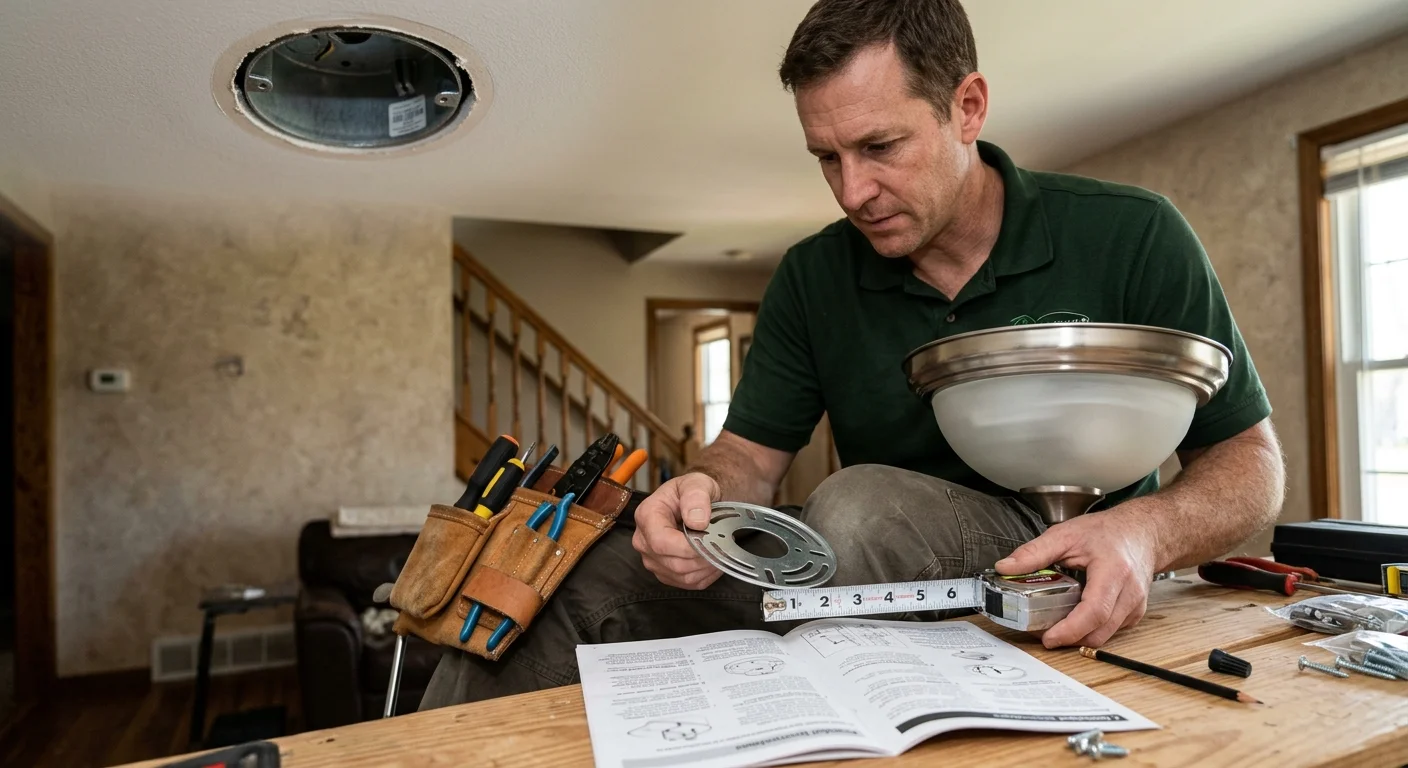
Use a tape measure in at least one close photo. Keep the full measurement visible. A written measurement helps, but the photograph shows where you placed the tape. If the existing fixture has already been removed, photograph the exposed opening and every loose hardware piece. Don’t diagnose what’s behind the opening. Let the qualified installer evaluate it.
Describe the room and mounting surface. “Kitchen ceiling” is more useful than “inside light.” Note whether the ceiling is flat, sloped, or unusually high. Mention stairs, built-ins, counters, or other features beneath the fixture. These details help the pro identify access questions before preparing a quote.
If you don’t know a mounting term, use plain language. “Round metal piece behind the cover” is better than guessing. Clear photographs usually communicate more than an uncertain label. Our light fixture installation referral page gives you a direct place to submit the request.
Check fixture dimensions before requesting installation
The replacement product matters as much as the existing opening. Send the exact product page, model number, or manufacturer instructions. A photo of a similar fixture isn’t enough when the actual dimensions differ.
Record the details available from the product documentation:
- Width of the new ceiling or wall cover
- Overall width, depth, and hanging length
- Product weight
- Included mounting parts
- Assembly requirements
- Any separate components included in the package
Compare the new cover with the old fixture’s visible footprint. A smaller cover may leave old paint, holes, or texture exposed. A larger cover may overlap nearby trim, a cabinet, or another surface. Don’t assume that a close visual match means the mounting details match.
For a pendant or hanging fixture, state your preferred finished height. Include the ceiling height if you know it. For a wall fixture, measure from the mounting location to mirrors, shelves, door trim, and nearby fixtures. These are planning measurements, not installation instructions. The pro should confirm the final placement and mounting approach.
Open the package before sending the request if you can do so without damaging it. Confirm that the model and finish match the order. Photograph the box label, instructions, and included hardware together. Note any missing or damaged piece rather than expecting the installer to discover it after arrival.
For additional budgeting context, read our guide to light fixture installation cost factors in San Diego. It explains why the product and existing conditions belong in the same request.
Identify wall or ceiling finish repairs separately
Fixture replacement and finish repair aren’t automatically the same scope. Removing the old cover may reveal an unpainted outline, screw holes, texture differences, or a larger opening. Show those conditions before asking for a final quote whenever they’re already visible.
Tell the pro what result you expect. Some homeowners only want the new fixture mounted. Others want visible holes patched and the surrounding finish addressed. Put that preference in writing so each pro quotes the same request.
Useful finish notes include:
- Whether you have matching paint
- Whether the paint container still has a readable label
- Whether the surface is smooth or textured
- Whether an old fixture outline is already visible
- Whether prior patches surround the mounting point
Don’t promise yourself an exact paint or texture match before the surface is inspected. Instead, ask how the pro would handle the exposed area. Ask whether patching, texture work, priming, or painting appears in the written quote. If another specialist must handle part of it, the pro can identify that separation.
Location also matters when confirming permit treatment. City of San Diego Information Bulletin 203 says certain repair exemptions don’t apply to designated historical resources or properties within historic districts. That bulletin doesn’t settle every fixture or finish request. Ask the city or the authority serving your address to confirm the current requirement.
Outdoor fixtures need another set of product and location details. Use our San Diego outdoor fixture planning guide when the light is on an exterior wall, patio, entry, or other outdoor area.
Send product details and room photos with the request
Put everything into one short message. A scattered series of texts can separate the product link from the room photos. A single request makes the desired scope easier to compare across written quotes.
Include:
- Property city and room
- Existing fixture photos
- Existing cover measurements
- Replacement product link or model number
- Product dimensions and weight
- Photo of included mounting hardware
- Preferred placement or hanging height
- Visible wall or ceiling repair needs
- Any permit question that still needs confirmation
State what you don’t know. “Mounting hardware not visible” is useful. So is “permit requirement not confirmed.” Don’t fill either gap with a guess. A qualified installer can review the mounting conditions. The appropriate local building authority can answer permit questions for the address.
Fix Pro San Diego doesn’t set installation prices. The approved source review found no government-published average rate for San Diego County fixture installation. Ask the independent pro for a written quote and confirm what it includes. Compare quotes using the same fixture, photos, finish expectations, and location details.
The California Contractors State License Board recommends getting at least three written bids for licensed-contractor projects. It also says bids and contracts must display the contractor’s license number. Homeowners can verify that number through the CSLB license check.
San Diego residents can also start from our local handyman referral page. Fix Pro San Diego matches homeowners across San Diego County with licensed, independent local handyman professionals. The customer contracts with and pays the selected professional directly.
When to call us
Hand this request to a pro when the fixture, mounting point, finish work, or permit question can’t be described with confidence. Fix Pro San Diego is a referral service and performs no physical work itself. Call us at (858) 400-4611 and we’ll match you with a local pro who quotes the job before starting.
Would you rather hand this one to a pro than do it yourself? Call (858) 400-4611.
Request a quote