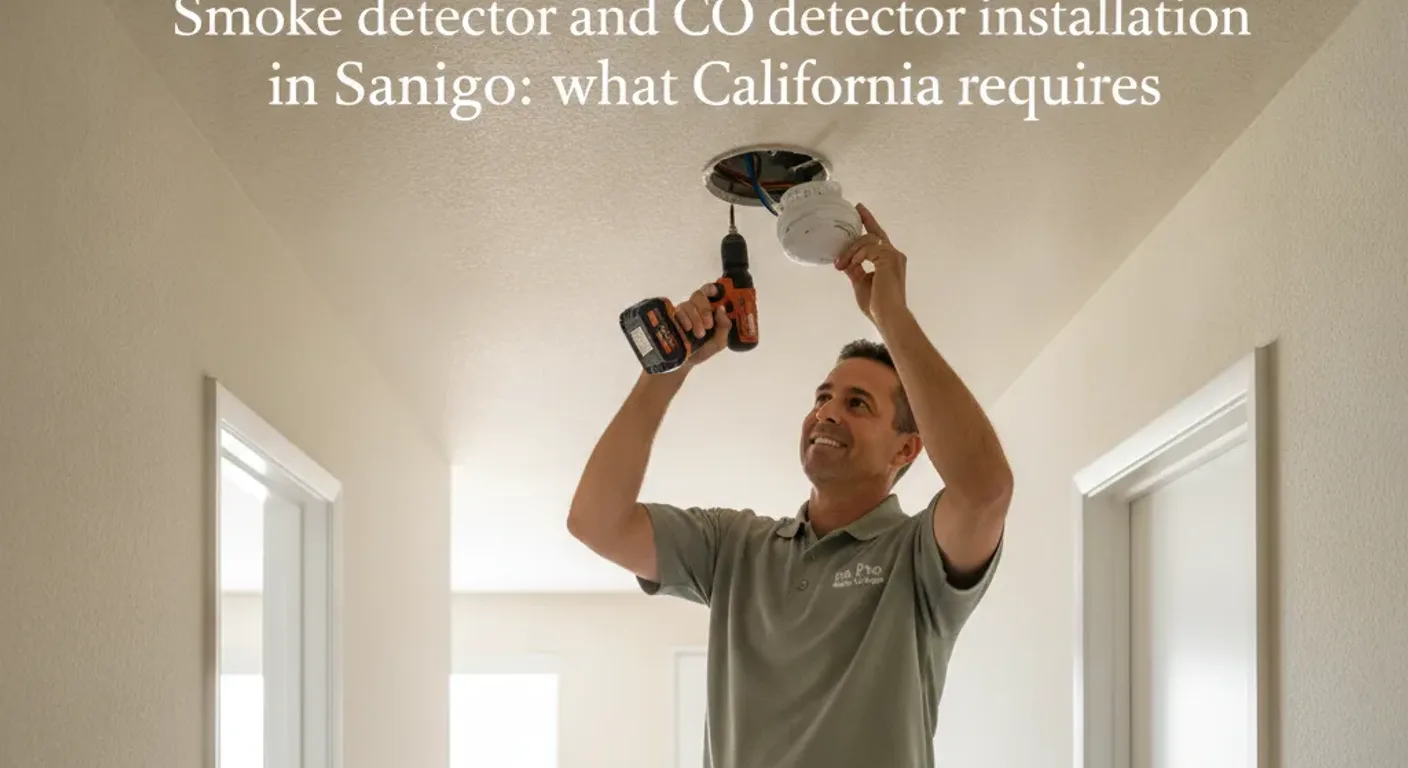
Handyman installation of smoke and CO detectors in San Diego runs $25–$75 per unit for battery or existing-wired replacements, and $100–$200 per unit when a handyman needs to access an attic run or swap out a hardwired unit on an existing circuit. A whole-home package covering four to eight detectors typically lands between $150 and $400 in labor. Buying compliant detectors yourself and scheduling one visit keeps costs down.
California has specific requirements for both smoke alarms and carbon monoxide detectors. If you’re selling a home, just moved in, or haven’t replaced detectors since around 2014, there’s a good chance your setup is out of date. Here’s what the law actually requires and what a handyman can handle for you.
California’s detector requirements: what the law says
Carbon monoxide detectors became required statewide under a California law that took effect in 2011. Every single-family home with an attached garage or a fuel-burning appliance, think gas furnace, water heater, range, or fireplace, must have a CO detector. The requirement later expanded to include multi-family dwellings. CO detectors must be installed outside each sleeping area. If bedrooms are on multiple floors, each floor needs coverage. This law is sometimes referenced as SB 183, the Carbon Monoxide Poisoning Prevention Act.
Smoke alarms have been required in California residential buildings for decades, but the requirements have tightened. Current state law requires a working smoke alarm in every bedroom, outside each sleeping area in the immediate vicinity, and on every level of the home including the basement if there is one. When you replace or newly install a smoke alarm in a California home, it must be a listed device, meaning it meets UL standards and has been tested and certified.
The 10-year sealed-battery rule matters if you’re replacing smoke alarms. California law, updated in 2014, requires that any smoke alarm installed in a single-family home use a sealed, non-removable battery that lasts the life of the device, typically 10 years, unless the alarm is hardwired. This was specifically intended to prevent the chronic problem of people removing batteries and never replacing them. If your current smoke alarms use replaceable AA or 9V batteries, they’re likely non-compliant under current replacement standards.
If you’re selling a San Diego home, the seller is required to certify that compliant smoke alarms and CO detectors are in place at the close of escrow.
Where detectors go: placement that actually works
Placement determines whether a detector saves your life or just fills a legal checkbox.
Smoke alarms perform best mounted on the ceiling, at least four inches from any wall, or high on a wall between four and twelve inches from the ceiling. Keep them away from kitchens and bathrooms: false alarms from cooking steam or shower humidity lead people to disable them. The goal is every bedroom, the hallway immediately outside bedrooms, and at least one detector per floor.
CO detectors should be installed near sleeping areas so the alarm wakes you if carbon monoxide builds up overnight. Unlike smoke, CO is roughly the same density as air, so it doesn’t settle or rise dramatically. Mounting height is less critical than placement near where people sleep. Keep CO detectors away from gas appliances and vehicle exhaust sources, where low-level CO is normal and will trigger false alerts.
Combination smoke and CO units are popular and often the most cost-effective option. One device handles both requirements in each location. This works well for most San Diego homeowners and simplifies maintenance since you’re tracking one device instead of two per room.
| Detector type | Where required | Typical installed cost (labor + unit) |
|---|---|---|
| Smoke alarm (sealed battery, 10-year) | Every bedroom, hallway outside bedrooms, each floor level | $40–$80 per unit |
| Carbon monoxide detector | Outside each sleeping area (homes with garage or fuel-burning appliances) | $40–$80 per unit |
| Combination smoke and CO (sealed battery) | Satisfies both requirements in one unit | $55–$100 per unit |
| Hardwired smoke alarm (replacement, existing circuit) | Same placement as above | $75–$150 per unit (labor only) |
| Hardwired interconnected system (existing wiring) | When all alarms must trigger together | $80–$200 per unit (labor only) |
Hardwired vs battery: which is right for your home
Most homes built after the late 1980s have hardwired smoke alarms that connect to your home’s electrical system. These are always powered and don’t depend on a battery for primary operation, though they have a battery backup for outages. Interconnected hardwired systems are the gold standard: when one alarm goes off, all of them go off simultaneously. That matters in a two-story home where a bedroom alarm upstairs needs to wake someone sleeping downstairs.
Replacing a hardwired alarm with a like-for-like unit, same number of wires, same connector, is straightforward handyman work. You disconnect the old unit, plug in the connector on the new one, and mount it. The wiring stays in place.
Sealed-battery alarms are the right choice for locations that don’t have existing wiring, or in older San Diego homes where running new circuits would require significant wall work. Modern 10-year sealed units are reliable and genuinely convenient since you never deal with a chirping 3am low-battery warning again.
Where a handyman scope ends: if you want to add hardwired interconnected alarms to a home that currently has none, that requires running new wiring and possibly a new circuit from your panel. That work needs a licensed electrician. A handyman can replace existing hardwired units or install sealed-battery units anywhere, but can’t legally pull a new circuit. If you need new wiring throughout the home, get a licensed electrician and have the handyman handle the physical mounting after the wiring is complete.
For related electrical work like light fixture installs, see our light fixture installation service.
What handyman installation costs in San Diego
The main cost drivers are the number of units, whether they’re battery or hardwired, and how accessible the locations are.
A straightforward visit to swap out four sealed-battery smoke alarms and two CO detectors in a typical San Diego single-family home takes about two hours. Labor for that kind of visit runs $100–$200. Most customers supply their own detectors after confirming the model is California-compliant. If you’d like the pro to supply compliant units, that’s something to confirm when you call.
Hardwired replacements take a bit longer per unit since each one involves confirming the wiring, testing the interconnect, and verifying all units trigger together. For a home with six to eight hardwired alarms, plan on three to four hours of labor.
Interconnected sealed-battery alarms are a middle-ground option. These use wireless radio signals to communicate, so when one triggers, all do, without any wiring between units. They cost more than standard battery units, roughly $30–$60 per unit at retail, but they’re a practical upgrade for older homes.
For a full picture of what handyman work costs across different projects, the home maintenance checklist for San Diego homeowners is a useful reference. Detector replacement pairs well with our general home repair service.
Frequently asked questions
How many smoke detectors does a California home need?
At minimum, one in every bedroom, one in the hallway outside each sleeping area, and one on each floor level including the basement. A typical three-bedroom, two-story San Diego home would need at least five smoke alarms to meet California requirements.
Are combination smoke and CO detectors acceptable under California law?
Yes. A combination unit satisfies both the smoke alarm and CO detector requirements for that location, as long as the unit is a listed device meeting current standards. Most major brands, Kidde, First Alert, and others, make California-compliant combination units.
Can a handyman replace hardwired smoke detectors?
Yes, a handyman can replace existing hardwired smoke alarms on a like-for-like basis. That means swapping one hardwired unit for another using the existing wiring and connector. What falls outside handyman scope is running new wiring, adding a new circuit, or installing hardwired alarms in a home that doesn’t currently have any wiring in place. That work requires a licensed electrician.
What is the 10-year sealed battery rule in California?
California requires that any smoke alarm installed in a single-family home use a sealed, non-removable battery with a 10-year life, unless the alarm is hardwired. This applies when you replace a smoke alarm, not just when building a new home. If your current alarms use replaceable batteries, swap them for 10-year sealed units when they’re due for replacement.
How do I know if my CO detector is up to date?
CO detectors have a printed manufacture date and an expiration date, typically seven to ten years from manufacture. Check the back of the unit. If there’s no date visible or the unit is older than seven years, replace it. CO detectors degrade over time and may fail to detect carbon monoxide even while appearing functional.
Does a handyman need a permit to install smoke or CO detectors in San Diego?
For standard replacement of existing detectors, no permit is required. For new hardwired circuits, a permit and licensed electrician are required. If you’re uncertain about your situation, ask when you call for a quote.
Ready to get your home up to code? Call Fix Pro San Diego at (858) 400-4611 and we’ll match you with a pro who can quote the job. We serve homeowners across San Diego County, and the pro you’re matched with confirms timing when they call. For outdoor electrical work in the same visit, see our outdoor light fixture installation guide.
Would you rather hand this one to a pro than do it yourself? Call (858) 400-4611.
Request a quote