The cracked bead on the tub rim is what you see first. A caulking handyman still needs the rest of that surround before a quote means anything. One failed corner in a Chula Vista combo tub is a smaller ticket. A rim, apron, and door-track recaulk in a Clairemont ranch is not.
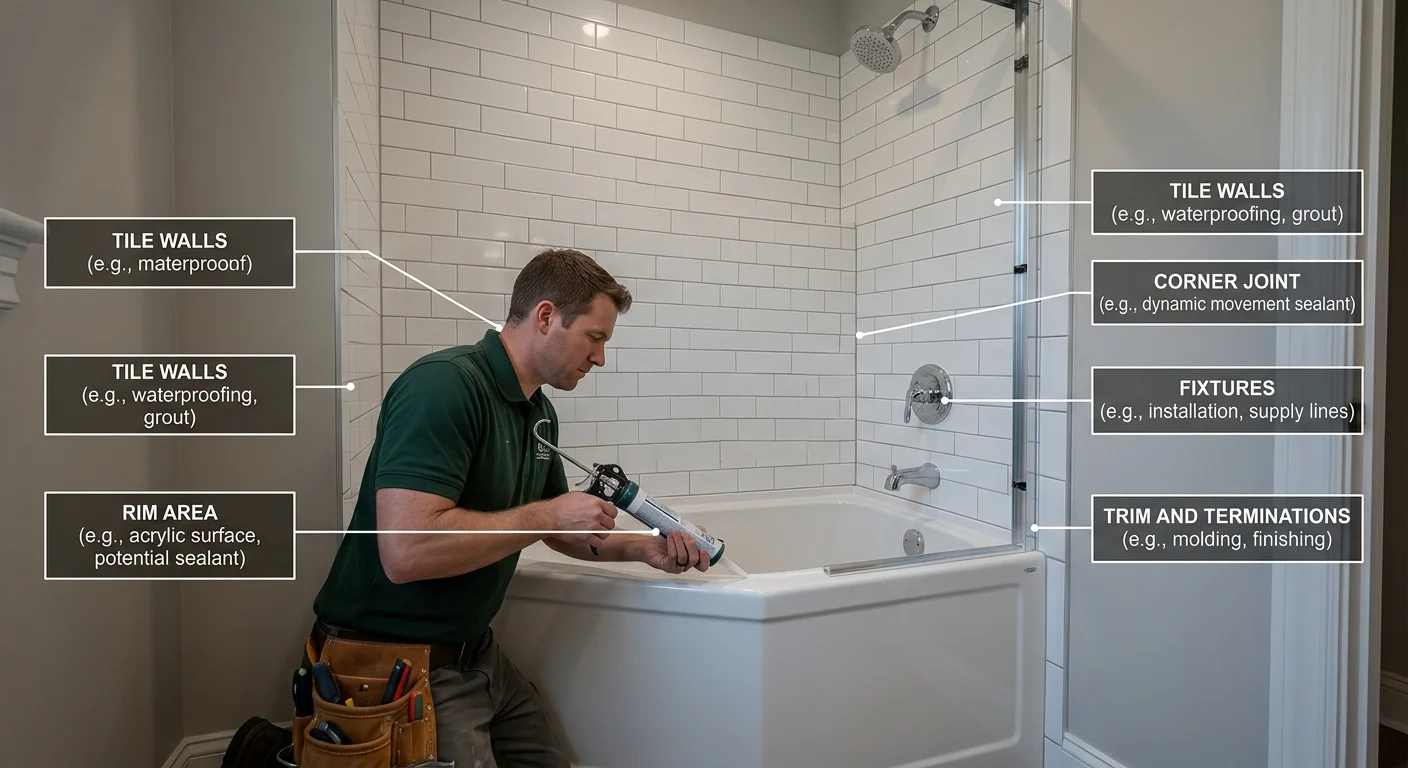
Map every joint around the tub
Walk the tub with a notepad, not one photo of the ugly spot. Each joint is a line item. Miss one, and the quote is for a different job than the one in the room.
Start at the rim, the horizontal bead where the tub deck meets tile, acrylic, or cultured marble. Older bungalows in North Park and Normal Heights often have a short ceramic lip. Production homes in Otay Ranch and Carmel Valley often have a one-piece surround. Write which one you have.
Then mark the corners. Tub-shower combos in Linda Vista, Serra Mesa, and Spring Valley put shower walls on the same fixture. People type “handyman to recaulk shower” when the fixture is still a tub. Name both in the request so the matched pro doesn’t quote a stall that isn’t there.
Add the short beads around the spout, handles, and overflow plate. Those fail on their own. Don’t assume they ride along with the rim. Add the apron-to-floor joint too. Wet-mopping hits that line every week.
If a sliding door sits on the deck, the track joint is its own line. Compact condos in Pacific Beach, Mission Beach, and downtown stack that track tight to the rim. Write whether the door stays on or comes off.
Map soap dishes, niche edges, and grab-bar plates in the splash zone. Map panel seams on fiberglass or acrylic kits. Those seams are caulk, not grout. Close the list with the city and the tub body: enamel, acrylic, or a tile deck. A South Bay apartment tub and an East County ranch with a marble surround aren’t interchangeable tickets.
Separate caulk from grout and trim
Caulk is the flexible bead at a change of material. Grout is the packed joint between tiles. Trim is a separate piece of wood, PVC, or metal. Mix all three in one vague request and the quote gets messy.
If the failure is the bead where the tub meets the wall, you’re in tub caulking services. If the failure is the sanded line between wall tiles, you need a grout conversation. That split is the point of whether the repair is caulk or grout. Keep this page on the tub.
If a wood return, marble threshold, or vinyl cove is loose, that’s trim. Recaulking over a moving piece wastes the new bead. Don’t ask a caulking handyman to seal a joint that still shifts.
Stay on this fixture. One joint or the whole bathroom is a different decision. You can add the hall bath later. Don’t bury it inside a tub request.
Caulking and sealing is the service bucket for the bead. If field grout or a rocking tile is part of what you see, say that in plain words. The matched pro may keep the recaulk on the tub and send the tile work down a separate path.
Photograph the material that’s there now: smooth bead, sanded grout, or a trim strip. Don’t name a product the pro must use. Cultured-marble surrounds in Santee and El Cajon ranch baths often run long caulk lines and almost no grout on the tub itself. Ceramic three-wall surrounds in Encinitas and Carlsbad mid-century homes mix both. Write the finish.
Record loose material and surface damage
You’re documenting the surface. You’re not diagnosing what sits behind the surround. A new bead doesn’t prove the wall cavity is dry, and it doesn’t fix a problem you can’t see.
On paper, list what a finger and a flashlight can confirm. Cracked, peeled, or missing bead. Bead pulling off the tub or the tile. Grout crumbling next to the bead. A tile edge that rocks. Trim that moves. Drywall at the surround edge that feels soft or looks stained. A gap you can see through. Discoloration on the old bead. Write the discoloration as color, not as a mold claim.
If a tile rocks, the recaulk isn’t the whole story. Note it. The pro may pause the bead until the tile sits flat. If the wall at the tub deck feels soft, write “soft to the touch” and show it. Don’t write “leak in the wall.” You can’t see that from the bath.
City of San Diego Information Bulletin 203 covers minor maintenance under $1,000 that doesn’t affect plumbing, electrical, or mechanical systems. That work doesn’t need a building permit, except on designated historic resources or in historic districts. Recaulking an existing tub joint is usually in that maintenance bucket. It isn’t a private ruling for every house. If the job becomes a tub swap, a new fixture, or a plumbing change, ask Development Services. The same bulletin lists same-size, same-location tub or shower replacement as not requiring a permit, still with the historic exception. Other cities in the county set their own rules. No matching recaulk permit figure was confirmed for Chula Vista, El Cajon, Oceanside, or the rest of the county. Ask that city’s building counter if the ticket grows.
Don’t promise the recaulk will stop a drip at a ceiling below. Record a separate stain if you have one.
Compare one failed bead with nearby joints
Look left and right of the failure. If the rest of the rim is intact and matching, you can ask for that joint only. If the same split, peel, or stain repeats at every corner, the scope is the full tub line.
Check the opposite end. Check the floor joint even if the rim is what caught your eye. Matching failure means matching work.
On a combo, compare the tub deck to the first few courses of wall. If the wall grout is sound and only the tub bead failed, keep the request on the tub. If both failed, say both.
Don’t fold the kitchen, the windows, and the other bath into this ticket. This page is the tub in front of you. A Clairemont ranch with matching peel on all four tub corners is one job. A single split at the spout in a Mission Valley condo is another. Don’t let the first photo you took set the whole scope.
Coastal baths in Imperial Beach and Oceanside sit in damper air than baths in Ramona or Escondido. You don’t need a lab report. You need a visual match on this fixture. Inland ranch tubs in El Cajon often show long splits on marble. Coastal condo tubs often show a failing track bead and a cleaner rim. Write the pattern you actually see. If only the overflow plate is peeling, say that.
Send wide and close photographs before booking
Send a wide shot from the doorway with the lights on and the curtain or door open. Then send a close shot of each failed joint, filling the frame. Add one of the floor joint, one of the spout and overflow, and one of the door track if it’s there.
Put the city in the message. Upstairs or downstairs. HOA or not. Door on or off. Street parking on a canyon lot in La Jolla isn’t a wide driveway in Santee. Those notes change how the independent pro plans the visit. They aren’t a promise about when anyone arrives.
Fix Pro San Diego is a referral service. It matches you with licensed and insured independent local handyman pros. It doesn’t recaulk, own a truck, or set a price. You contract with the pro directly.
California requires a licensed contractor once the quoted total for labor, materials, and everything else reaches $1,000. That’s Business and Professions Code section 7048. A tub recaulk may stay under that line. It may not, once extra joints, grout, or trim enter the same ticket. Ask for a written total. Check the license on the CSLB site before you hire. CSLB also tells homeowners to get at least three written bids. Watch bids that sit far below the others. Keep down payments at 10% of the contract or $1,000, whichever is less.
Clear photos keep the request on this tub. That’s the job a caulking handyman can quote.
When to call us
A single peeling inch you can reach and clean may stay a homeowner task. A full tub map with loose trim, a rocking tile, or joints behind a door track is work to hand to a pro. Call us at (858) 400-4611 and we’ll match you with a local pro who quotes the job before starting.
Would you rather hand this one to a pro than do it yourself? Call (858) 400-4611.
Request a quote