A Mission Hills galley with original oak doors and a Chula Vista kitchen with peeling thermofoil are two different jobs. Searching cabinet painting near me only helps once you can split a coating request from a refinish, and both of those from wood that needs a carpenter first. The boxes can still be sound while the finish is the part you cannot live with.
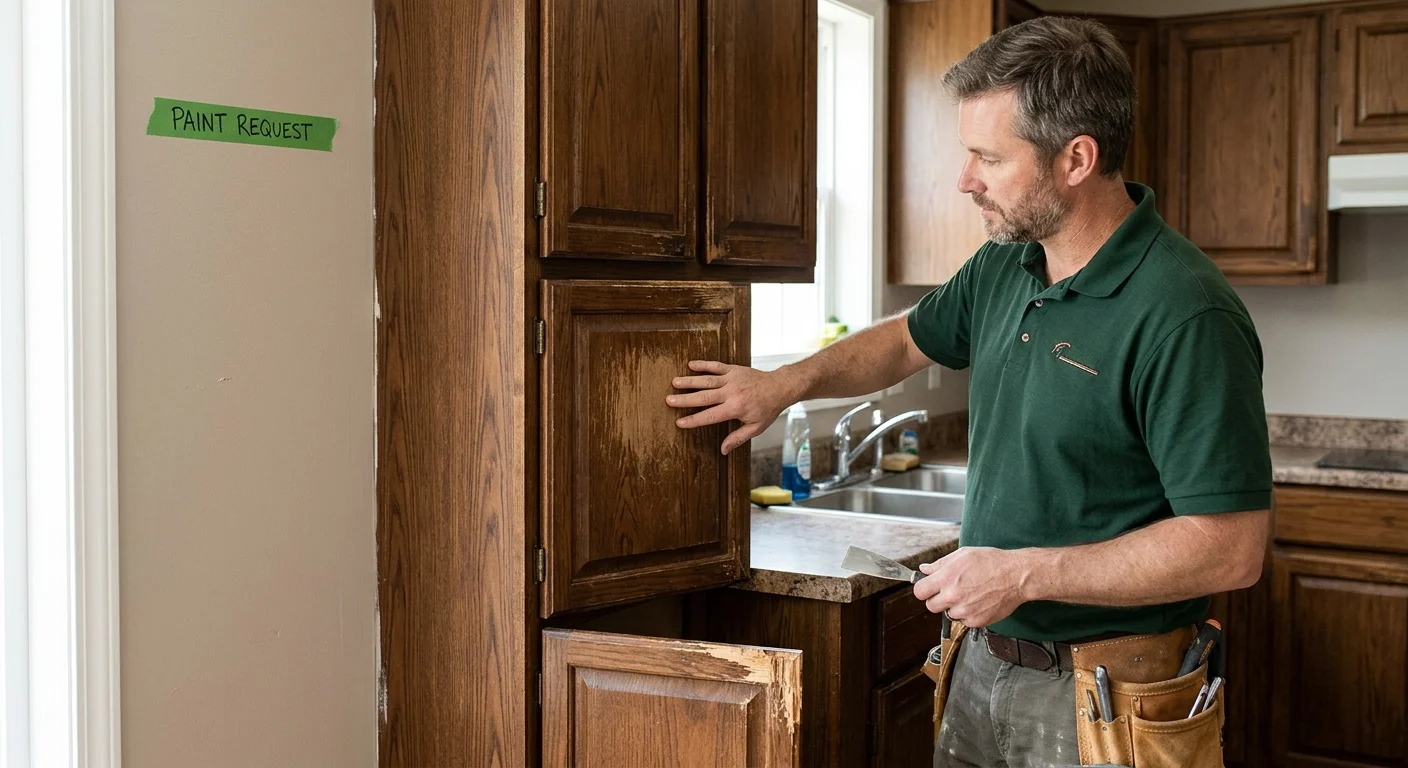
Separate painting, refinishing, and hardware repair
Painting cabinets means a new opaque coat on doors, drawer fronts, and usually the face frames. You keep the boxes and the layout. You change color and sheen. Grain gets covered, or quieted, depending on how the pro fills and coats the surface. That is the request most San Diego County searches mean.
Refinishing is a separate scope. The pro sands or strips back toward the wood, then stains or clear-coats so grain stays in view. Open-grain oak in Escondido, Ramona, and Lakeside still reads as oak after a careful sand. Maple in Encinitas or Del Mar can take a quieter stain. Ask for a refinish when you want wood to keep looking like wood. Ask for paint when you want white, cream, or a color that hides grain.
Hardware and box work is the third line. Sagging doors, stripped hinge screws, drawers that rack, and crushed corners are carpentry. A new film will not square a door that no longer sits in its opening. For hinge, slide, and fit problems, start with kitchen cabinet repair in San Diego. Failing wood is carpentry.
Keep those three lines apart on the request. A painting pro can coat sound doors. A refinisher can bring grain back. A carpenter can rebuild a blown corner at the dishwasher. One vague sentence (“make the kitchen look new”) forces the person quoting to guess. Guessing is how a coating bid drops door removal, skips degreasing, or ignores a swollen sink base.
Coastal kitchens in Ocean Beach, Pacific Beach, and Imperial Beach collect grease and salt on the same faces people touch every day. Inland kitchens in El Cajon, Santee, and Poway take more heat through west glass. South Bay homes in National City and Chula Vista often carry a heavier film on the range wall. Photograph the greasiest doors and the sun-faded ones as separate shots.
If you already compared repair and refinishing in one inland city, the Escondido cabinet refinishing or repair article stays on that fork. This page is countywide, and it treats painting as its own request.
Record doors, drawers, finish, and nearby walls
Count what has to be handled. Write the number of doors and the number of drawer fronts. Include false fronts and the finished panel under the sink. Uppers, lowers, a pantry, and a bathroom vanity are four counts. A Point Loma galley with a dozen doors is a different list than a 4S Ranch kitchen with a pantry wall and a long island.
Then record the finish that is already there. Look at a door edge, not only the face. Solid wood and plywood-face doors take a coat differently from paper-wrap, thermofoil, and laminate. If a film is lifting at a handle, say so. If grain still shows through a clear coat, write stain. If the doors are a factory color with no grain, write painted or coated, and note chips at the pulls.
Nearby walls go on the same notes as a second line. Cabinet work throws dust and needs masking. Scuffed paint, stained backsplash caulk, or a room-color change while doors are off is interior painting. Write whether the ceiling, the window trim, and the strip of wall between the uppers and the soffit are in or out. A Mira Mesa kitchen with builder-white walls and oak doors is two finishes. A North Park bungalow with one color on cabinets and casing is still two surfaces if the sheen differs.
Photograph the range-hood surround, a refrigerator panel if you have one, and any open shelves. Those pieces get left off the first bid, then return as extras. Photograph the inside of one door. Some homeowners want interiors coated. Some want them left. Put that in writing.
Stand in the kitchen at noon and again after dark. West rooms in La Jolla and Carlsbad shift under late sun. You do not need a product name. You need a note such as “lighter than current, similar sheen to the trim,” or “keep the grain.” The matched pro will name the coating system in the written scope. Compare primer, sheen, door-off details, and interiors on paper. This site does not publish a paint brand, a wear rating, or a county average price for cabinet coating.
Compare worn finish with damaged wood
Worn finish is dull, yellowed, or sticky. Pull edges are darker from hand oil. The door is still flat. The corner is still a corner. The box still meets the wall. Degreasing, sanding, and a new coat can be a fair conversation. That conversation is painting or refinishing, depending on color versus grain.
Damaged wood is a different list. A corner crushed by a dishwasher. A sink base swollen from a slow leak. Thermofoil lifting in a sheet. A door warped so the latch misses. Particleboard crumbling at a screw. Those pieces need a carpenter, or they need that door or box replaced, before anyone talks about sheen.
Press the kick plate and the sink-cabinet side with your palm. If it flexes, stop calling the whole kitchen a paint job. Look under the sink with a flashlight. Stain on the floor of the box, rusted screws, and a soft toe-kick are water history. Fix the leak and the box first.
Open every door and drawer. One broken hinge is hardware. A whole run that droops is a box or install problem. Photograph the worst three pieces, not only the pretty elevation.
In older central neighborhoods (University Heights, Golden Hill, parts of City Heights) cabinets may be original to a house built before 1978. If the work will sand or disturb existing paint, ask whether the pro follows the EPA Lead-Safe Renovation, Repair and Painting rules. That is a handling question.
Sound boxes, a layout you still like, and a color you cannot live with point to coating. Sound boxes and failing doors point to new doors plus coated frames. Swollen boxes come out. Coating the rest of the kitchen leaves that line in place.
No verified countywide price for painting versus replacement sits in this site’s approved claims. Treat cheaper as a bid comparison. Replacement is a larger project: new boxes, possible counter disruption, and a longer stretch without a working kitchen. Coating keeps the layout. If you are on that fence, get both paths in writing and compare what each includes.
Plan kitchen access and adjacent trim
Cabinet work happens in the room you cook in. Plan how the pro will use that room before you ask for a number.
Ask, in writing, whether doors and drawer fronts come off. Work in a contained spray area is a different mess than coating boxes with doors still hung. Neither method is automatically correct. It is a scope choice. A Coronado galley may have no garage bay for doors. A two-car garage in Rancho Bernardo might. Put the method on the quote so two bids describe the same work.
Ask how the boxes stay usable while doors are gone. You still need a place for plates and a path to the dishwasher. That is logistics. This site does not publish how long a job lasts. Your written scope should.
Adjacent trim is the other leak. Crown on the uppers, light rail, scribe at the wall, and the backsplash top edge all meet the new finish. If crown stays stained and doors go white, write that. If window casing should match the new cabinets, that is interior paint and trim, on the same visit or as a second line.
City of San Diego Development Services Information Bulletin 203 lists kitchen and bathroom cabinet relocation in single-family, duplex, or townhouse units as work that does not need a building permit, except on designated historic resources or in historic districts. Relocation is a move. It is not a finish coat. If you are only changing color, confirm permit status with the city’s counter, or with your own city’s desk in Chula Vista, Oceanside, Escondido, or the county, especially on historic property or as part of a larger remodel.
California’s contractor rules still follow the dollar total. Under Business and Professions Code section 7048, work is exempt from licensing only when it is casual, minor, or inconsequential, the aggregate price for labor, materials, and everything else is less than $1,000, and the work does not need a building permit. The exemption does not apply when the work is part of a larger operation, when jobs are split to stay under the cap, when someone advertises as a contractor, or when they employ others to do the work. Price alone is not permission. If the written total reaches $1,000, verify the license on CSLB before you sign.
Send photos and finish notes with the request
A useful request is specific on purpose.
Send a wide shot of each wall of cabinets, then close shots of one door edge, one drawer front, the worst wear at a pull, and any damage at the sink or dishwasher. Add a photo of the adjacent wall paint and a photo of the crown or light rail. Write the door count, the drawer-front count, the current finish (paint, stain, laminate, thermofoil, or not sure), and the change you want: new color, same color cleaned up, or grain kept.
Name the city and the housing type. A downtown condo with elevator access is a different setup than a single-story ranch in San Carlos. Stairs, parking, and HOA rules change how doors leave the unit. If an HOA has finish rules, attach that page.
Ask each pro for a written scope that states doors on or off, whether interiors are included, how grease is cleaned, whether damaged pieces are repaired or excluded, which adjacent trim is in, and how hardware is handled (reused, coated in place, or replaced by you). Compare those lines side by side. A lower number that leaves doors on and skips interiors is a different job from a higher number that takes everything off.
Fix Pro San Diego does not paint, refinish, or repair cabinets. It is a referral service. It matches you with licensed, independent local pros. You contract and pay the pro directly. The brand does not set prices, hold a trade license, or warranty the coating. A photo pack with your request makes the match clearer, and the quote is about your kitchen rather than a generic search.
If you want a second look at whether the wood is even a candidate, say that in the notes. A painting pro and a carpenter will not always agree. Hearing that before anyone opens a can is the point of a written scope. CSLB tells homeowners to get more than one written bid and to confirm license status before work starts. For licensed home-improvement contracts, down payments cannot exceed 10 percent of the contract price or $1,000, whichever is less.
When to call us
Hand this to a pro when the doors still work but the finish does not, when you cannot tell worn film from swollen wood, or when a full kitchen coat is larger than a weekend with a roller. A matched local pro can separate painting, refinishing, and carpentry in writing before anyone starts. Call us at (858) 400-4611 and we’ll match you with a local pro who quotes the job before starting.
Would you rather hand this one to a pro than do it yourself? Call (858) 400-4611.
Request a quote