A television is coming down, but that may be only half the job. Before booking TV mount removal and wall repair, decide whether the wall stays open, gets patched, or supports another television.
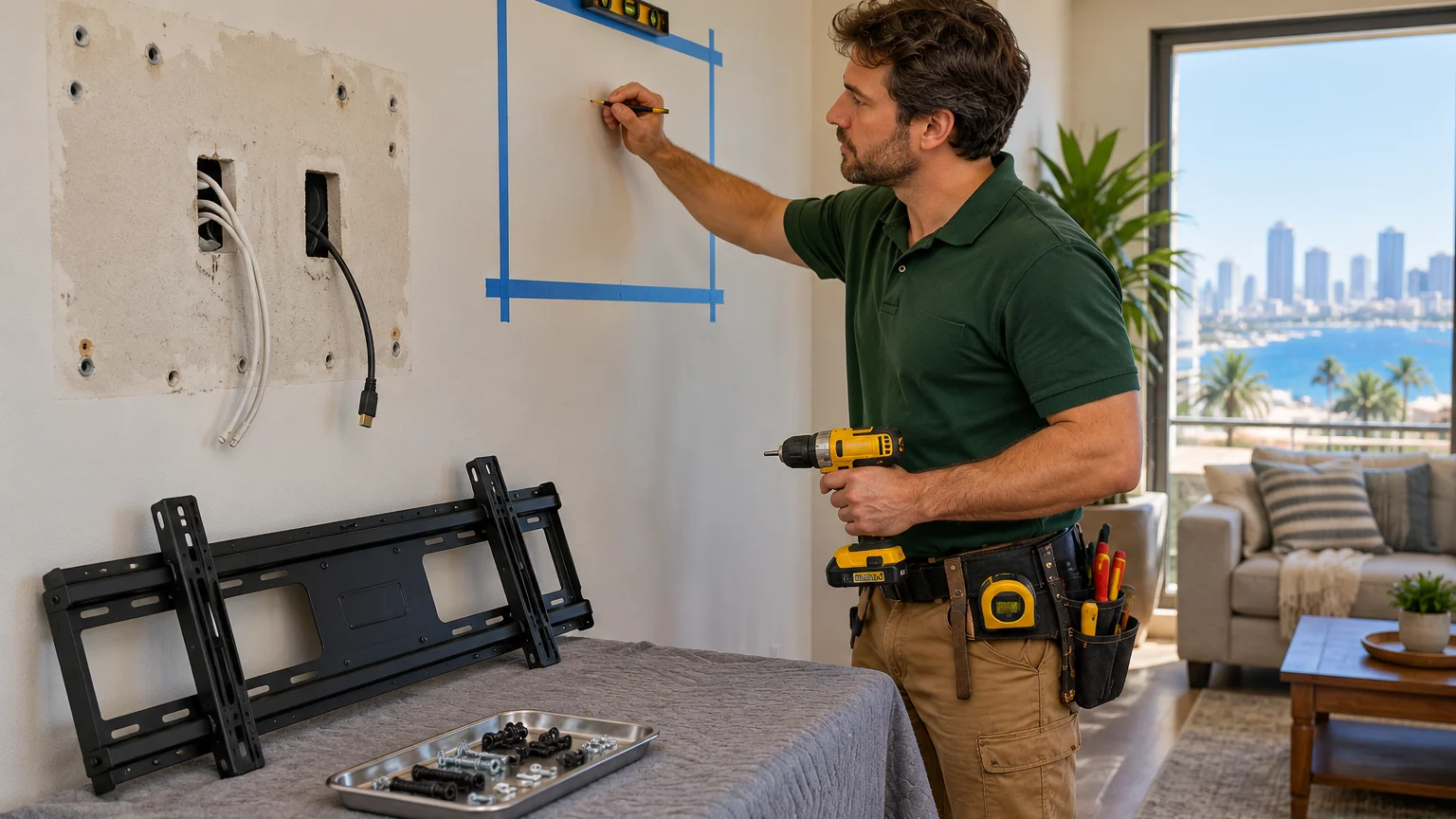
Record the television, mount, and planned destination
Start by treating the television and mount as separate items. Record the television brand and model from its label. Then photograph the mount from the front, side, and underneath. Include any visible model label without removing parts to find it.
Next, write down where each item will go. The television might move to another room while the mount stays behind. Both might travel from Chula Vista to Oceanside. The television might leave the property while the wall gets repaired for a move-out. Each version creates a different request.
Use a simple destination note:
- Television stays in this room
- Television moves to another room
- Television moves to another San Diego County address
- Mount stays on the wall
- Mount gets removed and stored
- Mount gets reused elsewhere
- Mount gets discarded after the pro reviews it
Don’t describe the request as “move my TV” alone. That phrase doesn’t tell a pro whether removal, transport, repair, or remounting is included. It also leaves the destination unclear.
If this work is connected with a household move, review the separate guide to TV mounting after a move. Keep the removal request focused on the current wall and the intended result.
Fix Pro San Diego can match homeowners across San Diego County with licensed, independent local pros. The customer contracts with and pays the matched professional directly. The brand doesn’t remove televisions, repair walls, or provide mounting hardware.
Separate hardware removal from wall repair
Mount removal and wall repair are two distinct tasks. A request can include either one or both. State the stopping point clearly before booking.
For removal only, the pro takes down the agreed hardware. Your request should say what happens to the television, bracket, wall plate, fasteners, and cables. If you want every removed piece saved, say that in writing. Prepare a labeled container for small parts.
For removal plus wall repair, describe the finish you expect. “Patch the openings” isn’t the same request as “leave the wall ready for paint.” Painting the repaired area, matching an existing finish, and working across the full wall should each be identified separately. Don’t assume one automatically includes another.
Photograph the wall before anything comes down. Capture the full wall, the mount, nearby outlets, visible cables, and furniture that limits access. If the television has already been removed, photograph every visible opening with the mount still in place.
The drywall repair and patching service covers the wall side of the request. The related guide to documenting drywall holes after moving can help organize photos for a move-out or handoff.
Don’t label the surface as drywall unless you’ve confirmed it. If you don’t know, write “wall material not confirmed.” A clear gap is more helpful than a confident guess. The matched pro can review the photos and explain what must be confirmed on site.
Compare reuse, replacement, and no-remount requests
Removal followed by remounting needs two decisions. First, decide whether you want the existing mount considered for reuse. Second, name the intended wall and television.
Don’t promise that the existing hardware can be reused. Instead, ask the pro to assess it. Share the television model, mount label, saved fasteners, and photos of the proposed location. Mention any missing pieces or visible damage without diagnosing the cause.
A replacement request is different. Say whether you already bought another mount or want to discuss the required product with the independent pro. If you own one, photograph its box label and all included parts. Don’t rely on a store listing alone when the physical product is available.
A no-remount request has a simpler endpoint. The television leaves the wall, the mounting hardware comes down, and the agreed wall work follows. Still explain whether cables, covers, shelves, or nearby accessories are part of the request. Those items shouldn’t be hidden inside “remove everything.”
For a new setup, the TV mounting and mounting hardware service explains how Fix Pro San Diego connects customers with local pros. Keep product selection open until the pro reviews the television, mount, wall, and requested position.
Three short statements can define the job:
- Remove the current television and mount.
- Assess the saved mount for possible reuse.
- Repair the former mounting area, or remount at the named destination.
Delete any line that doesn’t apply. That gives the pro a cleaner scope without making unsupported assumptions about the wall or hardware.
Document wall material and visible openings
Wall photos should show context and detail. Take one image from across the room. Take another centered on the mount. Then photograph the edges, visible fasteners, openings, cables, and any nearby wall features.
Use daylight or steady room lighting when possible. Don’t cover the area with décor before taking photos. Include a common household object for visual scale, but don’t treat that object as an exact measurement. Send written measurements separately if the pro requests them.
Record the wall material only when known. If the surface looks different from another wall, describe what you see without naming it. Useful notes include “surface has a raised texture,” “opening shows a different layer,” or “material isn’t confirmed.” Avoid guessing about what sits behind the finished surface.
San Diego County requests can involve a current address and a separate destination. Label both sets of photos. “Downtown San Diego removal wall” and “La Mesa proposed wall” are clearer than “before” and “after.” Add the room name to prevent confusion when several televisions are involved.
Don’t enlarge openings or pull concealed material merely to improve the photos. Document what’s already visible. If the area includes wiring or electrical changes, keep that work outside a general wall-patching assumption. ESFI recommends using a qualified licensed electrician for home electrical work.
The City of San Diego has specific permit information, but a rule for the exact property and scope couldn’t be confirmed from the supplied details. Ask the matched professional which authority governs the address and whether the requested work needs further review. Historic status and the precise scope can affect which City guidance applies.
Send room photos and product details before booking
Create one message that a pro can review without chasing missing context. Start with the property location, room, and requested endpoint. Then attach the room photos, television label, mount label, proposed destination, and hardware photos.
A useful request might read:
Remove the television and wall mount from the living room. Save all removed hardware. Review the wall openings for patching and a paint-ready finish. The television may be remounted in the upstairs bedroom. Wall material isn’t confirmed. Photos of both rooms and both product labels are attached.
Change that wording to match the real request. Don’t add repair, painting, disposal, transport, or remounting unless you want it included in the discussion.
Mention access conditions visible to you. Examples include furniture in front of the wall, stairs between rooms, a gated entrance, or limited parking instructions. State observations, not predictions about how the pro will handle them.
If several people are involved, identify the decision-maker. A tenant, owner, property manager, buyer, or seller may have different instructions. Don’t assume permission for wall repair or a new mounting location. Confirm the approved endpoint before work begins.
When searching for “TV mounting near me,” compare the actual scope each professional discusses. For California projects, licensing can depend on the entire scope, permit requirements, employee labor, and aggregate project price. CSLB says projects requiring a permit, using employee labor, or costing $1,000 or more require licensing. Fix Pro San Diego matches customers with licensed, independent local handyman pros, but the appropriate classification still depends on the work.
When to call us
Hand the request to a pro when removal, wall repair, or remounting needs coordinated decisions. It’s also helpful when the wall material, saved hardware, or final scope isn’t clear. Call us at (858) 400-4611 and we’ll match you with a local pro who quotes the job before starting.
Would you rather hand this one to a pro than do it yourself? Call (858) 400-4611.
Request a quote